Venice

The Venice Art Biennale draws to a close: between resigning juries and disputed pavilions, how much does it cost to take part?

The Venice Biennale – one of the most controversial in recent years – is drawing to a close. Whilst the awards remain uncertain, the financial accounts of the national pavilions are becoming clearer

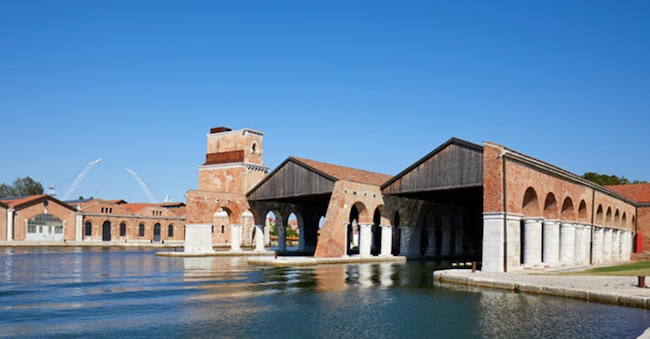
Tese delle Vergini, Biennale Venezia

8' min read

Translated by AI
Versione italiana

8' min read

Translated by AI
Versione italiana

The final ten days of the 61st International Art Exhibition ‘In Minor Keys’ by Koyo Kouoh are set to spark debate: from Friday 13 to Sunday 22 November, the Arsenale venues will host an extensive public programme of performances, lectures, debates and round-table discussions, alongside an Assembly bringing together ten organisations led by artists and collectives.

The Venice Art Biennale as well as attracting the usual art enthusiasts, this year it has caught the attention of geopolitical experts and legal scholars for allowing the participation of states that violate international law or whose leaders are the subject of arrest warrants issued by the International Criminal Court. The furore that arose in the spring has now turned into a veritable smokescreen, preventing us from fully understanding what will happen when the exhibition closes next November.

Loading...

The first issue to be clarified is who makes up the jury, following the resignation of the panel initially appointed by the La Biennale di Venezia Foundation. The Foundation’s website answers this question, explaining how the voting took place (and continues to take place), which is reserved for ‘ticket holders who have visited both exhibition venues (the Giardini and the Arsenale)’ and whose visit is ‘verified by the ticketing system’s tracking’. Following verification, 24 hours after entering the second venue, these visitors receive an email containing a link to cast their vote. As a rule, ticket holders may cast only one vote for each of the two prizes: for the best Participant in the main exhibition ‘In Minor Keys’ and for the best National Participation. This voting system, open for the entire duration of the event, is certainly democratic and sets this Biennale apart from previous editions, but it raises questions about the critical judgement of the public – who are not always experts – and who are asked to vote without predetermined criteria.

The second issue, however, concerns the contestants. With the introduction of the ‘Visitors’ Lions’, all national entries on the official list – including the Russian and Israeli pavilions – have automatically been reinstated in the competition for the public vote, following the controversy and the resignation of the international jury. However, as the Russian Pavilion has been closed following pressure from the Italian Government and the European Union – unlike the Israeli Pavilion – it is unclear how visitors could vote for Russia, should anyone wish to do so.

Amidst all this, there are a few bright spots: namely, the certainty regarding the high visitor numbers recorded on the first day of the exhibition (around 10,000 visitors: up 10 per cent on 2024) and in the days that followed, as well as the expenditure on individual national pavilions. We would like to focus on this point, to understand how much it costs to maintain a national presence at the Biennale.
The historic pavilions

Since the early 20th century, the City of Venice has granted the governments of those states which have historically held ‘significant influence’ in global politics and the arts the right to use land or to build their own pavilions in the Napoleonic Gardens, in order to take part in the exhibitions organised in the lagoon. These were 90-year concessions, renewable over time.

The Giardini are the public gardens designed by Giannantonio Selva on the orders of Napoleon in the early 19th century and are now owned by the City of Venice. According to a statement made in 2023 by the then mayor Luigi Brugnaro, these concessions, now ‘outdated’, had almost all expired and were in any case subject to financial charges which, over time, had become negligible.

And then there are new partners such as Qatar: in 2024, a five-year (until 2029) renewable agreement was announced between the City of Venice and Qatar Museums, aimed at strengthening cooperation and cultural investment. On the same day, Qatar Airways resumed its direct Doha–Venice route. The agreement provides for a donation of 50 million euros from Qatar for the management of Venice’s cultural heritage and, one might say, ‘in return’, in February 2025, news emerged of the construction of a permanent pavilion at the Giardini, under a 90-year concession, in the central space of the Esedra. This news sparked controversy, not least because, at the time of the announcement, it appeared that the necessary authorisations and state land concessions were still pending. And above all because, over the last fifty years, only two countries had been granted permission to build in the Giardini: Australia (1987) and South Korea (1995). Today, however, a new chapter is beginning. The Qatar Pavilion, designed by the Franco-Lebanese architect Lina Ghotmeh, is due to be completed in time for the 2027 Architecture Biennale.

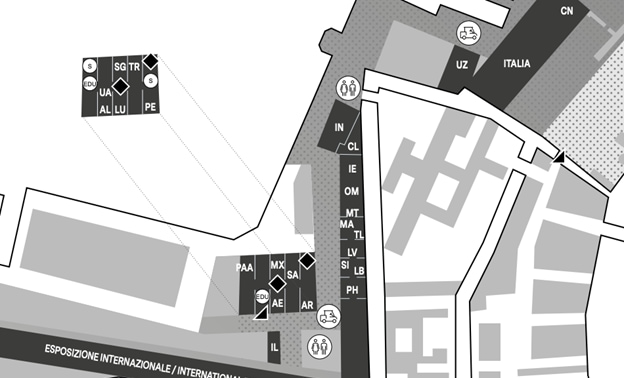
Mappa dei padiglioni all’Arsenale di Venezia

New pavilions: restoration, concessions and maintenance

Since 1980, the year of the first International Architecture Exhibition, the Arsenale has served alongside the Giardini as an exhibition venue for the Biennale. Since 1999, a programme to restore and enhance the area has also been underway, which has enabled the opening to the public of, amongst other spaces, the Piccolo Arsenale (2000), the Giardino delle Vergini (2009) and the Sale d’Armi (2011–2015) to the public.

The Italian national pavilion, which in the past had no permanent home and was housed in the Giardini, was also moved in 2006 to the Tese delle Vergini in the Arsenale, for reasons of space and reorganisation. The restoration and refurbishment of the building took place in several phases from 2001 onwards, with works aimed at creating exhibition and multi-purpose spaces. The most recent intervention, in 2010, made the section known as the ‘dei Soppalchi’ available for the Biennale’s activities, restoring the existing wooden mezzanine. The Tese delle Vergini cover an area of 3,850 m² and today house the Italia Pavilion, the Chinese Pavilion and the Biennale’s educational activities.

Loading...

On top of the concession costs come the maintenance costs borne by the two states that occupy them, Italia and China – areas that some consider (perhaps) excessively large. In addition to this, in 2016 the Ministry of Cultural Heritage (MiC) allocated a further 7.8 million euros for the restoration and enhancement of the Tese delle Vergini. PNRR funds were subsequently added to this amount.

Also at the Arsenale, as mentioned, new permanent pavilions were established in the Sale d’Armi around fifteen years ago. This approach is more ‘accessible’ than the recent agreement which granted Qatar a site in the Giardini. The United Arab Emirates, Mexico, Saudi Arabia, Singapore, Turkey, South Africa and Peru, to name but a few, have gradually taken up residence in these spaces and reshaped the geography of the Biennale.

But how much do these venues cost?
According to Marco Aveggio, director of the Patronato Cultural del Perú, a 20-year lease for a 250 m² space in the Sale d’Armi costs around 1.2 million euros, payable in advance. This sum would be earmarked for the restoration of the premises. The price increases in proportion to the floor area: for 500 m², over the same period, the cost rises to 2.4 million euros. In addition to this one-off payment, there is an annual maintenance fee of 22,000 euros, which rises to 44,000 euros for 500 m². One must also take into account the cost of fitting out the pavilion, which will be discussed later, and which is often increased by the restrictions imposed by the Superintendency on the use of the premises. The Sale d’Armi are, in fact, a protected cultural heritage site. According to the Code of Cultural Heritage and Landscape (Legislative Decree 42/2004, Articles 20–21), any work carried out on the property – including the fixing of supports for installations to the walls – is subject to prior authorisation from the Superintendency. Added to this is the principle of reversibility – a cornerstone of restoration theory – which requires that any intervention can be removed without leaving any traces on the historic surfaces.
In 2011, Argentina adopted this approach for a 500 m² space. It was subsequently adopted by Saudi Arabia, which now occupies the space adjacent to the Argentine one (see photograph). On the upper floor, directly above the Argentine pavilion, South Africa and Peru share the 500 m² available.

The Biennale’s model, which restores the Arsenale’s monumental spaces through multi-year concessions granted to participating countries, is certainly an interesting one. It is an attractive form of foreign patronage in support of the national heritage, something Venice has long been familiar with thanks to private international committees for the preservation of Venice, such as Save Venice and Venice in Peril.

Public and private spending on the national pavilion: the Italian Pavilion

Most of the national pavilions at the Biennale are funded through a combination of state and private funds, which cover expenses ranging from the hire of the venues to the installation and routine maintenance. In addition to these funds, there are private sponsorships which, as in the case of Italia, can amount to considerable sums.

Every year, the Directorate-General for Contemporary Creativity of the Ministry of Culture (MiC) publishes the expenditure for the Italia project, but does not disclose the sums paid by private sponsors. This year, public expenditure amounts to 800,000 euros. Of this, €570,000 goes towards the realisation of the exhibition project, including the curator’s fee, which, according to the call for proposals, may amount to a maximum of €30,000. The remaining €230,000 is earmarked for the running of the venue. The main support came from the Zegna Group, as the ‘main sponsor’, and from Banca Ifis, for the fifth consecutive year. The amounts allocated by private donors for this year have not been disclosed. It is, however, likely that they will be similar to those of 2024, when the €800,000 in public funding was supplemented by €400,000 from the partner Tod’s and the sponsor Banca Ifis, bringing the total to €1.2 million.

It is difficult to make comparisons with other countries, as many prefer not to publish their data. An interesting – and ‘unbalanced’ – case is that of the United States. The State Department has always funded the pavilion, but the selection of projects was entrusted to the National Endowment for the Arts (NEA). For the 2026 edition, the NEA did not take part, officially due to ‘staffing and scheduling issues’, against a backdrop of severe cuts to the agency by the Trump administration. The decision therefore fell entirely to the State Department. The federal contribution is fixed at just $375,000, a small fraction of the actual cost. In 2022, the pavilion by Simone Leigh cost around $7 million. In 2024, Jeffrey Gibson’s pavilion cost $5.8 million, of which just $375,000 came from federal funds. The remainder came from private donors, notably the Mellon Foundation, which contributed $1 million, and the Ford Foundation. In 2026, however, Alma Allen’s pavilion was able to rely, on the public side, on a fixed contribution from the State Department, but, on the private side, had to resort to online donations, raised by the American Arts Conservancy (AAC).

Peru: the privately funded pavilion

Another noteworthy case is that of Peru. Originally, the State and certain private organisations were to share the cost of the concession for the pavilion in the Sale d’Armi (250 m²) equally: 600,000 euros each, making a total of 1.2 million. However, as Marco Aveggio of the Patronato Cultural del Perú explains, ‘a change of minister has turned the tables, calling public participation into question’. The private contribution consisted of 300,000 euros from the Miró Quesada Foundation, owner of the daily newspapers *El Comercio* and *Gestión* and the broadcaster *América TV*, and 300,000 euros from the Wiese Foundation. In contrast, the Peruvian government contributed just 210,000 euros. The two foundations were therefore forced to increase their contribution, with the result that public funding accounted for just over 17 per cent of the Peruvian pavilion’s budget. In 2015, the Patronato Cultural del Perú replaced the Wiese Foundation in the agreement.

Operating costs are also covered by private donors. “This year, the cost of the pavilion was covered entirely by private donors,” says Aveggio. Among the supporters are a number of Peruvian universities, such as the Universidad de Lima and the Pontificia Universidad Católica del Perú, which each contribute around 10,000 euros a year. The Instituto Cultural Peruano Norteamericano contributes around 14,000–15,000 euros a year, but only towards the Art Biennale. Police Security, a company specialising in cash-in-transit services, covers the annual maintenance fee for the venue (amounting to around 22,000 euros). In addition to these, there are sponsors active in various sectors, including fashion, air travel and the hotel industry.
As for the cost of individual editions, Aveggio explains that for Peru ‘an Architecture Biennale can range from 80,000 to 120,000 euros, and an Art Biennale from 160,000 to 190,000. This year’s project by Sara Flores is estimated at between 140,000 and 160,000 euros, partly thanks to a model based on private donations’.

Copyright reserved ©
Loading...

Brand connect

Loading...

Newsletter

Notizie e approfondimenti sugli avvenimenti politici, economici e finanziari.

Iscriviti