
Biffi: ‘A ZIS dedicated to artificial intelligence in Milan’
The first use cases for the ForgIA project, aimed at developing a platform for sharing and testing applications, have been presented

Sharing warehouse data to improve time-to-market. Or real-time monitoring of order status throughout the supply chain. Or the certification of energy-efficiency measures, and training models on distributed data without sharing it, thereby safeguarding intellectual property and privacy.
Those highlighted by Hydroservice, Maire, Epta and Bracco, respectively, are the first concrete use cases of Assolombarda’s ForgIA project, an initiative aimed at transforming secure data sharing into new opportunities for innovation, enabling businesses to develop artificial intelligence applications capable of solving concrete operational problems, thereby improving efficiency and competitiveness. A landmark development is currently underway in the sector, with Assolombarda putting Milan forward as a key hub, including in terms of the regulatory framework.
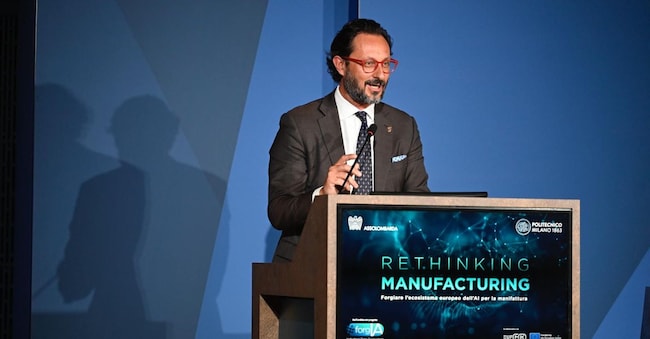
“To the Lombardy Region,” explains Alvise Biffi, president of Assolombarda , during the ‘Rethinking Manufacturing’ event, “we have proposed the establishment of a Special Innovation Zone dedicated to Artificial Intelligence. This is to transform Lombardy, and in particular the Metropolitan City of Milan, into the leading ecosystem for the adoption, testing and industrial development of AI. Milan, in fact, has everything it takes to become the capital of AI applications: its strong manufacturing tradition, already integrated with digital technology and working in synergy with innovative services, is the key to establishing itself as a laboratory capable of embracing change, acting as a trailblazer for the country.”
A significant step forward in this regard has come from the President of the Lombardy Region himself. “Our region,” explains Attilio Fontana speaking at the conference, “can position itself to become a leading hub for these issues, not only for Italia but for the whole of Europe. With a ZIS, it can become a platform that channels the use of artificial intelligence to benefit the manufacturing sector.”
Among the challenges to be tackled along this journey is, first and foremost, that of transforming the existing data assets into industrial value – the fundamental premise around which the ForgIA project revolves. “An ecosystem,” adds Biffi, “that enables businesses, particularly SMEs, to access advanced artificial intelligence tools and develop solutions capable of boosting productivity, efficiency and competitiveness. Our aim is to contribute to a 10% increase in productivity among local SMEs, generating up to 2.4 billion euros of added value in the Assolombarda area.”


