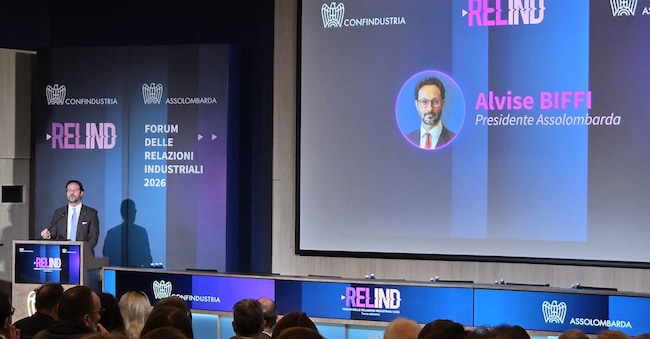
Third edition of Relind at Assolombarda

Biffi: ‘Representation is not a privilege; it must be earned every day’

Marchesini: ‘The agreement reached with the trade unions confirms the value of dialogue.’

4' min read

Translated by AI
Versione italiana

4' min read

Translated by AI
Versione italiana

The future of representation. This is the central theme of the third edition of Relind, the Industrial Relations Forum jointly organised by Assolombarda and Confindustria, with the involvement of the national trade unions, now in its third year.

This is a key issue, all the more so in light of the agreement on representation, contracts and wages reached last week between the trade unions and the employers’ organisation.

Loading...

“This is an extremely important agreement,” notes Alvise Biffi, President of Assolombarda, “which lays the foundations for subsequent specific agreements and demonstrates how the social partners are capable of finding common ground and assuming shared responsibilities, even on complex issues.”

The analysis was based on research carried out by Assolombarda in collaboration with Adapt. Between 2005 and 2015, the proportion of businesses belonging to an employers’ association fell from 64 per cent to 44 per cent. However, the companies that remain members are, on average, larger, more productive and more focused on exports, innovation and training: this represents a more selective group. At the same time, national collective bargaining covers almost all employment relationships – the applicable collective agreement can be identified in around 99 per cent of cases – with levels among the highest in Europe, even in the absence of legally established universal applicability. The rules drawn up by the social partners thus reach a far wider audience than those who help to shape and support them. By the end of 2024, 1,017 national collective agreements had been filed with the CNEL, compared with 267 in 1995. However, 722 of these apply to fewer than 1,000 employees, whilst 97 per cent of workers are covered by agreements signed by the comparatively more representative organisations. The problem, therefore, is not the number of agreements, but the cases where competing scopes overlap in the same sectors and the choice of agreement is driven by the search for the lowest cost: this is the realm of contractual dumping. For this reason, measuring representativeness – including that of employers’ organisations – is now a priority.

According to the study, disintermediation has not eliminated the need for mediation: it has simply changed the conditions under which it operates. The more the regulatory, contractual and production frameworks become fragmented, the higher the costs that individual businesses – particularly small ones – must bear in order to navigate them, and the more central a role is played by those capable of reducing these costs. The legitimacy of associations is no longer guaranteed simply by their presence at the negotiating table: it must be demonstrated through their ability to generate knowledge, coordinate and create collective value.

“Some people think that intermediary bodies are a relic of the past,” explained Alvise Biffi, president of Assolombarda, “but the figures tell a different story: disintermediation has not eliminated the need for mediation; on the contrary, it has made it more complex. The more the system fragments, the greater the need for bodies capable of reconciling differing interests and translating them into shared rules. Representation, however, is not a privilege of office: it must be demonstrated every day, by transforming the problems of individual businesses into collective solutions. And it is in the workplace that this challenge is played out: staff shortages due to the demographic crisis, the constantly changing skills required, training and collective bargaining are issues that no company can tackle alone. This is why the new Framework Agreement is a crucial turning point: clear rules on measuring representativeness are the best defence against contractual dumping. It is a responsibility that concerns everyone – businesses and trade unions alike – and if we can fulfil it together, representation will once again become what it was intended to be: a driver of growth for the country.

“The agreement reached between businesses and trade unions,” says Maurizio Marchesini, Confindustria’s Vice-President for Labour and Industrial Relations, “represents a significant achievement, which confirms the value of dialogue and the ability of the social partners to identify mutually agreed solutions. This achievement has been facilitated by the 1 May Decree, which recognised and promoted the role of collective bargaining and the organisations with the highest level of representation, and by the Government’s decision not to exercise its delegated powers on pay and collective bargaining, thereby allowing the social partners to act autonomously. Strengthening representation and collective bargaining means building a more modern and robust system of industrial relations, capable of supporting the transformations taking place in the world of work. The common challenge is to support investment, productivity and the competitiveness of businesses, whilst at the same time promoting sustainable wage growth and quality employment. The future of our industry and the country’s growth depend on this shared responsibility.”

“This agreement,” comments CGIL Confederal Secretary Michele De Palma, “puts the general interest before individual interests and is the strongest antidote to contractual dumping; the fragmentation of contracts is a weakness that we should have addressed long ago.”

“The agreement,” explains CISL General Secretary Daniela Fumarola, “has also been drawn up to combat ‘pirate’ contracts and ‘dumping’ contracts, which are not in the interests of either the company or the workers. We also believe it is a way to speed up contract renewals, to guarantee workers protections and rights that are increasingly suited to the times we are living in, starting with the recognition of cost-of-living adjustments, which are currently a burden.”

“Starting with representation,” adds UIL Confederal Secretary Vera Buonomo, “was the right way to stem the chaos, and above all to understand the authority of those who sign the contracts.”

Loading...

At the conclusion of the institutional session, Assolombarda, together with the trade union organisations CGIL Camera del Lavoro Metropolitana di Milano, CISL Milano Metropoli and UIL Lombardia, signed a memorandum of understanding on the adoption of artificial intelligence and digital technologies. The aim is to support businesses and their employees in adopting artificial intelligence and digital technologies. The agreement updates the one dated 4 October 2019 and places the involvement of workers in the change processes at its core. It provides for prior consultation on organisational and technological changes and joint training on digital skills. It also establishes a joint regional committee to analyse the impacts of AI and disseminate best practice.

Copyright reserved ©
Loading...

Brand connect

Loading...

Newsletter

Notizie e approfondimenti sugli avvenimenti politici, economici e finanziari.

Iscriviti