
Big data in aid of the sea with mussel robots and sound analysis
Artificial intelligence revolutionises conservation science: the role of the Nbfc, the National Centre coordinated by the CNR

3' min read
3' min read
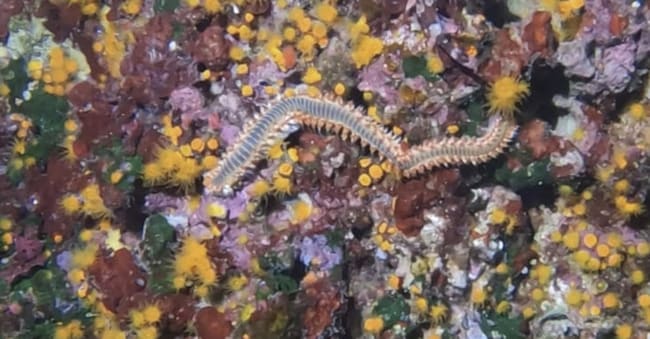
Son the trail of the worm, one of the most recent nightmares for the Mediterranean. This sea worm prefers warm temperatures and is an indicator of ongoing climate change. Very voracious, it feeds on corals, gorgonians and starfish, putting the biodiversity of our seas at risk. Thanks to underwater cameras and the Internet of Things (IoT), it is possible to study its predatory behaviour and then transmit the big data to scientists who will analyse it. This is one of the projects fielded by the Nbfc, the National Centre for Biodiversity based in Palermo and coordinated by the CNR. Launched in September 2022 and financed by the NBRP with a total budget of 320 million, its mission is the monitoring, conservation, restoration and enhancement of Italian and Mediterranean biodiversity. "I make it clear to fishermen that their ability to get something out of their cash depends on the state of health of the marine ecosystem on which, however, they can have an impact, and not a little," notes Gianluca Sarà, professor of ecology at the University of Palermo and at the helm, together with Simonetta Fraschetti, of spoke 1 of the Centre focused precisely on marine biodiversity. This is because, he adds, "it is now well established: more than half of the world's GDP is directly or indirectly supported by biodiversity. Its protection is not the problem but the solution to ensure human well-being'. In Italy there are 394 marine habitats, 267 of which are of high conservation value and whose presence is considered a priority. And in Europe, one third of those subject to degradation are in the Mediterranean. These are numbers that render well the sense of urgency: by 2030, according to the new EU regulation (Nature restoration law), at least 20% of marine areas must be restored.
'The first difficulty, but also the starting point for preserving the biodiversity of ecosystems,' says Sarà, 'is measurement: we need large-scale, real-time data. This is where artificial intelligence is revolutionising conservation science, because it offers innovative tools for monitoring and protecting endangered species, but also those that threaten the balance of the ecosystem, such as the vermocane'. Unlike traditional methods, which can be invasive, expensive and time-consuming, says Sarà, 'Ia is able to quickly and efficiently analyse large amounts of data from the real world, achieving greater protection for the same budget'. The Nbfc is drawing heavily on these technologies that enable it to collect and analyse data, detect potential threats in real time and support strategic decisions with a mix of knowledge between scientists, engineers, computer scientists and mathematicians.
Among the new protagonists are molluscs and robot limpets. Inside their shells they house sensors that constantly detect their body temperature, which mirrors the outside temperature. Two species chosen not by chance: they live in cycles of six hours in the water and six outside, which makes them particularly useful for climate research and for measuring the impact of human activities on the marine ecosystem. Not only that. The centre is also implementing algorithms to improve the automatic identification of species of fish, sharks and marine invertebrates through Ia techniques to aid computer vision and the development of deep learning models. Other projects involve the use of Ia to identify animal species from audio recordings of their sounds, allowing biodiversity to be quantified in a non-invasive manner. Even the myriads of social media images, properly analysed and classified with the aid of artificial intelligence, can be used to create new datasets.
"We are only at the beginning," says Sarà, "but the potential is enormous, also for companies. At the end of March, a cascade call issued by Nbfc's Spoke 1 closed with a total budget of EUR 2.2 million aimed at public administrations, SMEs, and start-ups in Southern Italy to co-finance expenses for the development of technological innovations and enabling technologies for marine conservation. Two mixed public-private teams coordinated by the University of Messina and the Catania-based foundation Csfnsm (Sicilian Centre for Nuclear Physics and Structure of Matter) won.


