
Biofuels, a 120 billion opportunity for farmers
Burato (Corteva): 'Crops such as sunflowers contain a high percentage of oil in their seeds and are a perfect raw material for the production of aviation fuel'

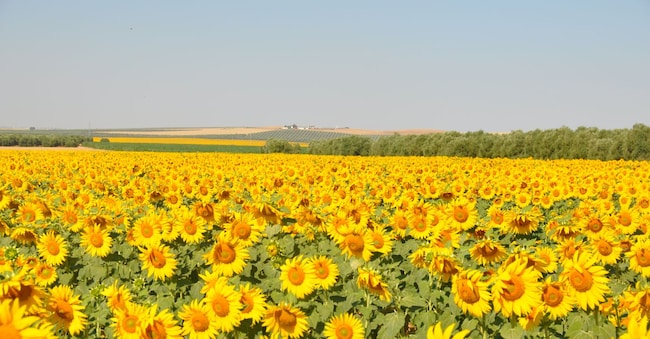
Sunflowers in the engine. A much more concrete prospect than the sixty-eight slogan about flowers in cannons, provided that Brussels clarifies some rules for farmers and industry. In fact, the Commission is about to define what is meant by 'intermediate crop' in the Renewable Energy Directive, a fundamental step to allow Italian farmers too to intercept the rich biofuel business, a 120 billion market destined to double in the next 10 years. "Europe is about to take a crucial decision that could open up new markets for Italian farmers, while helping to drastically reduce emissions from aviation. Without a broad definition, we believe that European farmers will be excluded from this opportunity. Gabriele Burato is the head in Italy of Corteva Agriscience, the agrochemical giant born from the merger between Dow and DuPont with a turnover of more than 14 billion that together with the other three biggies in the sector (Bayer, Basf and Syngenta) controls the majority of the world market for crop protection products, seeds, plant protection products and fertilisers. In Italy it has two plants and two research centres concentrated in the north and is now preparing to invest in the new frontier of biofuels. Thus, sunflowers grown in Italy are also a candidate to provide part of the fuel for the next flights.
"These days," Burato explains, "the aviation industry is busy finding cost-competitive sources of sustainable aviation fuel (Saf), due to new European regulations that require companies to include at least 2 per cent Saf in fuel blends, with a target of 70 per cent by 2050. Biofuels derived from agriculture could be part of the solution. Crops such as the sunflower contain a high percentage of oil in their seeds and are a perfect raw material for the production of biofuels'.
While Italy, also with the latest revision of the NRP, is accelerating on the latest generation of agri-voltaics that does not involve soil consumption and adds to the agro-energy mix dominated by biomethane, at a global level there has long been a debate on the contrast between energy and food uses of agricultural raw materials. In Europe, says Burato, 'the role of farmers in the production of sustainable energy is often overlooked, because having a limited amount of fertile land at their disposal they have to give priority to food and feed production, as is also the case in Italy. However, with innovative solutions and the right regulatory support, biofuels can also become a key element for the future of sustainable energy in Europe, with agriculture playing a leading role. Farming to produce biofuels will be increasingly profitable'.
Normally, the crops associated with biofuel production are rape, maize and soya. Alongside these, Corteva wants to bet on sunflower in Italy. On the convenience of the bet Burato has no doubts: 'First of all, in terms of cost, growing dedicated crops such as sunflowers between harvests is cheaper than producing fossil fuels, or synthetic aviation fuels. The advantage of using oil crops is that there is already a value chain for all the components of the seeds that are used, and in Europe there are already activities such as crushing plants, storage, and refineries, operational and with the capacity to convert the oil into aviation fuel'.
Above all, he adds, 'there is a way to produce these crops on existing land without compromising food production. For thousands of years, farmers around the world have grown intermediate crops between their main, food-essential crops such as wheat, soya and maize to protect their soils. These cover crops keep carbon out of the atmosphere, retain water and nutrients in the soil and prevent erosion. They are often ploughed directly into the soil and not used. But now things are changing; today we are working with farmers to test the potential of oilseeds for cover crops, such as sunflowers. By working with energy companies to refine and process this oil, we create a market for these crops, which is essential for farmers. Every day we invest more than 4 million in research, our breeding technologies allow us to develop the best seeds for use in double cropping systems. We want to convince farmers to grow our seeds'.

