
Bioplastics: Italian companies’ turnover set to fall by 6.8% in 2025
Revenue of 656 million, down for the third year running: Chinese competition is taking its toll. To capitalise on the opportunities offered by the new Ppwr, further investment in innovation will be needed

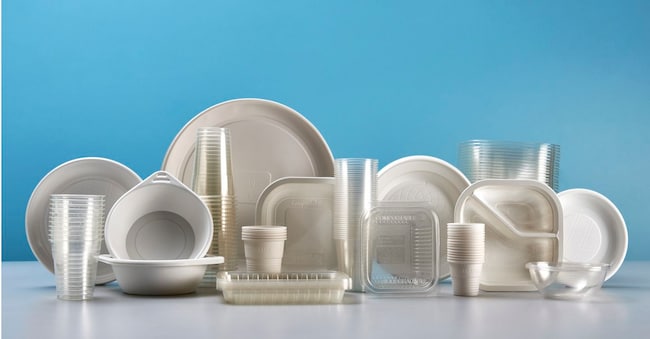
Compostable bioplastics: in 2025, for the third year running, the sector is experiencing a slowdown, following a decade of growth from 2012 to 2022. The Italian sector currently comprises 252 companies, 2,838 dedicated employees, 119,100 tonnes of manufactured products and a total turnover of 656 million euros. Compared with the previous year, 2025 saw a decrease in the number of companies (-9.4%), employment (-2.6%), turnover (-6.8%) and production volumes (-2%). Competition from Chinese production, the proliferation of counterfeit products and the uncertainty surrounding European regulations continued to weigh heavily on the sector.
The figures, compiled by Plastic Consult, were presented on 18 June during the 3rd Forum on Compostable Bioplastics, organised in Rome by Assobioplastiche and the Biorepack recycling consortium. This provided an opportunity for the sector to take stock of the current situation, which appears to be a crucial juncture in the sector’s development.
The reusable fake
Some of the key issues that have affected the balance sheet in recent years have been resolved: at the end of April, the regulation against counterfeit ‘reusable’ items was finally published in the Official Gazette, setting out the dimensions and weights for this category. This will help put an end to the practice of plastic cutlery and tableware being sold on the market as ‘reusable’, when in fact they are disposable. It was eagerly awaited by the sector, which estimates that the new regulation will help it recover 25,000 tonnes in sales volume.
The new EU regulation
Meanwhile, 12 August is fast approaching, when the new EU Packaging Regulation (the PPWR) will come into force, setting the stage for the situation we will face from 2030 onwards. ‘From that point onwards, around 400,000 tonnes of packaging will struggle to remain on the market. Of this, more than half could be replaced by compostable bioplastics. This mainly concerns food packaging, which cannot currently be mechanically recycled. This could present an opportunity for bioplastics. We currently produce 120,000 tonnes, but our capacity is already 250,000. Our supply chain, which integrates bioplastics into organic waste recycling via composting, is the leading one in Europe: for years we have demonstrated our ability to manage this waste by transforming it into compost and biogas,” says Armido Marana, who has been chairman of Biorepack since the end of May and is also CEO of Ecozema in Santorso (Vicenza).
However, there is no shortage of obstacles: “Unfortunately, Europe only recognises mechanical and chemical recycling, not composting, which is the end-of-life process for our products and which the rest of Europe does not have, despite the fact that the collection of organic waste will be mandatory for everyone from 2024,” continues Marana. “However, if certain products are not converted into bioplastics by 2030, there is a risk that entire factories will have to close, which will also affect those who manufacture packaging machinery.”


