
The 'black cube' in Florence becomes a case in the public prosecutor's office: what's going on
Even the Ministry of Culture turns a spotlight on the affair of the 'black cube' in Florence, the disputed ultra-modern building constructed on the site of the former Municipal Theatre in the city centre
Key points
3' min read
The case of the new palace with a black and white 'cube' built in place of the former Municipal Theatre in Florence is no longer just an aesthetic or political case that has been stirring up debate in the city for days - with draperies and some scaffolding removed. Chief Prosecutor Filippo Spiezia has opened a fact-finding file, at the moment without any suspects, to verify whether there were any violations of building and town-planning regulations or anything else in the construction of the 'big box' in the city centre, an area under Unesco protection. Palazzo Vecchio has made no comment on the judicial enquiry, while in recent days it has been pointed out from several quarters that the municipality had carried out its own procedure and that there had been a positive opinion from the Superintendency at the time.
Prosecutor's Office intervention
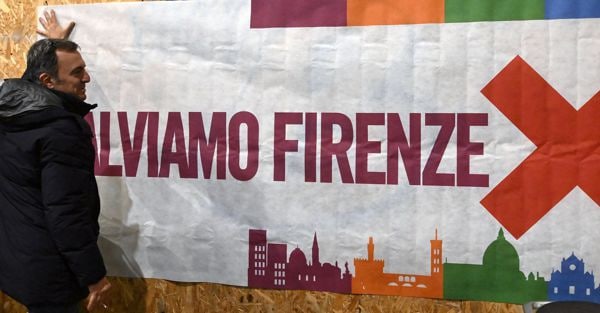
.The Comitato Salviamo Firenze, which is active against overtourism and had asked for the prosecutor's office to intervene, states that it is 'right to know how it was possible to arrive at that nightmare that offends the city, which must know not if they got the authorisations but how they got them. Above all, whether everything was carried out without any substantial illegality'. The controversy over the 'black cube', which towers above new luxury flats and temporary accommodation for rich tourists, is ongoing both because of its imposing size, since - unlike the glorious Comunale - the volume towers over the other buildings in the Corso Italia and Lungarno Vespucci areas, modifying the skyline and taking away the view of the city and hills from the pre-existing buildings; and because of the colours and materials, which are different from the renderings presented. Not only the black and white, but also the metal used in the construction break the measure of Renaissance Florence and that of the 19th-century district where it is located.
Loading...
The History of Theatre
.Decommissioned and sold in 2013 by the then Renzi junta to the Cassa Depositi e Prestiti for 23 million, after three unsuccessful auctions the former Teatro Comunale was bought in 2019 by the Hines real estate fund in a joint venture with Blue Noble. More than 150 luxury flats, mainly for short-term tourist rentals, have been built in the new buildings since October. An urban planning variant approved by the city council made the change of use possible, both residential and receptive. The case was raised by La Nazione after the dismay of Florentines at the unveiling of the scaffolding. Many reactions so far. Former superintendent Andrea Pessina, in the role from 2016 to 2022, said he "cannot remember" how it was possible that the offices had given the go-ahead ("I signed thousands of acts during my mandate").
The Mic also shone a spotlight on the affair
.The current superintendent Antonella Ranaldi expressed doubts from an aesthetic point of view. Philosopher Sergio Givone has panned it, calling for "knocking down the part that overhangs the roof profile, that would be the best idea" not to mention the colours and materials that are alien to the city. The municipality has for days claimed the correctness of the procedures followed without expressing an opinion on the 'beauty' or otherwise of the work, the PD reiterated that there had been 'respect for all constraints'.
The controversy
.Meanwhile, controversy mounts. Eike Schmidt, former director of the Uffizi, now a minority city councillor, is considering a complaint to Unesco for the change given by the new building to the skyline, citing Dresden, which lost its Unesco World Heritage designation in 2009 for a single new construction. A similar fate befell Liverpool most recently in 2021. And some are ready to bet that Florence will be next. The Ministry of Culture also turns a spotlight on the Florence 'black cube' affair. The offices of the Collegio Romano intend to verify, to the extent of ministerial competence, the procedures followed in issuing the permits that authorised the building works. The Mic, which supervises the Superintendency that issued the authorisations, has requested a detailed report to shed light on the procedure.
Copyright reserved ©


Brand connect
Loading...
