
Train blackout at Termini for the 'nail'. The transport authority: Rfi negligent, risks a fine of up to 2 million
The authority headed by Zaccheo opens a sanctioning procedure against the subsidiary FS for the blocking of trains in Rome last autumn. Rfi: 'We are certain that we have acted in accordance with the prescribed procedures'

5' min read
5' min read
A damaged cable, the famous spike, Rome's Termini station in the dark, trains at a standstill and disoriented travellers. All it took was an electrical fault to send one of the beating hearts of the Italian railway system into a tailspin on 2 October. Nine months later, the Transport Regulatory Authority has decided to shed light by opening a sanctioning procedure against Rete Ferroviaria Italiana. According to resolution no. 113/2025, approved on 10 July, Rfi 'has not adopted appropriate measures to guarantee the operation and maintenance of the infrastructure, ensuring its accessibility and functionality', in violation of the regulations in force and the Network Information Prospectus (Pir). And so, nail or no nail, according to the Authority headed by Nicola Zaccheo, it was the failure to manage the emergency by the FS subsidiary responsible for the infrastructure that created the chaos, and which now risks a fine of up to €2 million.
The chaos of 2 October
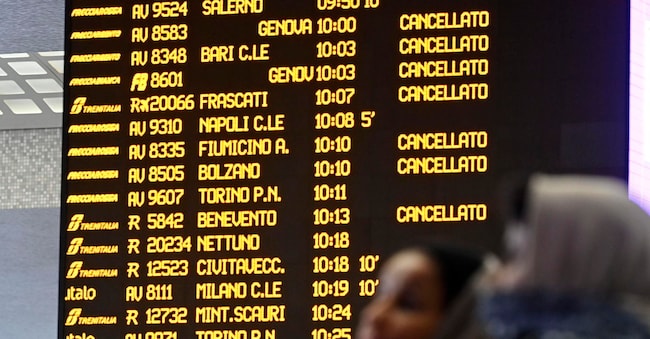
.The breakdown, which occurred in the early hours of the morning due to damage to a cable by a contractor, led to a critical disconnection of the signalling and circulation systems, reconstructs Art. At 6.20 a.m. the emergency batteries were exhausted and Roma Termini lost operational control: trains stopped, information missing, flows interrupted. The figures are impressive: 1,165 trains involved, 69,267 minutes of delay (59 minutes average delay), 680 cancellations and 31 diversions. The Rome node comes to a standstill. Art speaks bluntly of 'very serious disruption to rail traffic', with impacts on the entire national network. But to understand what happened, we have to rewind the tape and read the authority's reconstruction.
The Fault
.The reconstruction of the dynamics begins with the breakdown that occurred at 1.20 a.m. between 1 and 2 October: that night, work took place near the station of Roma Termini, "during which a line was damaged that powered the medium and low voltage cabin of that station". From this moment onwards, a series of events followed, which Art reconstructs as follows: the damage occurred at 1.30 a.m. and, as soon as it was detected, the company responsible notified the Rfi escort personnel, who then forwarded the information to the competent structures of the managing company; these latter intervened, disconnecting the Acea backhoe of powering the cabin at Roma Termini station, writes Art in the order. "Thowever," Art continues, "a permanent blockage of the logic inside the cabin had occurred, which inhibited the low-voltage supply to the Roma Termini plant."And here the short-circuit cascaded with the failure to activate the generator set. But the circulation in the Roma Termini station "was temporarily guaranteed by the batteries" until "the latter also exhausted their efficiency at 6:20 a.m.". This is when the technological systems are switched off and Termini goes into blackout. It is in that circumstance, at 6.20am, writes Art, that the staff intervenes, repairing the fault, in technical terms "closing the event at 9.15am, although its effects residues continued to impact rail service until late afternoon.
L'istruttoria
In the measure, the position of the FS group is also taken into consideration, and in particular the interview given by managing director Donnarumma to La Repubblica on 20 February. Fs, for its part, had verified that "the intervention on site by Rfi technicians did not detect the presence of the block of logic inside the medium and low voltage cabin of the Roma Termini station, which could have been removed only by manual intervention" and that "there was no alarm system of the low voltage power supply of the Roma Termini station". Finally, that "theactivation of the Ups batteries was not reported to because of the failure of the relevant alarm system"..
The Decision
.In the light of all the acts, declarations and reconstructions, for Art "it seems to emerge, also with respect to the role and responsibilities of the manager of the railway infrastructure national, the inadequacy of the measures adopted by Rfi for the prevention and management of such an emergency and its causes, given the lack of suitable alarms to alert Company personnel of any disqualifications and the failure to carry out appropriate checks on the correct functionality of the plants". This is why the prerequisites for normal operating conditions would seem to have disappeared. Moreover, Art notes, 'sonly following the emergency in question, the Company has strengthened the alarm system', with new operating procedures that 'cwhich foresee, in the event of faults, an on-site verification even in the absence of further alarms". It is therefore "configurable that there has been a violation of the rules on access and use of the railway infrastructure referred to in Article 37, paragraph 14, letter a), of Legislative Decree No. 112 of 15 July 2015, given that, in light of the very serious impact that the emergency of 2 October 2024 has had on railway traffic, it appears that Rfi has not put in place appropriate measures to guarantee the operation and maintenance of the infrastructure so as to ensure its accessibility and functionality


