
Bleaching alert: save the coral giants of the Maldives
An Italian project is trying to protect these marine monuments as one does artistic ones, because they are custodians of climate information vital for the future.
4' min read
4' min read
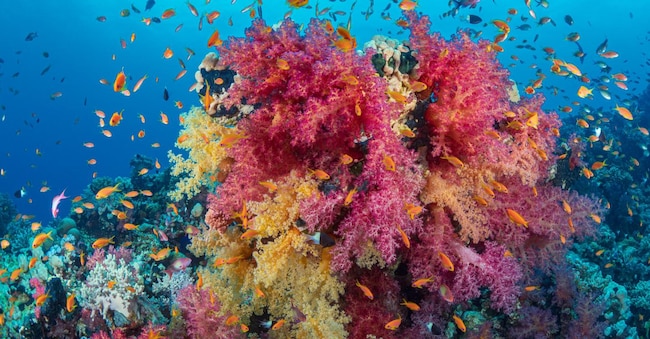
Far from our attention, marine biodiversity is in danger of disappearing in general silence. In the last fifty years, the shark population in the Tyrrhenian Sea has plummeted by 99 per cent, globally intensive fishing is pushing a third of shark and ray species towards extinction, while abnormal ocean temperatures have led to the fourth global bleaching event of coral reefs, which from Asia to Australia are losing colour and life due to climate change.
Keeping attention on the issue also means helping care and conservation: this is why monitoring and dissemination operations are important. On the shark front, for example, Eleonora de Sabata, journalist and citizen scientist, is active in Italy: she has launched a project to collect information from below - thanks to tourists, divers and fishermen - on sightings of sharks in the Mediterranean, which are threatened by the degradation of ecosystems and by fishing, accidental and otherwise (European countries are among the top suppliers to Asian markets). Its Stellaris campaign has made it possible, among other things, to improve the protection status of the Banco di Santa Croce, a shoal near the Gulf of Naples frequented, for breeding purposes, by catsharks or greater spotted dogfish, and small polka-dot sharks.
Loading...
Bleaching, the bleaching of coral reefs, is instead a problem on a much larger scale, one of the greatest ecological tragedies of our age of climate change. As Simone Montano, a researcher at the University of Milan-Bicocca, explains, the increasingly long and frequent marine heat waves are causing the symbiosis between coral and algae, which underlies the entire ecosystem, to break down. "Without algae, corals can no longer feed themselves because they are unable to proceed with photosynthesis. The limestone skeleton then appears white and begins to glow as if someone had turned on underwater light bulbs emitting cold, ghostly light. Thus, nature manifests its suffering'. The comparison that marine biologists often make is with an extensive forest fire, which, however, takes place underwater, so it is even more difficult to tell and above all to bring to the world's attention. But also to be extinguished.
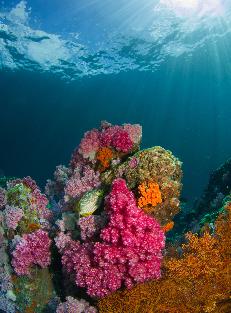
Montano observed the first bleaching episode in Kenya fifteen years ago, then began studying the reefs of the Maldives, which became the battle of his life. He has seen the episodes increase, in proportion to the rise in ocean temperatures, watched coral reefs manage to recover, partly with the help of scientists, and then collapse again: a piece of marine life trying to survive in an ecosystem that we are making more and more inhospitable by the blow of greenhouse gas emissions. "Over time, we marine biologists have had to transform ourselves from scholars into reconstructionists," explains Montano. Neutral observation of collapsing ecosystems is becoming increasingly difficult: those who do research must now participate in the struggle for the survival of the object of their research. This work will be in vain if it takes place in silence, with the scientific community separated from public opinion: biodiversity needs emotional and political participation, even from those who will never see a coral reef.
This is why the Milan-Bicocca University's Map the Giants project was born: a scientific expedition to 'map the coral giants' of the Maldives, documenting their difficulties, but also their extension and majesty: Montano's dream is to turn them into monuments of the sea, to be protected as one does with artistic ones. "We must realise what we would lose without these giants, which are natural unicums, able to grow undisturbed for centuries, becoming really big: some are as tall as three-storey buildings. Moreover, they can store information about the past climate, vital for the future". Resources are needed for the mission, Map the Giants is also a crowdfunding campaign, set up to raise EUR 10,000 on the Ideaginger portal, to which the University would add co-funding.


Loading...
