
Blockades at Alpine crossings: 1.5 billion extra costs
Uniontrasporti study on the impact of interruptions. Restrictions along the Brenner axis cause damage of 370 million a year

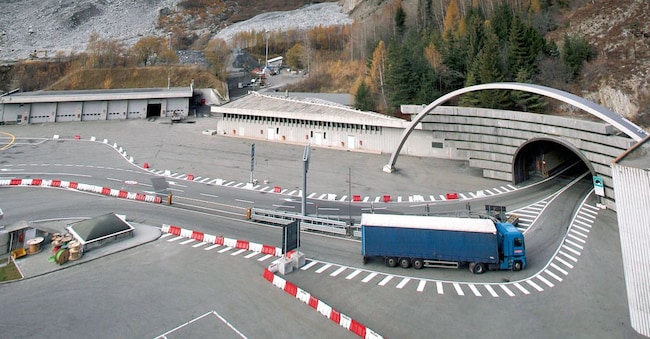
The Alpine passes are increasingly resembling an obstacle course for Italian goods bound for Europe. Landslides, blockades, construction sites, prolonged closures for maintenance work (Mont Blanc tunnel) and bans on heavy vehicle transit imposed by other governments (see Austria with the Brenner Pass) are to blame. The reduced permeability of the Alpine passes seriously increases the risk of isolating Italia from the rest of Europe, our main trading partner. The alarm resounds at Transpotec Logitec, the freight transport and logistics exhibition being held at the Milan Trade Fair. At the centre of attention is a study by Uniontrasporti (a company that belongs to the Chamber of Commerce system) measuring the impact of closures, restrictions and infrastructure delays on Alpine crossings. "All these obstacles at the crossings create slowdowns that damage the economy and penalise the competitiveness of Italian exports," says Antonello Fontanili, director of Uniontrasporti and coordinator of the study.
There is one striking fact. Since 2023 there have been a series of negative events that have caused prolonged blockades at the Alpine crossings: the closure of the Fréjus due to a landslide (August 2023); the derailment of a goods train in the Gotthard tunnel that divided Europe in two (August 2023); the three-month closures a year for maintenance in the Mont Blanc tunnel; the work on the Lueg bridge in the Austrian section of the Brenner motorway, in addition to the traffic bans imposed by the government of Vienna. All this has resulted in an enormous cost for the Italian economy, which Uniontrasporti estimates for the year 2025 at around 1.5 billion euros, almost 90% of which can be attributed to operating costs (increased journey times and distances travelled). In the case of the Brenner Pass, the transit restrictions (night bans, sector bans, and quota restrictions) imposed unilaterally by Tyrol, against which Italia has filed an appeal with the European Court of Justice (the ruling is expected by the end of the year) entail an economic loss for Italian companies alone that can be estimated at 370 million euros per year. Fontanili notes: 'Today the crossings are perceived as a barrier, not for natural causes but for infrastructural and political ones. In this emergency scenario, road transport is certainly more resilient than rail transport, which tends to lose traffic in the event of closures. But road also suffers and the bottlenecks along the Brenner axis amply demonstrate this.
Fontanili continues: "A series of works are now underway that, starting in 2034 with the activation of the two railway maxitunnels at the Brenner base (Bbt) and Turin-Lyon (Tav), should make the Alpine passes system more resilient. But there is a risk, indicated by the Uniontrasporti study: the delay, even of just one year, in the activation of the Bbt and Tav could lead to an increase in costs for the national economic system quantifiable at about 1.4 billion euros per year, concentrated above all on the Brenner axis and with a significant environmental component.
Another critical front is the Mont Blanc tunnel, which will be closed for three months a year for 18 years due to maintenance problems. The Valle d'Aosta industrialists are pushing for the doubling of the tunnel, i.e., to build a second tunnel alongside the historic tunnel, but so far France has opposed this project. By the summer, the Italy-France Intergovernmental Commission will have to decide how to proceed with the rehabilitation of the tunnel; there are two options on the table: quarterly closures or a total closure for a few years. Both solutions involve significant economic repercussions and risk further aggravating the pressure on the other Alpine crossings (Fréjus in the lead), which are already congested. For Italia's exports, 80% of which pass through the Alps, this is a strategic node and whatever decision is taken, it will be strongly affected.


