
Blue economy record, every euro spent generates two
The numbers. Northeastern companies active in sectors
related to the sea, from fishing to shipbuilding and
accommodation and catering services number 32,916 and rising

4' min read
4' min read
A land of mountains but also of coasts, the North-East is a major player in the blue economy which, at national level, generates over 64 billion euro of added value and employs over a million people. There are 32,916 (+0.3%) North-Eastern enterprises active in sectors linked in one way or another to the sea, such as fishing, shipbuilding and accommodation and catering services. Trieste ranks first in Italy for the incidence of the blue economy on the wealth produced at a provincial level (19%), while Venice ranks fourth for companies in the sector as a percentage of the total (12.4%). The data comes from the 12th Report on the Sea Economy, edited by Ossermare, Centro Studi Tagliacarne-Unioncamere, Informare, Chamber of Commerce Frosinone Latina and Blue forum Italia network.
The report places Friuli Venezia Giulia on the podium for the contribution of the sea economy to the overall regional wealth (7.2%, second only to Liguria with 11.9%) and identifies the North-East as having the highest multiplier effect in Italy: for every euro spent in sectors directly linked to the sea industry here, another 2 are generated, against the national average of 1.8.
The goods and passenger handling sector and the shipbuilding sector are driving this. Accomplice also to the Green Deal, sustainability and ecological transition are words that are repeated like a mantra. Green washing exists, but Romeo Danielis, professor of applied economics at the University of Trieste, notes that both the public and private sectors are working hard to increase sustainability. "Reducing harmful emissions favours a better relationship between productive uses of sea-related resources, starting with shipbuilding, fishing and transport, and civil uses, such as housing and hospitality, and recreation. This is all the more true in a densely populated area such as the North-East. All the entities involved, public and private, are committed to finding a better balance between the different uses. And, fortunately, technological innovation offers more and more opportunities'.
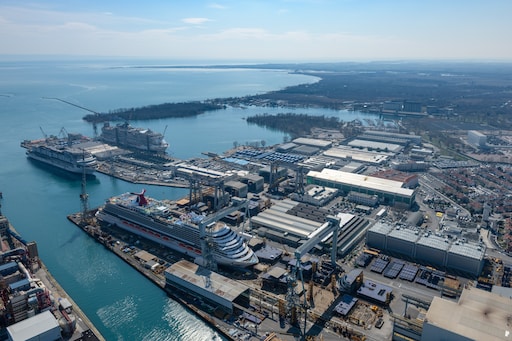
In the shipbuilding industry, there is of course Europe's largest shipbuilder, Fincantieri, driving an entire supply chain in the search for sustainability solutions. The north-eastern giant The north-eastern giant (7.6 billion in revenues in 2023) has placed a development path focused on frontier technologies, digital transition and zero-impact power systems at the centre of its 2023-2027 industrial plan. By 2030, it aims for a ship that produces 61% fewer total emissions and zero emissions in port. In the meantime, he has designed and applied new solutions on new ships. Such as a system that creates large water bubbles under the hull reducing friction, and therefore consumption. "We aim to consolidate our position as a global leader in the construction and management of the ship of the future, conceived as a floating smart city, with a digital and green heart," explains Pierroberto Folgiero, Fincantieri's CEO and managing director. - By integrating state-of-the-art technologies, this model not only reduces environmental impact, but also optimises performance in every operational phase. A greener ship is inevitably more digital, and this allows us to fully embrace innovation, strengthening Fincantieri's positioning on a global scale as a player capable of generating added value for customers and for the future of the industry".
Naturally, special attention is paid to cruise ships. Just this year the group delivered the Sun Princess, its first LNG-powered cruise ship. "Our mission is to maintain Fincantieri's role as a leader in the design and construction of cruise ships through the development of new technologies and continuous improvement of all activities," notes Luigi Matarazzo, general manager of Fincantieri's merchant ship division. "The cruise sector will continue to evolve in a direction that combines sustainability and performance. The group is also one of the partners in the 'Venture builder of the nautical and port-logistics supply chain' project launched in July by CDP Venture Capital with an initial endowment of €8.7 million to create ten new companies in three years to develop products or services for the digitalisation of SMEs active in the shipbuilding, nautical and port-logistics supply chains. Trieste will host one of the project's two permanent offices.

