
Telefono Azzurro at the UN: protecting children in AI governance
The Italian organisation emphasises the urgent need to incorporate child safety right from the design stage of AI technologies, as part of a global dialogue on ethical and social challenges

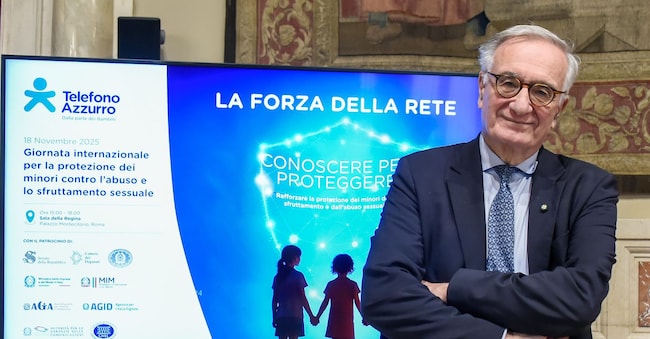
To place the best interests of the child at the heart of the development of Artificial Intelligence, so that technological innovation, the protection of rights and human dignity go hand in hand. This is the position put forward by Telefono Azzurro at the international forum organised by the United Nations on 4 and 5 September in Rome at the Pontifical Gregorian University, which was attended by the Foundation’s president, Ernesto Caffo.
The meeting in Rome
The event in Rome was the fourth in a global series dedicated to Artificial Intelligence and human development, following those in Cairo, Mexico City and Xi’an. Convened under the leadership of the United Nations Deputy Secretary-General Amina J. Mohammed and hosted by the UN Office for Partnerships, the event brought together thought leaders, public decision-makers, technology experts, academics, religious representatives and development professionals to discuss three key themes: AI and Human Civilisation, AI and Human Development, and AI and Human Dignity.
The role of human rights
During the proceedings, the effects of AI on education, learning, human relationships, trust and social cohesion were examined in depth, alongside the need for governance, institutions and ethical principles to keep pace with the rapid pace of technological change. The United Nations has framed this debate in terms of the need for an approach grounded in human rights, inclusion and respect for human dignity.
Child protection
In this context, Caffo highlighted the need to consider Artificial Intelligence from the specific perspective of children and young people. For Telefono Azzurro, the protection of young people cannot be entrusted solely to the ability of children, adolescents or their families to defend themselves against risks, but must be incorporated into the design and governance of technologies in accordance with a ‘Child Rights & Safety by Design’ approach. ‘We cannot allow the development of Artificial Intelligence to outpace our ability to protect children and adolescents: the safety and protection of minors must be built into the design of systems from the outset, not added as an afterthought,’ said Ernesto Caffo, President of Telefono Azzurro.
AI governance
The Rome conference forms part of the wider international initiative promoted by the United Nations on AI and human development, which is set to continue during the 81st session of the United Nations General Assembly. The series contributes to global discussions on the governance of Artificial Intelligence, from the Pact for the Future to the Independent International Scientific Panel on Artificial Intelligence, with the aim of strengthening international cooperation and ensuring that technological development serves the interests of people.

