What’s new

BMW 3 Series: the new generation is on its way, featuring internal combustion engines and an electric version

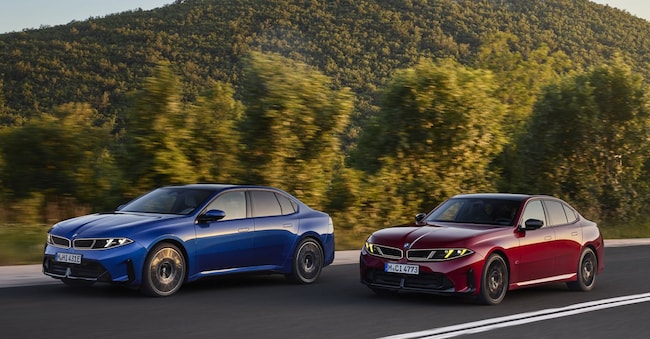
BMW is continuing to transition its range to the Neue Klasse; following the 7 Series and the iX3 electric SUV, the 3 Series – the quintessential D-segment sports saloon – has now also been revamped, incorporating the brand’s new design language and the latest technological innovations

5' min read

Translated by AI
Versione italiana

5' min read

Translated by AI
Versione italiana

The new 3 Series is a platform designed to accommodate a range of powertrain technologies: the latest generation of this mid-size saloon combines petrol engines with a fully electric variant, the BMW i3 , which made its world debut last March as the first battery-powered model in the 3 Series family based on the Neue Klasse platform. Production of the i3 is set to begin shortly at the Munich plant, and in a year’s time the same facility will be dedicated exclusively to fully electric vehicles. The two powertrains – electric and internal combustion – remain technically distinct, with dedicated control units and software, but share the same design language and part of the electronic architecture.

At launch, the range of petrol and diesel models will include the BMW 318 and BMW 320, both four-cylinder, rear-wheel-drive models, paired with 48-volt mild hybrid technology. The top-of-the-range model will be the BMW M350 xDrive, the only variant with a six-cylinder engine. A plug-in hybrid powertrain has already been announced for a later stage in the model’s lifecycle, whilst for the electric version, the i3 40 xDrive and i3 50 xDrive variants will be offered at launch, likely to be followed by other configurations, including the high-performance M Performance version.
Loading...

The Neue Klasse style, inside and out

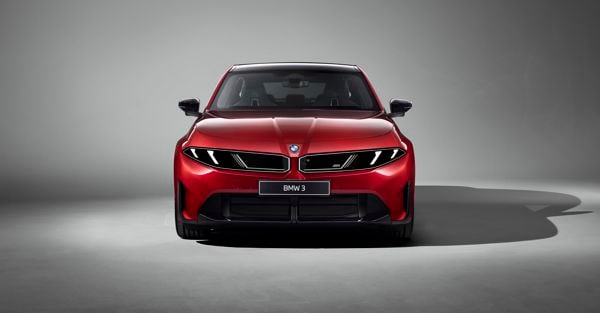
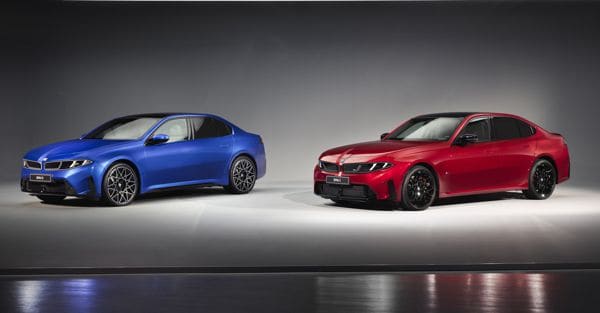
Externally, all variants of the new 3 Series adopt the ‘Neue Klasse’ design language, featuring a reinterpretation of the ‘four-eyed’ front end that combines the grille, twin headlights and sensors into a single design. The bodywork follows a two-and-a-half-box layout, with a longer wheelbase and shorter overhangs compared to the previous model. The petrol version measures 4,752 mm in length, 1,852 mm in width and 1,457 mm in height, with a wheelbase of 2,860 mm; the electric i3 is slightly longer, wider and taller, with a wheelbase of 2,897 mm; these differences are mainly due to the varying mechanical dimensions of the two powertrains. Eleven exterior colours will be available, including the M Le Castellet Blue metallic paint, reserved exclusively for the new range. Alloy wheels range from 18 to 20 inches for the internal combustion versions and from 19 to 21 inches for the i3.
Engines and performance
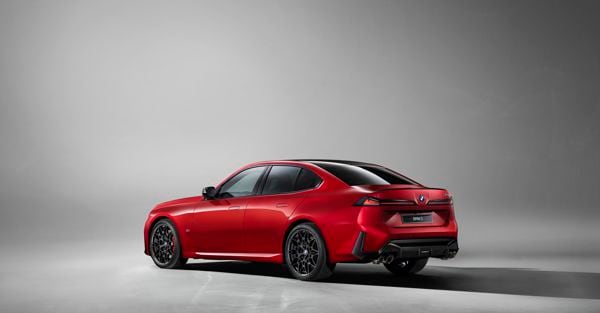
The top-of-the-range petrol model, the BMW M350 xDrive, is powered by a 3-litre TwinPower Turbo inline six-cylinder engine combined with 48-volt mild hybrid technology, delivering a claimed total power output of 443 cv (326 kW) and 580 Nm of torque. The transmission is an eight-speed Steptronic automatic, with xDrive all-wheel drive as standard; acceleration from 0 to 100 km/h is stated as 4.1 seconds, whilst the top speed is 250 km/h.

The BMW 320 produces 210 cv (155 kW) and 330 Nm of torque, accelerating from 0 to 100 km/h in 7.6 seconds; Technical specifications for the BMW 318, the entry-level model in the range, have not yet been released.

In terms of chassis design, the new 3 Series features a double-joint front suspension with spring struts and a five-link rear suspension, with newly developed shock absorbers as standard; Adaptive suspension is available as an option, and, for the M350 xDrive, M Adaptive Suspension with variable sport steering and a sport differential.

For the first time, optional sports tyres are available in sizes 245/35 R20 at the front and 275/30 R20 at the rear. From 2027, the M350 xDrive will also feature the Drift Moment function, which can be activated via the central display and transfers all drive torque to the rear wheels; this function will also be available on cars already delivered via a remote software update.

As for the BMW i3, the figures provided for the i3 50 xDrive version are a power output of 469 cv (345 kW) and, thanks to a new generation of 800-volt batteries with cylindrical cells, a range of up to 900 km (according to the WLTP cycle). DC charging power reaches up to 400 kW, with a stated time of 21 minutes to go from 10% to 80% charge; the vehicle also supports bidirectional charging in vehicle-to-load, vehicle-to-home and vehicle-to-grid modes.

Loading...

Driver assistance and sustainability

In terms of driver assistance, the range features Level 2 systems grouped under the name BMW Symbiotic Drive, including an optional Motorway Assistant for hands-free driving on motorways up to 130 km/h and a City Assistant designed for urban driving, which manages turns, right-of-way and setting off at traffic lights even when there is no vehicle in front; this latter function will initially be introduced in Germany from the end of 2026. Standard equipment also includes Emergency Braking Assist with evasion function (the car assists with swerving to the side), lane departure warning, side collision warning with steering intervention, and an assisted parking system with AI-powered space recognition.

Nuova Bmw Serie 3, il debutto internazionale. Il nostro video

With EfficientDynamics technology, BMW has optimised the vehicle’s efficiency in terms of aerodynamics, lightweight construction, low rolling resistance tyres and overall energy management.

From an environmental perspective, targeted decarbonisation across the entire supply chain is a key driver for reducing CO₂ emissions. The BMW Group has focused in particular on the use of renewable energy and on increasing the proportion of recycled materials, as well as on innovations in the production process. The Gen6 battery cells in the BMW i3 use recycled materials for cobalt, lithium and nickel. Furthermore, energy from renewable sources is used in the production of anode and cathode materials and the cells themselves. Compared with the Gen5 cell in the BMW i4, the CO₂e footprint per watt-hour has been reduced by around 33 per cent. The use of recycled materials has also been increased for components such as alloy wheels and suspension, as well as for the plastics in the i3, where the proportion of such material stands at a full 85 per cent.

Bmw Serie 3, tutte le fotografie ufficiali

Photogallery15 foto

The start of production

In early September, the Bavarian carmaker announced that it had completed the final series of driving dynamics tests for the internal combustion engine versions at the Miramas test centre in the south of France. The prototypes underwent fine-tuning sessions following a programme that also included the icy and snow-covered tracks at the Arjeplog winter testing centre in Sweden and the Nürburgring circuit.

BMW 3 Series: how much does it cost? Italian list prices

The starting price for the i3 40 xDrive is 60,000 euros, whilst that for the i3 50 xDrive rises to 64,750 euros. As for the petrol-powered versions, the 318 starts at €52,000, the 320 at €57,550 and the flagship M350 xDrive at €83,000. The first models are expected to arrive at dealerships in Italia in mid-December. BMW has not yet announced any diesel models.

Copyright reserved ©
Loading...

Brand connect

Loading...

Newsletter

Notizie e approfondimenti sugli avvenimenti politici, economici e finanziari.

Iscriviti