
Bolgheri: constellation of wines, tenacity and the secret of a virtuous process
Cinzia Merli. With her winery, Le Macchiole, she contributes to the success of an area of great reds. And she tells her story (with the strength of women) of strategies, mistakes, successes

6' min read
6' min read
"Between August and September, programmes for the following year are established. This year it was difficult to do so. Especially with American importers. Since February, the Trump administration has used instability as a tool to destroy and rebuild trade and political relations with other countries. Now a 15 per cent dry tariff has been set for customs entry into the US. On the most valuable labels, which appear on the wine lists of large American restaurants or are bought by very wealthy customers, the damage will be limited. The problem will be for bottles priced between $10 and $40. The 15% tariffs put everyone in doubt whether to absorb this extra cost in full as a company or to pass it on, at least in part, to the consumer. The new world of tariffs has unknowns in terms of planning, positioning, and business finance'.
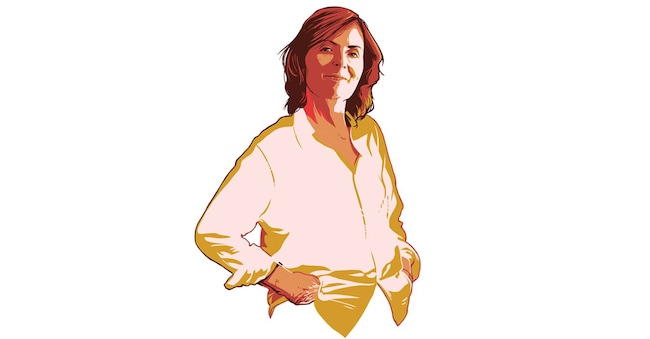
Cinzia Merli - class of 1967, a diploma from the Technical Commercial Institute - is petite and seraphic, has black hair and a teenage bob, is thoughtful and goes fast. She has a keen, analytical eye for things and a quick, intuitive feel for people. She is at the top of the Bolgheri and Bolgheri Sassicaia Consortium, together with the president Albiera Antinori and the other vice-president Priscilla Incisa della Rocchetta, and is the owner of the Macchiole, one of the new farms that have become more established in the last twenty years. Her enterprise overlooks the Strada Bolgherese. In 1983 Cinzia's future husband, Eugenio Campolmi, who is no longer with us, bought the first land and planted four hectares of vineyards. On the walls of the cellar, the two street artists Ozmo and Tellas have created murals that offer a sense of alienating modern harmony compared to the surrounding plains and foothills. We begin by eating a classic of popular Tuscan cuisine: pappa con il pomodoro. With the pappa con il pomodoro we drink a glass of Paleo bianco. "In 2024, we reached a turnover of 4.5 million. Between the winery and the commercial side, 35 people work with us. These are small numbers, but significant. The Bolgheri phenomenon stems from the fusion of large companies with internationally recognised brands and small producers who have been able to work with passion and results not only on the Italian market, but also abroad. The former have not engulfed the latter. The latter have developed autonomy and cooperation with the former. There is a common inspiration, which is not the result of a concert dropped from above, but which is the fruit of a synergy born from below,' says Cinzia.
Cinzia hands me a plate overflowing with Tuscan ham, seasoned lard and wild boar mortadella, to be eaten with a glass of Bolgheri red. The reality of Bolgheri has three matrices. The first matrix is made up of the nobles who have chosen to enter modernity by transforming the countryside and hills inherited for their centuries-old lineage into a business: the Incisa della Rocchetta with Sassicaia, the Antinori with Guado al Tasso and with Matarocchio, and the Frescobaldi with Ornellaia and with Masseto. The second is made up of the 'outsiders' who have arrived in the last thirty years: for example, first Angelo Gaja, the king of Barbaresco and prince of the clod (Gianni Brera's copyright was Carlo), and more recently Marilisa Allegrini, one of the protagonists of Amarone in Valpolicella and the first Italian woman to appear on the cover of the American magazine 'Wine Spectator'. The third matrix are the peasants who, born from families who had lived in these lands since time immemorial or immigrated after the Second World War, stopped growing fruit and vegetables and started planting vineyards too, first indigenous and then French. "My mother Rina and my father Silvano came from the Marche in the boom years. She from Acquaviva Picena and he from Ripatransone. Many emigrated from that region. There they were sharecroppers. Here they obtained plots of land thanks to the reforms of the Christian Democrat politician Amintore Fanfani,' Cinzia reconstructs, as she hands me a food rack full of slices of Maremma pecorino and raw milk pecorino, with which we taste Paleo rosso, Scrio and Messorio. Le Macchiole, which since 2001 has, among other things, invested with the Paleo wine on Cabernet Franc (now the third largest grape variety after Cabernet Sauvignon and Merlot), has received a series of awards from American magazines, which have over the last thirty years determined the scale of taste value (and price value) of global wine. In 2007, the Messorio - vintage 2004 - received one hundred points out of one hundred from 'Wine Spectator' and, in 2008, the winery was awarded 'winery of the year' by 'Wine & Spirits'. In 2019, Scrio (2015) received one hundred points from critic James Suckling.
On the table comes another popular Tuscan dish: ribollita. Delicious. We both accompany it with Paleo bianco. Out there, Bolgheri is full of light, smells of the sea, tastes of fruit trees. Mario Incisa della Rocchetta - an agronomist, an ancient noble family from Piedmont - brought French vines here after the Second World War. His son Nicolò transformed Sassicaia from a table wine into an international phenomenon of style and taste. An equally fundamental contribution was made to this microcosm by the farmers who became vine growers. Says Merli: 'My first husband's family is Tuscan. Mine is of Marche origin. Both are of working-class extraction. A particular thing happened in Bolgheri. Instead of social antagonism or personal envy developing, which are always sterile phenomena, a virtuous process has been created. This is not heaven on earth. There are also here sympathies and antipathies, correctness and incorrectness. They have always existed and will always exist. Everywhere. But, on the whole, cooperation has worked far more than competition. Imitation has served. When the Sassicaia phenomenon exploded, we all thought that perhaps everyone's product could have a less compressed and more elastic price. When Sassicaia was joined in international success by Guado al Tasso and Matarocchio, Ornellaia and Masseto, a veritable constellation of high-profile wines was formed. And, at that point, little by little all of us small producers gained confidence and started working on the brand and positioning'.
Intertwined in Cinzia Merli's story are the crazy pace imparted by Donald Trump to international politics and markets - with the instant and potential damage inflicted on Italian, French and Spanish wines - and the long life of a land like the Tuscan countryside so beautiful that it seems out of time. At the same time, the trajectory of this community and her personal destinies as a woman and entrepreneur intersect in her. Cinzia continues: 'When Eugenio passed away from an illness in 2002, Le Macchiole had 19 hectares and produced 110 thousand bottles. Now we are at 35 hectares and 190 thousand bottles. The first years after his death were very hard. Being a woman and being alone at that time was not easy. Not only because of the personal pain of the loss. But also because some people did not pay me my due for contracts that had been signed. I may be wrong. But I always thought that if I was not alone and not a woman, they would not have taken advantage. What's more, I overpriced that year. I only realised this later. But, in any case, the farm and our wines have improved since then. Not only in product quality, but also in market positioning'.


