
Bolkestein, bathers demand a meeting with the government
Licordari: 'Verification of the scarcity of the resource is necessary to understand whether EU law should impose tenders'

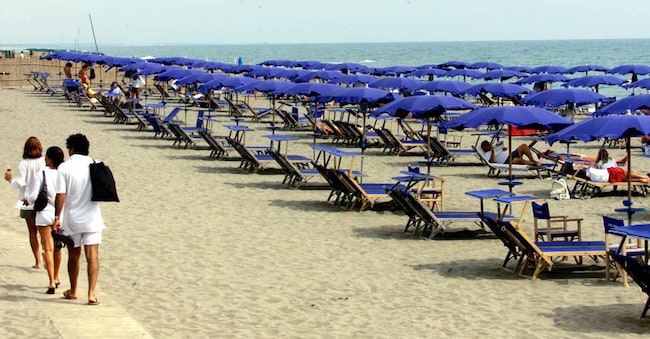
An institutional debate with the government on the correct application of Article 12 of the Bolkestein Directive. This is what Fabrizio Licordari, president of Assobalneari Italia, the association of bathing tourism entrepreneurs belonging to Federturismo Confindustria, requested yesterday from Prime Minister Giorgia Meloni.
The starting point, according to Assobalneari, is the prior verification of the possible scarcity of the available natural resource, as highlighted by the Court of Justice of the European Union in the Promoimpresa and Ginosa Municipality rulings. The key issues, according to the Confindustria (Confederation of Italian Industry) bathers, are four, starting with the re-establishment of the National Technical Table on the mapping of the state-owned resource. This is followed by the completion of the reconnaissance through the inclusion of lake and river areas as well; the involvement of the Regions affected by the phenomenon of lake and river concessions; and, finally, the adoption of an ad hoc measure that allows for business continuity during the completion of the national preliminary verification before the generalised start of comparative procedures.
"But is the resource really as scarce as the Council of State claims?" wonders Licordari. "In our opinion, the central theme of the Bolkestein Directive continues to be completely misunderstood," the president of Assobalneari continues. "The verification of the scarcity of the resource is not the end, but the necessary tool to understand whether European law really requires tenders. The European Court of Justice, in the Promoimpresa and Ginosa Municipality rulings, clarified that comparative procedures can only be applied in the presence of an actual scarcity of the natural resource. This ascertainment must be concrete and based on objective data, not abstract presumptions'.
This is why the survey should also include lake and river areas affected by tourism and bathing activities, territories around which businesses linked to the hospitality industry gravitate. Just think of the many lakes in northern Italia, from Viverone to Garda to Trasimeno. "This is why we ask that regions such as Lombardy, Piedmont, and Trentino-Alto Adige also be involved in the institutional debate on the national mapping of the resource. The path indicated by the bathers must pass through the prior verification of the available resource "a technical and administrative activity that is the sole responsibility of the competent institutions and cannot be replaced by general presumptions or abstract statements by one judge rather than another just because of a personal conviction," adds Licordari.
"We believe that the president of the Lecce Regional Administrative Court, Antonio Pasca, has played a very important role in the concessions affair," explains Licordari, "His orders of referral to the European Court of Justice have helped to clarify the crux of the issue. President Pasca has had the merit of bringing the debate back to the terrain of actual European law and the text of Article 12 of the Directive, asking the Court of Justice the correct legal questions on the issue of the scarcity of the resource'.

