
Bologna, 600 requests for help for flooded houses and one death
Too much concretisation has taken place in spite of the needs of watercourses and the fragility of the Po Valley territory, squeezed between reclaimed plains and landslide-prone hillsides

5' min read
Key points
5' min read
Yet another bad weather disaster in Emilia-Romagna, another 2,000 displaced persons and one victim, and a new request for a state of emergency. The Via Emilia bent by the weekend's heavy rains hardly makes the news any more, and while people continue to shovel mud, restore roads and bridges, and count the damage (this time concentrated between Reggio Emilia and Bologna, more than in Romagna), the responsibility of human carelessness and shortsightedness is becoming increasingly clear: too much concrete has been built in spite of the needs of the watercourses and the fragility of the Po Valley territory, forced between reclaimed plains and landslide-prone hillsides, and the new era of climate change is presenting its bill. Less than a month before the regional elections, however, the fourth flood in 16 months, instead of pushing the (exasperated) community towards internal cohesion, has become an instrument of political campaigning, which the coalitions of the left and right ride on.
Bologna epicentre of the damage
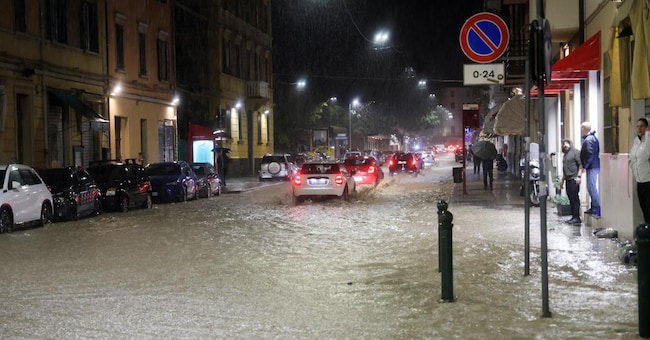
.The weekend's rains had this time Bologna as their epicentre, where more than 160 millimetres of rain fell in 24 hours, more than in May 2023, on land already saturated with water, with one dead in Pianoro, driving a car swept away by the water, and 2,000 people evacuated. "Romagna has been saved this time, the Senio and the Lamone, which are the most delicate rivers, are handling the floods," explained Irene Priolo, acting president of the Region awaiting the outcome of the polls on 17 November at a press conference yesterday. The State Railways did, however, interrupt sections of the Ferrara-Ravenna and Rimini-Ravenna lines yesterday as a precautionary measure, as well as the Porrettana line in the Bologna area. In Modena, there was flooding in several places and floods also affected the Secchia and Panaro rivers, but without serious consequences. In the Reggio Emilia area, the Crostolo torrent broke its banks, and in Parma there were "important events but no significant problems", is the summary of Priolo, who is preparing to ask Rome for a new state of emergency for the flooding.
The Rebellion of Streams and Canals under the Two Towers
"Twice as much rain has fallen as in May 2023, which has sent the city's stream and canal system into crisis," explains the mayor of Bologna Matteo Lepore, praising the mass of volunteers who have been doing their best since yesterday to shovel water and mud, especially in the south-west quadrant of the city, while Civil Protection men and vehicles are on their way. All the rivers and streams that flow through Bologna have created problems: from the Savena to the Navile, passing through the historical centre. "The manholes and sewers have burst, which means that the water pressure has been very strong. And the ground did not hold up because it was already soaked with the water of the past weeks coming down from the hills," explains the first citizen. The symbol of the disaster is the Ravone canal, which reached a height of 4 metres and flooded the central stretch of the Via Emilia, just outside the walls, breaking through cellar walls and basements due to the pressure of the water. And it would have been even worse in the historic centre," the technicians explain, "if the Reno canal had not been recently uncovered, a choice that allowed the water to drain away without bursting underground and into the sewers. The Bentivoglio hospital had to evacuate 59 patients due to flooding in some wards.
Today's Orange Alert and closed schools
Mayor Lepore also justifies the disaster because of errors in the weather warnings: 'It was not supposed to fall all this rain on Bologna but on the plain and the Modena area, instead it all fell on Bologna and its hills. We had already alerted the population in the critical areas on Saturday afternoon and this allowed us to make many evacuations and get people up to the higher floors. It didn't save the houses from damage, but if nothing else it saved people'. More than 600 requests for help and intervention have already arrived last night to the Municipality of Bologna, which in the morning (on Sunday) published online a form to ask for support in case of flooding of cellars, basements, ground floors, garages. 'Ninety per cent of the people who wrote to us have been contacted and we are contacting the others now,' the mayor assures.
An Orange warning for hydraulic criticality issued by the Regional Agency for Territorial Safety and Civil Protection is in force for today, not only in Emilia-Romagna but also in Lombardy and Veneto, while the block of the disturbed area begins to move slowly towards the south-west. In Bologna, all schools are closed, the Alma Mater university has moved all lectures to online mode, and cameras and speed cameras are turned off in the city to facilitate traffic, while roads are being repaired and cleaned. Schools are open, instead, after technical checks, in Modena and in the other towns along the Via Emilia.


