
Bologna business school, a campus to grow in the world
by Lello Naso
4' min read
4' min read
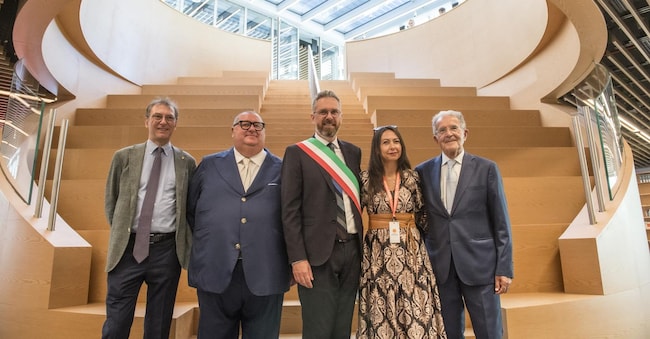
There are 180 steps, not even too steep, between Villa Guastavillani, the historical seat of the Bologna business school, the place where everything was born in the year 2000, and the campus extension designed and built by Mario Cucinella. A multi-storey building, "resting gently on the hill", as the archistar said yesterday at the inauguration of the new building, 28 million euro investment, in front of the whole Emilia-Romagna region that counts. Noble fathers and friends of the school, starting with Romano Prodi ("I do not understand what I am here for. I feel like the meowing cat that likes to be stroked,' he said in his final greeting, drawing amused applause from the audience). Then Pier Ferdinando Casini, former minister Patrizio Bianchi, Unipol CEO Carlo Cimbri, the last four chancellors of the University of Bologna (Roversi Monaco, Dionigi, Ubertini, Molari).
The steps are a bridge between the past, the millennial history of the University of Bologna, which initiated the creation of the business school foundation, and the future, the higher education that will be transmitted in these classrooms. "The University, Villa Guastavillani, is the first millennium of our history. The campus, we hope, is the next," said the dean of the Bbs, Max Bergami. "Our growth," he explained, "has led us to have to consider expanding the space, both to meet existing demand and in a future perspective to meet the needs of education in a rapidly changing society."
A journey that began 25 years ago and which, in addition to the university, has involved local institutions and companies. "Our business school," said Bergami, "combines academic and practical knowledge, and is strongly based on the relationships that accompany our students throughout their professional lives. The quantum leap made in these 25 years has been remarkable. From being a freshman in the sector, to Equis accreditation (260 business schools out of 16 thousand active worldwide), to joining Efmd, the international association of the category in which the most prestigious higher education schools are grouped. All the way to entry in the Financial Times rankings with recognition as the most progressive global reality. Today, it hosts 3,500 students a year from 65 countries around the globe. There are 300 lecturers, half from the corporate world, the other from academia.
There are forty visiting professors. Two million scholarships are granted, and there is a scholarship with Africa that brings the continent's best talents to Bologna. The members and supporters of the foundation, an open structure, are increasing and represent the best part of the region's entrepreneurship. In no particular order: Ferrari, Dallara, Lamborghini, Ima, Marchesini, Kerakoll, Coesia, Granarolo. "The Foundation," said Bergami, "has increased the number of founding members and launched a new plan to develop supporting members that immediately found many adhesions. We are making a great effort to involve all the forces in the area,' Bergami concluded, 'from the university to companies and institutions.
Yesterday there were Government, Region and Municipality represented by Minister Anna Maria Bernini, Council President Irene Priolo and Bologna Mayor Matteo Lepore. It may have been the short jazzy jingles played between speeches on a black grand piano, it may have been the serene atmosphere of the place, but all that was heard was collaboration, projects, the future, investment in training and research (1.5 billion on the territory, Mayor Lepore summarised). The Technopole, Cineca, the widespread hospitality of university residences in medieval buildings, as Minister Bernini mentioned.


