
In Bologna, Japan on show among antique prints and manga
At the Archaeological Museum of Bologna between Hokusai and a long itinerary recounting the fascination of contemporary art from the Rising Sun

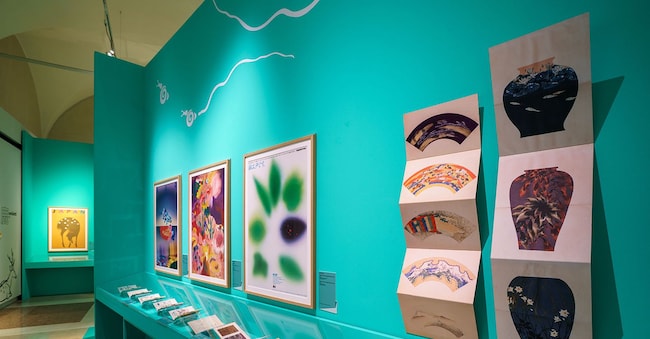
Irises, faces, masks: colourful motifs charged with timeless fascination. It is in the stylised sign of Issey Miyake's fashion that one can best trace the evolutionary path by which the aesthetics of ancient Japan have come to the present day. "The new spirit of Japanese design" dresses these collections thanks to the designer's collaboration with graphic designer Ikkō Tanaka (who so titled a 1984 poster). Born in Kansai, the rural cradle of Japanese civilisation, and educated at the University of the Arts in Kyoto, the imperial capital, Tanaka embodies a fruitful mix of tradition and innovation. He is today - a solo exhibition already at the PAC in Milan in 1997 - one of the most significant names among the many protagonists of Graphic Japan. From Hokusai to Manga.
An enlarged overview where the masters of the "Floating World" - the ukiyoe prints of Katsushika Hokusai and Utagawa Hiroshige - now return to the Museo Civico Archeologico di Bologna after the 2018 focus in an entirely new perspective: that of a "Japan in the age of technical reproducibility", as Walter Benjamin put it. This is how Graphic Japan talks about how we got to the present day and fully frames the game played on the field of soft power by this cultural powerhouse. An overview of over 400 years, more than 250 works (from woodcuts to posters, through applied arts and comics) and four thematic sections (Nature, Faces and Masks, Calligraphy and Typography and Contemporary Japanism).
"At the heart of the exhibition is reproducibility, the past brought back to the present," explains curator Rossella Menegazzo. "It starts in the 17th century, the Edo period, when printing from a wooden matrix marked a key passage for the modern production of images, allowing them to be widely disseminated on the market, even internationally. Then the Meiji era, at the end of the 19th and beginning of the 20th century, when technical drawing (zuan) was born: a conscious utilitarian transformation for craft and industrial production purposes of motifs used for example on porcelain and kimonos. Finally, a moment little addressed in Italy, the post-war years, from 1950 onwards, with posters and the affirmation of contemporary graphics.
Graphic Japan. From Hokusai to Manga, Museo Civico Archeologico, Bologna, until 6 April 2026

