
Borges, a spy story about the warrior of books
Llinás’s astonishing film about the Argentine writer takes its starting point from the objects in a collection: a detective road movie that is at once fetishistic and grotesque

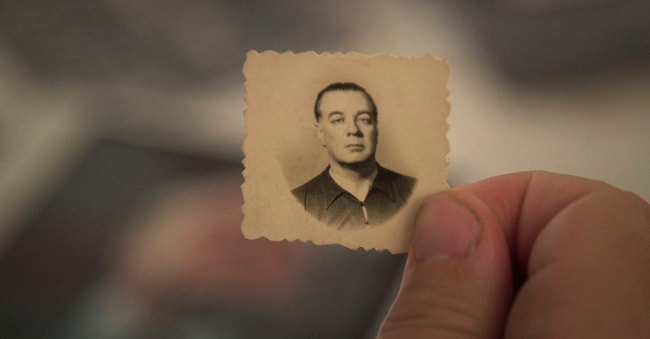
The son of a writer and obsessed with Borges ever since he first picked up *The i* *Aleph* at the age of 14, director Mariano Llinás has, throughout his filmography, done nothing but adopt a Borgesian style – that is, to shape his films around perplexities, conjectures, the lyricism of certain improbable landscapes, metaphors, uncertainty and fiction. His are unique adventure films, in which the protagonists are led to unknown lands: Balnearios (2002) is a satirical mockumentary about Argentine holiday resorts, with a touch of magical realism in the sirens. La Flor (2018) is, depending on the six episodes, a B-movie, a spy story, a tribute to Renoir and so on, always featuring the same leading ladies. It runs for thirteen and a half hours; by comparison, the five and a half hours of Biography of Jorge Luis Borges, presented out of competition at the Venice Film Festival, are practically a short film.
The Writer in Four Parts
In this documentary, Llinás is at the height of his creative enthusiasm and, over four episodes, imagines Borges as a dangerous country, full of threats and wonders, to be explored through a bizarre road movie that sets off from Buenos Aires and visits the places associated with Borges’s life and literature, from Geneva to New York, from Atlanta to the border between Brazil and Uruguay. Llinás is Borges’ squire, conceived as an underground and hidden warrior, the supreme defender of words and their musicality, from the stronghold of two libraries in Buenos Aires: the Miguel Cané, where he worked from 1937 to 1946, and the National Library of the Argentine Republic, of which he was director from 1955 for twenty years. Starting from the highly personal premise that Borges is a surrealist author, Llinás presents a cultured, well-informed and humorous visual diary. The first five minutes of the documentary consist of nothing more than the spilling out onto a table of hundreds of Borges’s volumes in multiple editions, studied, loved, underlined and stained by the director himself. And after this gruelling ordeal, this Argentine-style Michael Moore – a touch of Nanni Moretti in Ecce Bombo, with a hint of David Foster Wallace in A Funny Thing I’ll Never Do Again – keeps the viewer glued to their seat.
Borges’s Places
It is no coincidence that Llinás was the screenwriter of Santiago Mitre’s memorable Argentina, 1985 (2022). The film begins in Geneva, where Borges studied in 1914, and at places significant to the writer: the Arbalète, the hotel where he stayed with his student, assistant and, eventually, second wife, María Kodama, in 1986, before moving to a flat on the nearby Grande Rue, where he died on 14 June of that same year. Then there are the places of the double: the Russian church and the Rhône, where the elderly Borges speaks to the young Borges in *i* (*The Other* ). Place Bourg du Four, where, in a brothel, Borges had his first – and most unfortunate – sexual experience, which marked him for life and lay at the root of his subsequent troubled romances, perhaps merely dreamt of. This also gave rise to his belief that he was physically impaired. Finally, a very long shot of Borges’s grave at the Cimetière des Rois, whilst leaves tumble, swept along by a gale. This is immediately followed by a close-up of the artefacts at the Institute for Studies on Latin American Art (ISLAA) in New York, which commissioned the documentary. At ‘Las Nubes’, the Uruguayan home of the writer and friend Enrique Amorim, where Borges often stayed, the director meets Nicolás Helft, who, together with his parents – Jorge and Marion – has donated 14,500 documents, collected over decades of research fuelled by a passionate love for Borges: 150 original manuscripts, first editions, autographed books, letters, translations into 15 languages, annotated texts, photographs and around 10,000 press cuttings.
The collector and the expert
He is one of the characters whom the director treats as if he were the protagonist of a Coen brothers’ film, in which the leading Borges expert, Ernesto Montequín, plays himself alongside the film crew. Montequín’s musings – jotted down by Llinás in a notebook with orange and black diamond patterns, a nod to the short story *Death and the Compass* – are accompanied by Hitchcockian suspense music, in the style of a crime story, and a generous dose of sarcasm. Yet it also feels like the commentary for a football match, in which the director’s whimsical and roguish voice-over comments on Montequín’s encounter with the documents: ‘Like a reunion with an old flame after years of waiting’. The first disappointment arrives: the famous tigers – animals much loved by the writer, which Borges is said to have drawn as a child and which are reproduced as memorabilia – were, in truth, drawn by his friend, the writer and biographer Adolfo Bioy Casares. Then comes the shared thrill of seeing the original manuscripts, in which Borges’s wavering style becomes apparent: ‘He writes a sentence and regrets it,’ the director presses. ‘He improvises another and tweaks it with subtle variations, which aren’t necessarily any better.’ The ramshackle nature of the documentary’s production equipment – the ‘dirty’ camera, the footage shot even through the windscreen of the director’s car, cracked by a pebble – is perhaps a metaphor for the hereditary blindness that struck the poet and writer in 1955. Llinás jokes that he draws inspiration from the optical experiments of Man Ray, Marcel Lervie and René Klein, whilst his school-age son shouts from the back seat.
Blindness and misguided support for strongmen
Borges’s blindness took him by surprise at the height of his fame and left him in a position of dependence, first on his mother, Leonor Acevedo Suárez – who died aged 99 – a constant presence, as was his sister Norah. And then to various lovers and unlikely figures, such as his first wife, Elsa Astete Millán, about whom there is a most entertaining anecdote concerning a certain fur coat, the theft of which she allegedly blamed on the University of Oklahoma, where her husband was giving a lecture. There is his friendship with Macedonio, and the library in Cané, transformed into a ‘sanctuary’, where Paul Auster was moved by the thought of using the same toilets as Borges. There is his work as a translator, his poetry and his struggle with words, his meticulous and immaculately organised handwriting, his endings—whether or not they involve gunshots—and the Borges within Borges. The final chapter, triste solitario y final, recounts the provocations against the indigenous peoples, Black people, Perón, Evita and his initial support for the Argentine and Chilean caudillos – which cost him the Nobel Prize – and his subsequent repentance, after learning of the horror of the desaparecidos. As in The Theme of the Traitor and the Hero, Borges acknowledges that he is the murderer, the victim and the hero; and regarding the dinner with Pinochet in 1974, ten years later he stated, paraphrasing Pablo Neruda, ‘I confess I was wrong’.


