
Borges, Shakespeare and the ability to make targets fall in love
Falling in love with the objective, not the solutions, is the key to deeply engaging employees. The speech from Shakespeare's Henry V

Let's start with the moment when the 'Boss' announces the goals of the new year.
Variable audiences, equally variable media (in-person or, say, via Teams), slides, videos, hostesses, meeting rooms, gardens, hotels, dinners, aperitifs, handshakes and 'I recommend'.
But the theme remains the same: how do you 'sell' a common goal (of a company, a municipality, a school, a hospital, a kindergarten)?
Since I have witnessed about ten thousand events in which someone had to convince someone else to commit themselves to making some 'sol dell'avvenir' (absit any ideological reference) possible, I think I have understood a few things.
Both positive and negative.
Before suggestions, I would start with Borges and the consequences of a marvel written by this missed Nobel Prize for Literature (too soft on the Argentine dictators to receive it, unfortunately for him, but that's another story).
- "Then I reflected that everything, to everyone, happens precisely, precisely now. Centuries and centuries, and only in the present do facts happen; countless men in the air, on the earth and on the sea, and everything that really happens, happens to me ...". (Jorge Luis Borges, fromThe Garden of Forking Paths).
That is: here and now, me and only me, here and now. What does this stuff you propose mean for me here and now? That goal that the boss proposes 'happens to me' really only happens to me. So, it is important to explain what it means for me, not for the nursery or the company. What does it mean for me?
First lesson: It is true that I am the 'Boss' who talks to everyone and therefore I see a group in front of me and therefore I get to talk to everyone.
But if I do it wrong.
This is wrong.
I must speak to each one. Individually. I have three hundred of them in front of me at the same time, but I am by no means speaking to an audience of three hundred people, but to three hundred individual 'ones' to whom things only 'really' happen intimately to each one of them.
And how to do that?
Shakespeare helps us here (the Nobel was not there).
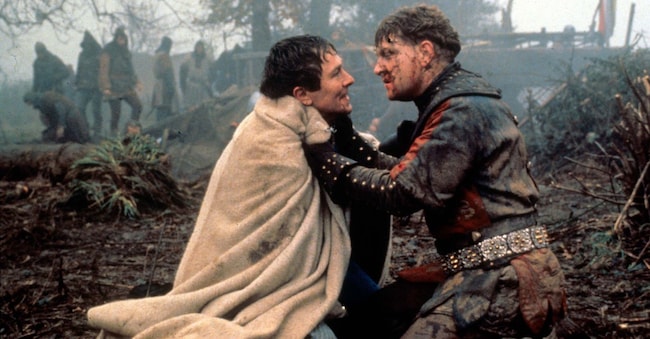
Here we learn from Henry V. The morning of the Battle of Azincourt (watch Kenneth Branagh's wonderful film version in his movie).
The famous speech of St Crispin.
To put it in context: having landed in France with a relatively small army, Henry V repeatedly beat the French, notably by conquering the important town of Harfleur.
But since the fighting decimated and prostrated the British troops, he decided to retreat to Calais, when the French army with five times the number of troops stood before him.
The night before the battle, disguised as a soldier, he wanders around the camp to get to know the true feelings of his troops. In this way, he hears his men despair about the certain death that awaits them, express doubts about his good faith... in short, the whole army is very demoralised.
(And sell them your targets now, Boss).
The next morning he seizes on the words of one of his nobles who complains that it would take at least ten thousand more of those Englishmen left at home to have any chance of victory... In this climate Henry speaks.
The debut is powerful:
"Who on earth wants this? My cousin Westmoreland? No, my dear cousin; if we are destined to die, we are sufficient in number to be a great loss to our country; and if we are destined to survive, the fewer we are, the greater will be our share of glory. In the name of God, I beseech you, do not desire one man more (...)
Here there is already a first individual possible benefit (the greatest share of glory). Everything only happens to me, Borges would say.
"Rather, Westmoreland, let it be proclaimed throughout the army that those who do not feel like fighting should go home: we will give them passports and put money in their purses for the journey. We would not wish to die with any who feared to be our companion in death."
Well: it is obvious that Henry does not want the army to go home at all, and yet that is what he says. How so?
Ask yourself these questions:
- In a situation where the balance of power is 5 to 1, how must that one's motivation and determination be to have any chance of succeeding? Obviously very high. And so a man who is unmotivated and discouraged is not only useless but also - like the famous rotten apple - counterproductive to the morale of others... he's just better off.
- And furthermore: if I am depressed because I am sure I will die soon, with what attention will I listen to the king's proclamation? Even if he were to say very persuasive things, Henry knows well that not being listened to (because one listens rather to one's own fears and despair) is the anteroom of failure of the one chance he has to convince them to stay... Well: I reassure you, you can leave with your pass and the money in your purse... but now, then, for a few minutes you will really listen to me.
At this point he draws with words a first possible scenario: stay alive.
- "Today is the feast of Saints Crispinus and Crispinianus: those who survive and return home, will tiptoe up and make themselves bigger to the name of Saint Crispinianus. Those who will not die today and will live to old age, every year, on the eve, will celebrate with their neighbours and say: 'Tomorrow is St Crispin's Day': then they will pull up their sleeve and show their scars and say: 'These wounds I had on St Crispin's Day'.
Some rules to take home:
- when one refers to the future (a rosy future of which one wants to convince one's interlocutors) exactly as Henry V does, it is better, so to speak, to 'set dates' rather than to say generically 'you will see that in the future you will be happy to have lived this day': the banging and banging on the name of Saints Crispin and Crispinianus achieves the purpose of extracting the future from the fog in which it is shrouded in the eyes of the listener: every year on the eve... I am assuring you that every year, on a specific day, you will be proud and satisfied. The image is more vivid, more powerful, more truthful.
- He does not use the plural (those) but the singular (those who will survive): it is the rule when one wants to speak to each and not, generically, to all... It favours the fact that individuals identify with that one, that unique one that each of us is... and who will survive the battle.
- Telling is better than preaching: Henry does not say "you'll see how nice it will be to be able to say I was there" but describes an old man who will celebrate with his neighbours, say a precise phrase "tomorrow is St Crispinian's" and then roll up his sleeves and show his scars: visualisation is more powerful than merely listening to words, even if the concept is the same.
Having mentioned hypothesis a (living) let us look at hypothesis b (dying).
"Old men forget: he will forget all as well as others, but he will remember his deeds of that day... and perhaps a little more. And then our names, which shall be familiar terms in his mouth, King Henry, Bedford and Exeter, Warwick and Talbot, Salisbury and Gloucester, shall be remembered again amidst the overflowing glasses: this story the good man shall teach his son. And the day of St Crispin and St Crispinian will not pass until the end of the world without our names being mentioned':
OK, the soldier will think, you told me earlier that when I'm old I'll have that date every year on the eve of my birthday, but what if I die? You know, I have a wife and kids, a mortgage to pay...
Well, your name will be spoken until the end of the world, along with those of King Henry, Bedford, Exeter..
Sure, it's a bit of a consolation prize... better than nothing... but I'd like to think about it some more... you know, the wife, the mortgage..
The conclusion of the speech, as we shall see, removes all doubt:
"We few, we happy few, we handful of brothers; for he who will shed his blood with me today will be my brother, and however humble his condition this day will ennoble it: many a gentleman who sleeps now in his beds in England will curse himself for not having been here today, and it will not even seem to them to be men when they speak to those who will have fought with us on St. Crispin's Day."
Again an individual benefit (he who sheds his blood will be my brother), but above all a third, very strong and fundamental image: you can stay and live (and then every year on the eve you will feel happy), or you can stay and die (and then your name will be mentioned forever), or you can leave but - like the many gentlemen who sleep in their beds - you will curse yourself for not having stayed here with us.
Just imagine the scene: in the same pub where another says: I was there and then he will toast showing his wounds, you will feel like maggots... and this, again, not in a generic future (you know, as some grumpy mothers say: you'll see that when you grow up you'll regret it) but concretely, every year, on the eve of St Crispin and St Crispin's Day... If that's how it is, better to die..
History will say that Henry V won the battle.
Of course, he did not win it only because of this speech (which by the way is not his but Shakespeare's), but also and certainly because of his great skill as a military strategist.
However.
Did he mention the strategy?
No.
Did he talk about the solutions he had devised for the battle?
No.
And here perhaps is the lesson: one must not fall in love with the solution one proposes, and talk about that, but one must fall in love and make people fall in love with the goal one proposes.
Because the solution that is proposed - especially today - is not always 'perfect' (everything is so complex and random).
Above all, because if you can make people fall in love with the goal, they will not question whether the goal is achievable or not, but only how to achieve it.
In a 1 to 5 ratio - as in Henry V - this is better the question that drives each one.
*Partner Newton
Brand connect

