
Borgo Egnazia becomes a brand, target 20 luxury resorts by 2029
From 13 to 15 June, the Apulian tourist hub will host the summit between the G7 leaders.

3' min read
3' min read
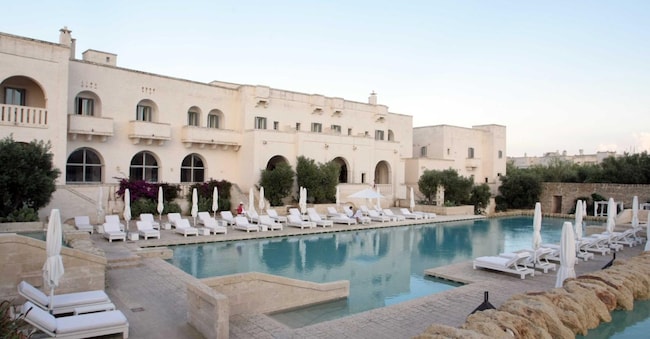
The 'Borgo Egnazia' brand - the ultra-luxury resort that will host the heads of state and government of the G7 countries in the Fasano countryside from 13 to 15 June - is setting the standard. By 2029 - this is the goal of Egnazia Ospitalità Italiana (Eoi), the management company founded and led by Aldo Melpignano who, with his mother Marisa, manages the group's hotel activities - the aim is to extend the Borgo Egnazia model to another 20 luxury resorts, scattered throughout Italy, to make them competitive on international markets and aim for a turnover of 250 million euro.
The first three openings, according to the Borgo Egnazia model, will be operational in 2025 when Eoi will directly manage the historic Ancora hotel in Cortina d'Ampezzo, thanks to the collaboration between Aldo Melpignano and Renzo Rosso's Red Circle (real estate investment and hospitality), the patron of Diesel, which began in 2023 with the Pelican Hotel in Miami. Another direct management is that of Castel Badia in Brunico, also in the Dolomites, in Val Pusteria, and finally Borgo di Pratica di Mare, on the outskirts of Rome. In all, 353 beds in high-end structures that retain their original naming and ownership.
Eoi thus marks the further evolution of the business, at first just a family business, literally invented by Marisa Melpignano who, in 1996, gave birth to Masseria San Domenico (today the structure has 86 guests, 6.2 million turnover in 2023, estimates at +20% in 2024), where it all began as hoteliers by chance in the family home. Then in 2010 came Borgo Egnazia (526 guests), the structure that alone generates a turnover of 63 million euro, growing - thanks to the direct effect of the G7 - by 20% in 2024. All concrete signs that the path mapped out 30 years ago was the right one. Today, the two facilities employ almost 900 people, 90% of them Apulian, with a retention rate in the two-year period 2022/2023 of 80%, and are the cutting edge of a sort of informal tourist district that has sprung up in the Fasano area to crown these luxury resorts, including mid-range catering and hospitality activities, services related to hotellerie, food, and transport.
"When we arrived,' explains Aldo Melpignano, 'this area had a purely agricultural vocation. Now, thanks to us and not only thanks to us, it has become a purely tourist area. My mother was a pioneer of tourism in Apulia'. In 30 years, thanks to this case history with two-thirds international clientele from all over the world (40% from the US and the UK, followed by Europe, Asia and Australia), a concept of hospitality closely linked to the territory and the people who inhabit it has become established, a model to be exported wherever the conditions are suitable. So, in addition to the properties already managed directly by Eoi - three of the five family-owned properties, including Borgo Egnazia, and six others owned by third parties with management contracts - others will follow, little known internationally and to be repositioned, or which have "unexpressed potential," says Melpignano, "such as Cervinia, Courmayeur and Madonna di Campiglio. Without excluding other territories in Umbria, eastern Sicily, Sardinia in the less beaten places, the Cilento. With third-party facilities, Eoi signs management contracts that retain the original ownership, with which it shares space planning, design and concept.
The strategic objective is to create an Anglo-Saxon-style house of brands, a home for all Italian quality hospitality, a platform where individual hotels that find it difficult to compete abroad, share service on distribution, staff recruitment, operations.

