
In Bormio the first Olympic legacy (24 million invested)
Inauguration of the Stelvio Olympic Ski Centre and the 'Pentagon Centre', Lombardy focuses on the Games for land redevelopment and energy sustainability

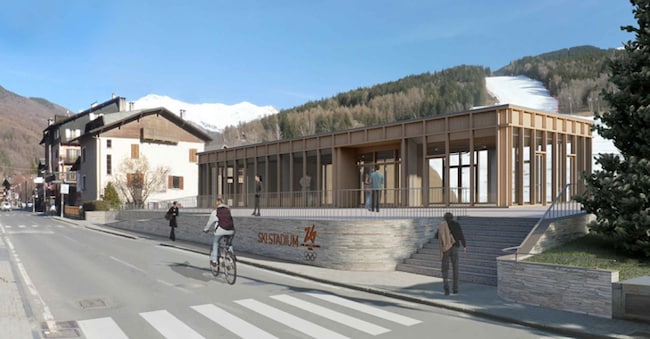
Valtellina is a candidate to be a virtuous example of the infrastructural and economic legacy of the Milan Cortina 2026 Olympic and Paralympic Games. In Bormio, on 1 December, two strategic assets such as the Stelvio Olympic Ski Center and the Pentagon Center, built with a total regional investment of 24 million, were inaugurated in the presence of Lombardy Region President Attilio Fontana and councillors Massimo Sertori (Local Authorities and Mountain) and Claudia Maria Terzi (Infrastructure). An intervention that is not limited to meeting the needs of Milan-Cortina 2026, but aims to increase the attractiveness and competitiveness of the Alpine district for the coming decades.
Stelvio Olympic Ski Center
The Family Lounge and Hospitality Lounge, the heart of the Stelvio Olympic Ski Centre, represent the logistical hub of the arrival area of the famous Stelvio slope. Entirely financed by the Region of Lombardy with 12.9 million euro and realised by CAL (Concessioni Autostradali Lombarde), the project emphasises sustainability, an increasingly crucial factor in large-scale works.
The new buildings are designed according to modern NZEB (Nearly Zero Energy Building) criteria, with a photovoltaic system and power supply from a biomass power plant. A model that not only meets international standards for competitions, but also guarantees permanent functional viability for events, services and public use, turning the sports infrastructure into an economic driver. Indeed, President Fontana emphasised how the approach was 'systemic', integrating competitive needs with functional and territorial ones, ensuring the local community a continuous use well beyond the closure of the Games.
The Pentagon
Even more significant in terms of its legacy for the community is the Bormio Pentagon Centre, for which ARIA (Azienda Regionale per l'Innovazione e gli Acquisti) has overseen a renovation of over 11 million in regional investment. The work returns to the area a completely redeveloped complex, focused on energy efficiency (thermal insulation, new roofing, photovoltaic system) and multifunctionality.
The Piastra/Pagoda now offers over 1,500 square metres of multifunctional areas and offices, designed to accommodate logistics services and activities of public interest. The project is completed by a logistics area that is crucial for mobility: a new multi-storey car park, a roundabout and a cycle-pedestrian walkway, which are integrated into the Transport Mall. This is a model of urban sports regeneration, in which the Olympic event acts as a catalyst for an architectural, energy and functional revitalisation.


