
Bosch celebrates 30 years of safety with Abs for motorbikes at Eicma 2025
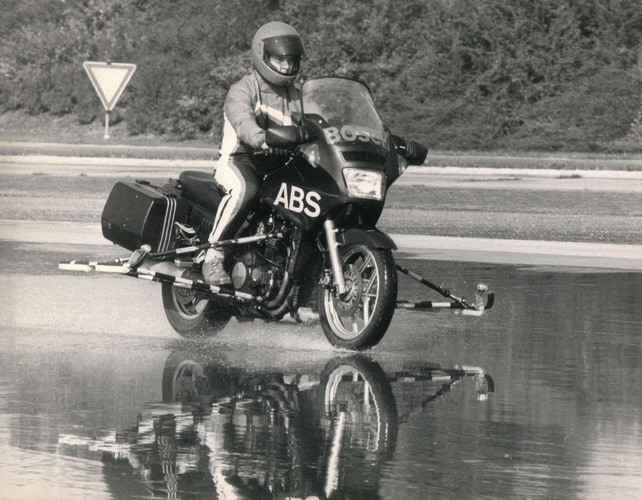
The Kawasaki Gpz1100, the first production motorbike equipped with Bosch Abs, is on display. Digital passport for batteries and new technologies for e-mobility are also on the way

Key points
Bosch has become synonymous with Abs systems for motorbikes, as demonstrated by the Kawasaki Gpz1100 on display in hall 18, stand E66 at the 2025 edition of Eicma in Fiera Milano Rho scheduled to run until 9 November. In addition to the first production motorbike equipped with Bosch Abs, on the German company's stand are a series of innovations including systems for electric mobility, the Digital Battery Passport, cloud services, driver assistance technologies and the Connectivity Cluster 4.2" Round to meet the need for a second navigator.
Abs Moto Bosch
Bosch's work on Abs for motorbikes began in 1986, building on the technology developed for cars introduced in 1978, reaching its zenith in 1995 with the first production motorbike equipped with Bosch Abs: the Kawasaki Gpz1100 Abs. Ongoing commitment led in 2007 to the creation of a competence centre dedicated to safety technology for two-wheelers in Japan, which then became the basis for a global development hub and a highly specialised engineering team. Subsequent milestones include the launch of Abs 9 for motorbikes in 2009, the introduction in 2016 of the compact and lightweight Abs 10 light and base models, designed for emerging markets, and in 2018 the debut of Abs 10 enhanced, a version developed specifically for high-performance motorbikes. The development in 2013 of the Msc (Motorcycle Stability Control) system based on inertial sensors marked the beginning of Bosch's expansion into the field of advanced active safety systems for motorbikes.
Motorcycle Stability Control
Bosch's Motorcycle Stability Control, or Msc, system offers crucial protection in situations where motorcyclists are particularly vulnerable, such as during cornering or dynamic manoeuvres. Combining wheel speed sensors with a high-frequency inertial measurement unit (Imu), the system analyses vehicle dynamics up to 100 times per second, managing braking and acceleration even when the motorbike is leaning or out of control in corners. In addition to the cornering control functions, the German company continues to develop additional Msc-based functions, such as rear-wheel lift-up control to prevent the rear wheel from lifting, vehicle hold control for hill starts and rear-wheel slide control, designed to improve performance on the track.
-30% motorbike accidents
A study by Bosch Accident Research indicates that if all motorbikes were equipped with Msc, the combined work of Abs and Msc could prevent or mitigate around 30 per cent of motorbike accidents involving personal injury in Germany alone. In order to make these benefits accessible to a wider global audience, Bosch introduced a version of Msc for small-capacity vehicles in 2023 and is now ready to provide solutions to markets where small-capacity motorbikes predominate, including India, China and South-East Asian countries. This development follows what international regulations demand: the European Union made Abs mandatory for motorbikes over 125 cc in 2016, followed by India in 2018. Singapore will take this commitment to the next level, becoming the first country in the world to require Abs on all new motorbikes, including those under 125 cc, from 1 April 2027.
Digital Battery Passport
Also on the Bosch stand at Eicma 2025 are solutions to future EU regulations, which from February 2027 will make a digital passport mandatory for every battery. The Digital Battery Passport is designed to meet European requirements, providing full transparency on the condition of the battery throughout its entire life cycle, through static and dynamic data. The solution seamlessly integrates information from multiple sources, providing clear and intuitive access for manufacturers, workshops, dealers and motorcyclists. It also simplifies regulatory compliance and optimises battery management. Complementing the Digital Battery Passport, Bosch presents Battery in the Cloud, a service designed to help motorbike manufacturers constantly monitor, predict and improve the status of their batteries. This innovative system creates a digital twin of the battery in the Bosch Cloud, which accurately reflects the actual condition of the battery thanks to sophisticated data analysis and models based on artificial intelligence. In this way, stress factors and anomalies can be detected early, significantly reducing failures and extending battery life.

