
Bosch is focusing on humanoids, which are expected to generate a billion euros in annual revenue
President Hartung outlines the German giant’s strategies: robots will be deployed on production lines, in the service sector and in homes

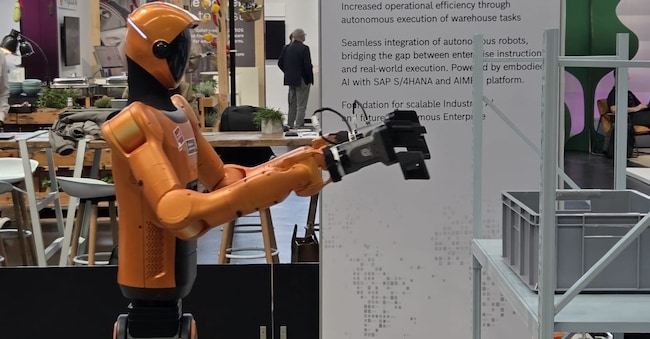
A global market worth two hundred billion by 2030, with steady growth. Humanoids will be the natural evolution of robotics, and Bosch, a global leader in digital technologies for industrial automation, is aiming for additional annual revenue growth of one billion. Stefan Hartung, Chairman of the Board of Management of Bosch, outlined his vision during the Berlin event dedicated to automation and applied robotics, the strategy of the German giant (€91 billion in turnover, of which €2.3 billion in Italia, 230 plants and 430,000 employees worldwide). Starting from a historical foundation, which is the Stuttgart-based company’s core business: automation in mobility. “Sensor technology, software and the efficient conversion of electrical energy into kinetic energy are not just about autonomous mobility technology, but are the cornerstones of modern robotics,” says Hartung. In other words: the technologies applied to cars for years, from wireless connectivity to autonomous driving, to name just a couple of examples, will naturally lead the way into industrial robotics.
The turning point will be the rise of humanoids. The gradual, yet now considered inevitable, transformation of machines into applications that resemble humans in every respect and can be deployed on production lines as well as in the service sector. “The growth of humanoid robotics,” explains Hartung, “will increase demand for digital components and solutions.” Which Bosch will be able to develop with its partners and supply to downstream customers. “We combine proven technologies from various industrial sectors with visionary innovations,” explains Hartung, “to advance the economies of scale of robotics in industry, with the aim of rapidly bringing humanoids into use in manufacturing and services.” Machines that are in every way similar to humans, which will be deployed not only on production lines but also in everyday activities. “From hospitals to care homes for the elderly, from private homes to car service centres,” says Hartung, “we envisage a world in which humanoids will play a significant role in alleviating the burden of human labour, but not in replacing it.”
This is why partnerships will be crucial. From collaborations with start-ups to strategic agreements with digital giants. Bosch is working with the German start-up Neura Robotics, for example, to develop cognitive robots. Furthermore, thanks to its long-standing experience in the manufacturing sector, Bosch is also a strategic partner to the world’s leading robotics start-ups, including Bowintec and SpiritAI in China, and Humanoid in the UK. In particular, the German giant is bringing their prototypes to production level. In China, the German multinational has brought its partnerships together under the Bosch Robotics Center China, established at the start of the year, which is accelerating the development of physical artificial intelligence and the commercialisation of robotic and humanoid solutions.
As well as contributing to the so-called “intelligence” of robots, Bosch also develops the components that enable the physical behaviour of humanoids. From high-precision electric motors that ensure dynamic movement to the intelligent and flexible control of robots in the workplace. Systems that give robots the power, speed and precision to operate in industrial and service contexts. A veritable technological backbone for many automation activities. A market set to explode, where global competition will be fierce. “Europe,” says Hartung, “must catch up. It must allow for experimentation. If our global competitors have precise rules, we must catch up or we will lose market share.” The focus is on the AI Act and clear regulation of the system. But that is another game. One that the industry will be playing out in Brussels over the coming months.


