
Bosnia goes to the polls, amid a resurgence of nationalism and protests against the high cost of living
On Sunday, the federation will elect local presidents and parliaments: internal tensions are delaying its accession to the EU

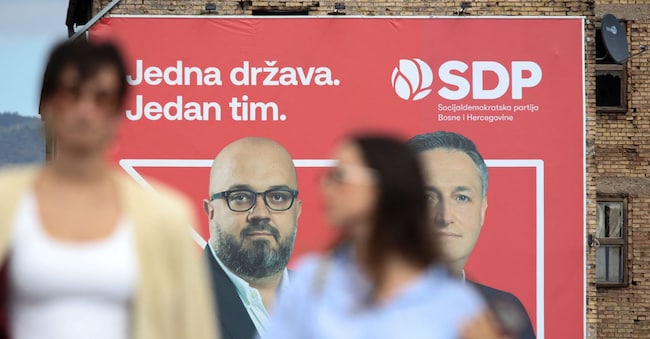
Bosnia goes to the polls on Sunday. Its three million inhabitants will be called upon to elect the new tripartite presidency (Croat-Serb-Bosniak), the presidency of the Republika Srpska and the three parliaments: the supranational parliament, the Serb parliament and the parliament of the Federation of Bosnia and Herzegovina. The country is governed by a complex and intricate institutional system, established under the 1995 Dayton Accords which brought the war in the former Yugoslavia to an end. The result is a system of checks and balances designed to hold together the Serb-majority territories – those of the Republika Srpska – with those of Bosnia’s Muslim population and the Croatian minority. Some 33 different lists will feature on Sunday’s ballot papers and, for the first time, voters will undergo biometric identification and votes will be scanned to prevent fraud and interference.
Speculating on possible winning coalitions in Bosnia, however, is a secondary concern. What matters most of all today, in fact, is the atmosphere in which the country is heading into the elections. Because, on the one hand, there are street protests against the high cost of living, the economic crisis and corruption. And on the other, there is a resurgence of nationalist sentiment, particularly on the Serbian side.
Opinion polls show the sovereigntist parties leading the multi-ethnic opposition coalitions led by the Social Democratic Party (SDP): the Bosniak SDA in Bosnia, the Serbian SNSD in the Republika Srpska, and also the Croatian HDZ BiH. According to the Poliwave monitoring platform, the pro-European Bosniak nationalists are in the lead with 21.4 per cent, whilst in the Republika Srpska the SNSD is ahead with 34.2 per cent, the party led by the secessionist leader Milorad Dodik – who was sentenced last year to one year in prison and a six-year ban from political activity – and which, by contrast, seeks to maintain close ties with Serbia and Russia.
The growing frustration among voters over the economic slowdown and rising prices is fuelling support for nationalist parties. In Bosnia and Herzegovina, the population has been declining for 25 years, according to World Bank data, whilst international investment is stagnating, corruption persists and young people are seeking opportunities elsewhere. In Sarajevo, citizens began taking to the streets last February following a tram derailment in the city centre that left one person dead and several injured. But the protests have continued ever since. Workers are striking over the failure to adjust wages and against energy costs, which have doubled as a result of the war between the United States and Iran. Younger people are marching against corruption.
Compounding all this is the issue of accession to the European Union, a process that is progressing slowly and is likely to slow down further should the nationalists prevail in Sunday’s elections. Bosnia and Herzegovina has been a candidate for EU membership since 2022 and opened the first negotiation chapters in 2024. However, for years Bosnian politics has been in a perpetual state of deadlock due to cross-vetoes by nationalist parties on key reforms in the country. The situation is further exacerbated by the boycott of state institutions by the leaders of the Republika Srpska.


