
AI agents outperform humans: bot activity now exceeds that of humans online
Ahead of schedule, this historic milestone has recently been officially confirmed: the internet will never be the same again, with businesses and individuals having to adapt to the new ‘agent-driven’ era characterised by automated traffic. Without humans becoming irrelevant


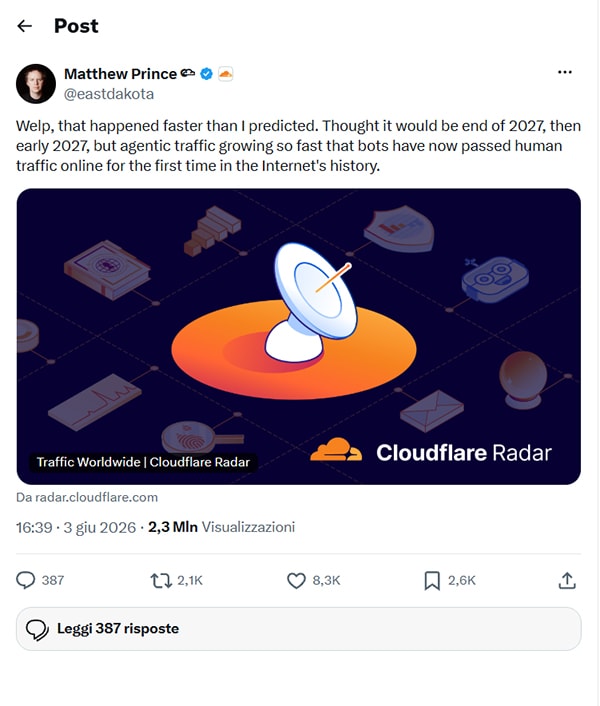
It was due to happen at the end of 2027; the forecast was then brought forward to early 2027, but the proliferation of AI-based agents has accelerated the process: the online activity of bots and autonomous agents has already surpassed that of humans. Cloudflare’s CEO, Matthew Prince, officially announced this historic milestone in a post on X in early June: ‘Welp, that happened faster than I predicted’, it happened more quickly than I had anticipated.
The figures speak for themselves. According to data from Cloudflare Radar, bots now account for 57.5% of all HTTP requests to web pages, whilst humans account for just 42.5%. This is the first time in the history of the internet that automated traffic has surpassed that generated by real people. It is a seismic development, set to shape the future of the web, which will no longer be the same as we have known it until now.
The main driver behind this acceleration has a specific name: AI agents. These are not the traditional bots that index pages for search engines, nor are they advertising crawlers. They are autonomous systems, often powered by state-of-the-art language models, capable of browsing the web, filling in forms, comparing prices, analysing documents and chaining together dozens of operations without human intervention.
According to a report by the Benton Institute, traffic generated by AI agents and agent-based browsers has grown by nearly 8,000% year-on-year. Monthly volumes of AI-driven traffic have almost tripled between January and December 2025.
“The main reason for this surge is the development of generative artificial intelligence,” explained Prince. “Modern AI agents carry out tasks on behalf of users, visiting a huge number of pages to search for and analyse information.” What once required hours of human browsing — comparing flights, analysing contracts, monitoring competitors — is now delegated to systems that operate round the clock, seven days a week. And they provide answers in less than a minute.


