Company

The Breath of the Mind: why the book lives again in the AI era

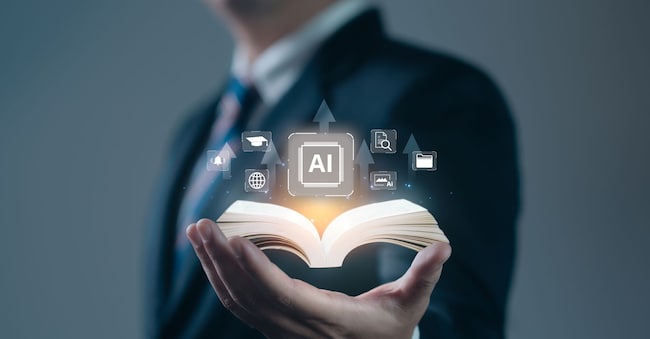
by Franco Amicucci

3' min read

Translated by AI
Versione italiana

3' min read

Translated by AI
Versione italiana

The book as an antidote to cognitive decline. A challenge to be met.

On the occasion of 'Più libri più liberi', the recently concluded fair for small and medium-sized publishers, I was invited - together with the president of the Accademia della Crusca, Paolo D'Achille, the neuroscientist Virginia Cipollini and the journalist Beatrice Curci - to the launch event of 'Do sport, read a book'. The initiative, promoted by Edizioni Lavoro, aims to integrate the times and spaces of everyone's life, now immersed in the digital sphere, with sport and reading.

Loading...

The debate on the frenetic use of digital media highlights a risk: too much online stimulation impairs the ability to concentrate, weakens critical thinking and can accelerate cognitive decline. Over-information reduces our ability to process content in depth.

The book is an indispensable antidote, a mental 'tool' to train slow and deliberative thinking - not in opposition to digital living, but in full integration with it. Authoritative neuroscientists such as Stanislas Dehaene have shown that reading relies on specific and highly plastic neural circuits: learning and practising reading reshape visual-linguistic networks and strengthen brain connectivity. In a digital environment that encourages continuous interruptions and multitasking, prolonged reading functions as an exercise in sustained attention and cognitive integration, offering an antidote to the fragmentation caused by continuous connection.

Reading complex narrative texts activates the prefrontal cortex, the seat of deliberative thinking and the ability to solve complex problems. Reading is not only a logical exercise, but also an emotional and social one: interaction with fiction develops empathy and sharpens social skills. This process stimulates complex cognitive functions - sustained attention, memory, critical thinking - and over time enhances verbal fluency and understanding of linguistic nuances.

Reading literary works and essays enhances abstract reasoning skills and helps interpret metaphors and hypothetical scenarios. The deep reflection that results from this immersion strengthens mental resilience and trains one to overcome obstacles.

Promoting reading as a daily exercise for the well-being of the brain thus becomes a concrete response to the current cognitive transition. It means seeking a new balance between the best roots of our history and the opportunities of the digital age, in a vision that rejects oppositions and subalternities. On the contrary, a new form of 'co-intelligence' is emerging: the AI takes care of the efficiency of the data, while the human being guides the process by defining the ethical direction of its action.

With this in mind, it is crucial to stimulate reading at every stage of life, from the youngest to the elderly, and to integrate it into the working sphere. Cultivating the pleasure of books from childhood enriches language and thinking; in adulthood it reduces stress and trains the mind; in old age it helps slow cognitive decline. Reading can bridge generations: young and old sharing stories and ideas creates dialogue and mutual enrichment.

In organisations, books improve well-being: creating libraries or reading groups in companies means investing in personal growth and nurturing creativity, critical thinking and empathy in teams. Ultimately, in the age of artificial intelligence, the book is not an artefact of the past, but an irreplaceable ally for our cognitive and social future. Reviving the book means spreading this breath of the mind in schools, families, businesses - and facing the challenges of the digital world with intelligence and humanity, building a co-evolution with AI.

Copyright reserved ©
Loading...

Brand connect

Loading...

Newsletter

Notizie e approfondimenti sugli avvenimenti politici, economici e finanziari.

Iscriviti