
Brecht according to Strehler: when epic theatre revolutionised the audience
Seventy years on from the Italian premiere of *The Threepenny Opera*, an essay traces the journey of Brecht and Weill’s masterpiece at the Piccolo Teatro

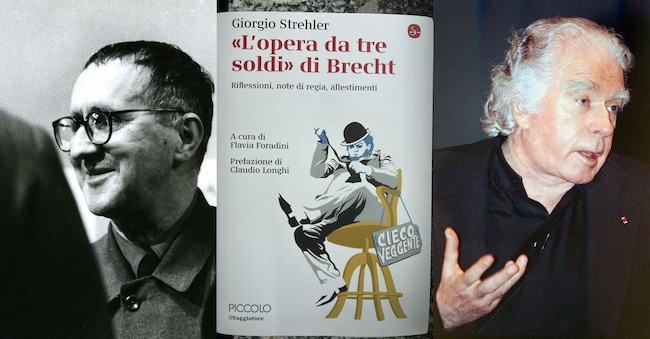
Whilst Strehler regarded Brecht as his mentor, Brecht found in Strehler his most passionate and committed disciple. Seventy years on from the Italian premiere of “The Threepenny Opera”, an important volume has been published that explores the director’s thoughts on the German playwright: “Giorgio Strehler, Brecht’s *The Threepenny Opera*: Reflections, Director’s Notes, Stagings, edited by Flavia Foradini, with a foreword by Claudio Longhi” (Piccolo il Saggiatore, €27.00; 359 pp.).
Delving into the countless texts, notes, letters and reflections that underpin the genesis and production of “The Threepenny Opera” is a painstaking and meticulous task that Flavia Foradini carries out with sensitivity and expertise. The essay follows a chronological journey marked by the various stages of the production of “The Threepenny Opera”: the first performance in 1956, and the revivals in 1958, 1973 and 1986. A lengthy, at times imaginary, dialogue between Giorgio Strehler and Bertolt Brecht, with its questions and reflections, confirms the director’s conviction: “I am not infallible”. For Strehler, Brecht represents a challenge that is constantly renewed; it is no coincidence that, in the 1970s, the director wrote: ‘The work on / with Brecht has only just begun’.
Brecht taught me to doubt
“Not the doubt that paralyses, but active doubt, which spurs one on to action whilst never allowing that foolish certainty of being the custodians of the truth to surface” is the quote from Strehler that Flavia Foradini chooses as the epigraph to her essay. Theatrical texts and Brechtian acting practice have long influenced the work of Giorgio Strehler and Paolo Grassi, co-founder with the director of the Piccolo Teatro. It was Grassi who first met the playwright from Augsburg. They had met in 1948, and not long afterwards, in 1953, the courageous Piccolo Teatro brought, to a Berlin still in ruins, in a half-destroyed theatre, Carlo Goldoni’s *Arlecchino, Servant of Two Masters*, a symbol of rebirth for the theatre as well.
The book features a moving account by Paolo Grassi, who recalls the audience’s reaction to the performance, including that of Bertolt Brecht, Langhoff and Herbert Ihering. It was also in memory of that evening that the playwright and poet decided to come to Milan to attend the premiere of *The Threepenny Opera*.
The book also includes a transcript of the conversation that took place in Berlin between Brecht and Strehler, which formed the basis of a deep, personal relationship that became increasingly less professional.

