
Brenner Base Tunnel: production of ashlars in Ahrental completed
Work progresses on the Austrian side of the new railway tunnel
by M.Mor.
3' min read
Key points
3' min read
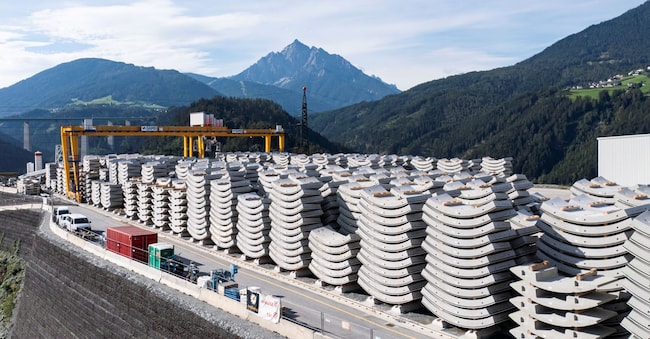
With the production of the last ashlar on Saturday, 19 July, the production of precast concrete elements in Ahrental, at the plant located in the immediate vicinity of the Austrian construction site of the Bennero base railway tunnel, Sill-Pfons Gorge, comes to an end. The plant was commissioned in February 2023 and, since then, just over 59,000 segments have been produced, corresponding to a daily output of approximately 90 precast concrete elements.
The ashlars form the final lining of the line tunnels and are laid by Tbm (mechanical tunnel boring machines), which not only excavate but also lay the final lining of the tunnel. On the Ahrental construction site, there was no railway connection for the transport of materials from outside. For this reason, the temporary grouping of companies Arge H41 chose to produce the ashlars directly on site. The production took place in series thanks to an innovative plant, which made it possible to organise the work in several stages: formwork, laying of reinforcement, pouring of concrete and hardening. An internal transport system ensured continuity in processing, optimising time and resources and ensuring high quality standards.
After storage, the ashlars were transported inside the mountain to a depth of 1,000 metres, first by special vehicle and then by construction train, to be finally laid by the mechanical cutters, which in addition to the excavation also take care of the tunnel lining. If the concrete elements had been produced externally, transport to the construction site would have required around 29,500 truck trips. Instead, by opting for an efficient and sustainable solution, the number of trips was reduced to only 3,000, which were only necessary for the procurement of construction materials and reinforcing steel.
As ashlar production on the Sill-Pfons construction site draws to a close, mechanised excavation work continues on the same lot with the two Tbm Ida and Lilia. In fact, the two machines are advancing southwards, in the direction of the neighbouring construction lot H53 Pfons-Brenner, simultaneously laying the prefabricated ashlars for the tunnel lining. Both operational from summer 2023, Ida and Lilia cover a total distance of just under 17 kilometres. Currently, Ida is about 400 metres from the finish line, Lilia about 800: the goal, for both, is to reach the municipality of Navis. According to current plans, the completion of this mammoth project, which is set to revolutionise cross-border connections between Austria and Italy, is expected in 2032. With the commissioning of the base tunnel (approx. 64 kilometres, including the Innsbruck bypass), a proportion of the freight traffic that today travels by road could more easily switch to rail. Thus relieving the pressure on the Brenner motorway.
European Cef Funds
Meanwhile, according to information from the European Commission, the Brenner Base Tunnel is among the projects that will again benefit from the funds of the European Connecting Europe Facility (CEF) programme for the transport sector in the next common multi-year budget. "The clarification - reports a note issued by the Province of Bolzano - came the day after the presentation of the budget proposal for the period 2028-2034. The Bbt is not just a tunnel: it is a corridor for the future of Europe. With the renewed support of the European Union, today we lay the foundation stone for the final construction phase of this project of the century, which is essential for South Tyrol as a border region". The CEC will mobilise a total of EUR 81.4 billion, of which EUR 51.5 billion will go to transport.


