
Brenner Pass, EU censures Austrian bans
The Commission's reasoned opinion now allows Italy to formalise its appeal to the European Court of Justice

3' min read
3' min read
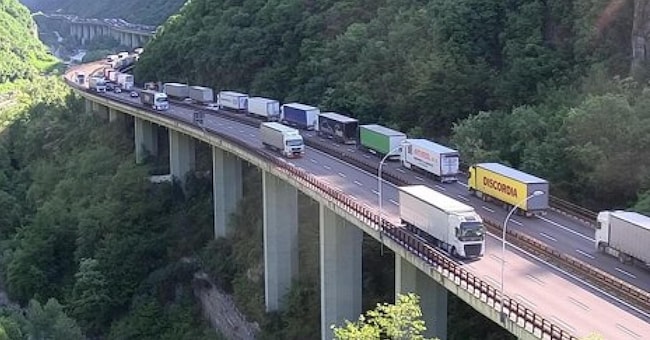
In the pro litigation that pits Italy and Austria against each other over the unilateral driving bans on heavy goods vehicles (HGVs) imposed by Vienna along the Brenner motorway corridor, our country scores a point in its favour that could decide the fate of this long tug-of-war. Yesterday the European Commission, which had summoned the representatives of the two governments to a hearing in Brussels in April, officially censured, through a reasoned opinion, the obstructive policy adopted by Austria. A policy that Italy has always contested because it is contrary to the founding principle of the EU, namely the free movement of goods and people. The Brenner corridor is strategic for the Italian economy, because it channels a large part of our exports to Europe and guarantees the supply of raw materials and semi-finished products to the national processing industry. Since 2010, in order to protect air quality, the Tyrol has introduced a number of transit bans on trucks, the first of which was a night ban.
Appeal to the Court of Justice
The news of the EU censure was greeted with "great satisfaction" by the Italian Ministry of Infrastructure and Transport (MIT) and in particular by Minister Matteo Salvini, who has done a great deal to protect Italian interests along the Brenner corridor, including on a personal level. Italy, explains the MIT in a note, will now proceed to formalise the appeal in the European Court of Justice as provided for by Article 259 of the Treaty on the Functioning of the Union (TFEU) to re-establish a favourable legal framework for businesses and protect the principle of freedom within the EU.
On the basis of the request submitted by Italy in February, the MIT recalls, 'the Commission has unequivocally censured all Austrian bans on traffic along the Brenner corridor as contrary to the free movement of goods provided for in Articles 34 and 35 of the TFEU'. The Commission's opinion 'therefore demonstrates the goodness of the Italian government's position' which, on the strong input of deputy prime minister Salvini, decided to take the judicial route after years of interlocutions aimed at finding a negotiated solution, frustrated by Austrian intransigence. 'It is another promise kept,' Salvini commented.
The Commission's opinion
.In its reasoned opinion, which Il Sole 24 Ore was able to inspect, the Commission censures en bloc all the Austrian bans introduced by the state of Tyrol: the ban on the night-time transit of heavy goods vehicles; the sectoral bans (affecting trucks transporting certain categories of goods such as log timber, marble, tiles, iron ore, stone, cement, pipes, paper and cardboard and other goods still); the winter ban on Saturday days and the metering system, i.e. all those measures that on certain days limit the number of trucks that can enter the A12 motorway near Kufstein to a maximum of 300 vehicles per hour. "While taking note of some explanations put forward by Austria in relation to environmental considerations", the EU considers that "the Austrian measures lack coherence and cannot be justified in their entirety". Rome may now decide to take Vienna to the EU Court of Justice.
The reactions
.The road transport categories rejoice. Says Riccardo Morelli, president of Anita (Confindustria): "The news is a significant victory for our country and for the companies that move the national economy on a daily basis, bringing made in Italy to Northern Europe". Commenting Paolo Uggè, president of Fai-Conftrasporto and a long-time proud opponent of Vienna's obstructive policy: 'An important step, now we are waiting for the Supreme Court, but it will be necessary to immediately lift the restrictions and open a debate that will lead to adequate solutions that guarantee respect for the environment and freedom of movement'.


