Truck driving bans

Brenner Pass, Italia before the EU Court. Judgment by the end of the year

The hearing on the appeal brought by the Italia government against Austria took place in Luxembourg

by Marco Morino

3' min read

Translated by AI
Versione italiana

3' min read

Translated by AI
Versione italiana

The Italian battle in Europe against the Austrian bans on the free movement of trucks along the Brenner motorway continues. On Tuesday 21 April 2026, a hearing was held in the European Court of Justice, based in Luxembourg, on the appeal brought by Italia. The hearing provided an opportunity for Italy to reiterate the seriousness of the bans with respect to the free movement of heavy vehicles and the proper functioning of the internal market.

The Advocate General's conclusions are expected on 16 July. By the end of the year, the Luxembourg panel's ruling will be expected. The MIT (Ministry of Infrastructure and Transport) expresses its strong expectation for a positive solution to the dispute that 'can re-establish legal certainty and more favourable conditions for road hauliers, who play a fundamental role in Italian and European competitiveness'.

Loading...

More specifically: the action, brought by the Italian government through the Ministry of Transport, challenges the compatibility of the bans introduced by the Land Tyrol (Austria) with the freedom of movement of goods guaranteed by Articles 34 and 35 of the Treaty on the Functioning of the European Union. Austria is the defendant in the case, while the European Commission has intervened in support of Italia.

The impact of blockades on logistics

For Italian and European haulage companies, the impact is above all operational and economic. Bans and dosing result in less predictable journey times, forced stops and the need to reschedule trips, with knock-on effects on delivery planning and vehicle utilisation. Routing alternatives, such as the Tarvisio pass or other Alpine crossings, lead to higher mileage and additional costs, affecting the competitiveness of supply chains that use the Brenner corridor for interchange with Central and Northern Europe.

Bans

The material theatre of the dispute is the Tyrolean section of the A12 Inntal motorway, between Langkampfen and Ampass, and more generally the Brenner Pass, the central node of the trans-European Ten-T transport network. At the heart of the dispute are four groups of measures taken by Austria. The first concerns the night-time transit ban for commercial vehicles, which is applied at certain times of day with limited exceptions. The second is the sectoral ban, which prevents the road transport of specific categories of goods, including paper, cement, metal products, and certain types of agricultural and consumer goods, with the declared aim of encouraging a shift to rail.

The third group includes winter bans and bans during peak periods, in particular weekends characterised by heavy tourist flows. The fourth element is the traffic dosing system, which allows the passage of a quota number of heavy goods vehicles from the A12 to the Brenner Pass at predetermined intervals. The 2026 timetable of the Land of Tyrol provides for about 30 dosing days with operational management entrusted to Asfinag (the Austrian motorway network manager).

The European Commission's opinion

An important step occurred on 14 May 2024, when the European Commission issued a formal opinion as part of the procedure initiated by Italia under Article 259 of the Treaty. The Commission found that the Austrian measures were neither justified nor consistent with the stated objectives, censuring the night ban, sector ban, seasonal bans and dosage system. Despite numerous attempts at discussion between the Member States concerned (Austria and Italia) and the European Commission, no agreed solution has yet been found.

Austria's reasons

On the Austrian side, the Federal Government and the Land Tyrol defend the restrictions as indispensable instruments for the protection of public health and air quality in the Alpine valleys, as well as for road safety and traffic peak management. Vienna argues that the measures are proportionate and part of a long-term strategy to encourage a modal shift to rail, consistent with European climate targets and the future full operation of the Brenner Base Tunnel.

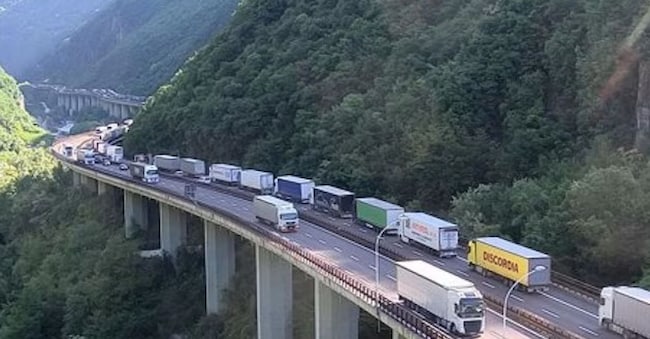
Anita, the transport and logistics association that is a member of Confindustria, observes that the unilateral restrictions adopted by Austria along the Alpine Brenner corridor continue to generate serious problems, with queues of heavy goods vehicles that, on days when traffic is regulated, can reach up to 80 kilometres, significantly compromising the flow of intra-European trade. Anita in particular insists on one point: the removal of the night ban would make traffic flow more smoothly during daylight hours and make the metering system unnecessary in the early morning hours. Says Thomas Baumgartner, Anita delegate for the Brenner Pass: 'We expect the Court of Justice to accept Italia's arguments and put an end to a situation that has penalised our economic system for too long. Europe must prove that it really is an area without internal barriers'.

Copyright reserved ©
Loading...

Brand connect

Loading...

Newsletter

Notizie e approfondimenti sugli avvenimenti politici, economici e finanziari.

Iscriviti