
Brenner, maxi damage from bans. 'EU arbitrator needed for crossings'
Destro (Confindustria): extra costs of 370 million per year, over 1.8 billion in the last five years. We call for a European coordinator with powers over restrictions and maintenance work

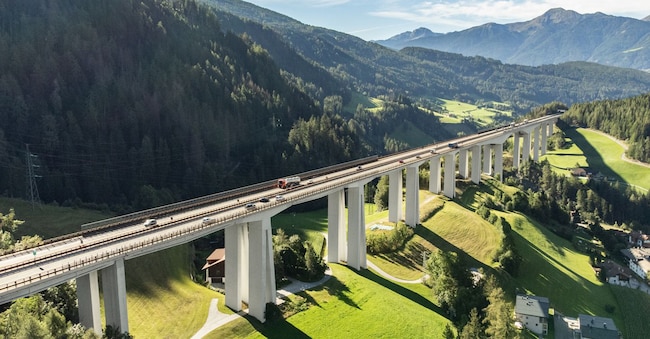
When the Brenner Pass is blocked, it is not just trucks that stop: it slows down the Italian economy, exports, agribusiness, manufacturing, the continuity of supplies to northern Europe and the supply of raw materials and semi-finished products to our processing industries. The Brenner Pass is the backbone of the Scandinavian-Mediterranean corridor and a strategic European infrastructure for the economic system.
Shared European solutions are needed on the Brenner issue, not unilateral bans. Among the demands: the on-time completion of the base rail tunnel (Bbt) and its access routes to increase the capacity of rail transport, investments to make the A22 Brenner motorway even more modern, the lifting of night transit bans in Tyrol.
This is how Leopoldo Destro, Confindustria's vice-president for transport, logistics and the tourism industry, sums up the sentiment of companies. Destro is in Trento, guest speaker at a conference organised by Confindustria Regionale Tentino-Alto Adige, where the Brenner Pass and the importance of this Alpine corridor for the entire Italian economy are being discussed. Present, among others, were the presidents of: Confindustria Trentino-Alto Adige, Alexander Rieper; Confindustria Trento, Lorenzo Delladio; Confindustria Veneto, Raffaele Boscaini; and the president of the Autonomous Province of Trento, Maurizio Fugatti. In a video message, the Minister of Infrastructure, Matteo Salvini, reaffirmed the government's attention to the Trentino-Alto Adige territories and announced: 'We are at 95% of the excavations for the new Brenner railway tunnel (Fortezza-Innsbruck line), with the aim of opening the work in 2033 to reduce the time needed to connect Italia and the heart of Europe'.
Destro explains: 'Around 2.4 million heavy goods vehicles pass through the Brenner Pass every year, transporting goods with an estimated value of around EUR 150 billion, which is more than 50 per cent of Italian exports to the EU. But these numbers clash with the policy of heavy transport blockades that the Land Tyrol, with the support of the government in Vienna, has been pursuing for many years. Confindustria estimates that the damage to Italian companies caused by Austrian obstructionism is 370 million euro a year, more than 1.8 billion in the last five years, mainly due to the increase in time and distances travelled. In addition to these extra costs, a further EUR 174 million per year is needed for the work on the Lueg Bridge (Austria), which will last until December 2028. According to Destro, it is indispensable - and Confindustria has already demanded this at the meeting in April with EU Vice-President Raffaele Fitto - to appoint a European coordinator for the Alpine crossings, with powers over unilateral restrictions and maintenance schedules. 'The Alpine border is not a limit: it is the point from which Europe decides how to stand together. We demand that these decisions be taken by a super partes European arbiter,' says Destro.
Rieper urges: "The Brenner corridor does not belong to a single territory: it is a European infrastructure, which impacts from Veneto to Bavaria. Solutions must be shared, because the issue concerns everyone: freight and passenger transport'. Commented Delladio: 'With this event we wanted to draw attention to the importance of these issues for Made in Italy. The infrastructure network and the organisation of transport have a direct impact on the competitiveness of companies'.


