Festival of Economics

Brenner motorway: Cattoni, we will evaluate 1 billion green bond hypothesis

DLA Piper study: Italy attractive to investors. Autobrennero CEO: 'Without infrastructure there is no growth'

by Luca Orlando

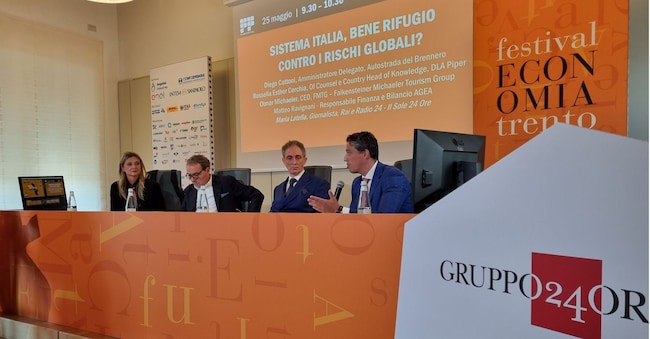
Da sinistra, Rossella Cerchia (DLA Piper), Otmar Michaeler (Ceo Fmtg), Diego Cattoni (Ad Autobrennero), Matteo Ravignani (Agea)

4' min read

4' min read

Autostrada del Brennero evaluates the hypothesis of issuing a green bond that could 'even be in the amount of more than one billion', once the ministerial tender process for the renewal of the concession of the Brenner Motorway (A22) and related works for more than EUR 10 billion has been completed.

This was explained by Diego Cattoni, CEO of the company during his participation in the Trento Festival of Economics at the panel 'Infrastructure: Planning or Improvisation'.

Loading...

A non-convertible bond, he explained to Radiocor, that 'could be, if the market demands it, also of a significant size; it could also be, if the market absorbs it, of a figure in excess of one billion'. The evaluation will take place 'at the outcome of the concession' and 'the decision will be shared with the shareholders: perhaps we will evaluate not only the part with the institutional, but also the retail, to bring it closer to the territories'.

Autostrada del Brennero recently issued a non-convertible bond reserved for institutional investors only, which attracted widespread interest among investors, including private ones, with applications exceeding the available ceiling.

On the occasion of the Festival of Economics, a survey by DLA Piper brought out a picture of a moderately attractive Italy. Favourably evaluated for quality, reputation, strategic location and advanced manufacturing. And judged to be a safe harbour for investments in specific sectors, with flows from abroad seen as growing over the next five years by 63% of the sample, compared to just 6% of those who thought they would decrease. The survey carried out by DLA Piper among its network of international business lawyers debunks more than one negative cliché about our country, returning a picture made up more of lights than shadows. Which of course remain, identified in bureaucracy, the excessive burden of taxation, and the rigidity of the labour market.

One of the Trento Festival of Economics' appointments is dedicated to the theme ('Sistema Italia, bene rifugio contro i rischi globali?'), with a specific focus on tourism, agrifood and infrastructure. And if for the latter,' recalls Autobrennero CEO Diego Cattoni, 'Italy was the leader in Europe until the 1970s, with 6,000 kilometres of motorways, since then development has come to a standstill, with other EU countries that have instead made enormous strides forward.

'Without infrastructure,' he explains, 'there is no growth and unfortunately Italy has been blocked for a long time by the many 'no' fronts. Yet mobility is a great multiplier of development, a sector in which one euro invested generates four euros of spin-off for the entire economy. We need mobility and this is objectively a critical issue for us, because compared to other countries we are lagging behind. That is why it must be clearly stated that, net of other interventions, new motorways must be built'.

Cattoni, however, calls for a move away from extemporaneous action linked to individual projects, however important, such as the Brenner base tunnel or the Strait Bridge. Important works, however, which must be accompanied by a broader vision.

"We must act as Italy did in the 1950s, drawing the needs of the future and setting up a global system plan. It is not resources that are lacking, because the grantor-concessionaire model, which the whole world has copied from us, allows us to entrust private individuals and the market with finding the funds. A model that, however, due to over-regulation is now jammed, as our case shows, with a concession that has now expired for 10 years, an impasse that is holding back the necessary investments'.

The great international turning points in logistics,' Cattoni explains, 'also have repercussions for our country, as witnessed by the doubling of the Suez Canal, which is also shifting additional traffic to Italian ports. "That is why we must relaunch intermodality and rail transport as much as possible," he explains, "because otherwise our motorways will burst, affected by additional heavy vehicle traffic that they will not be able to handle, starting with the Autobrennero. And it is no coincidence that we are working hard on this issue, making agreements with ports as well, precisely to prevent ship loads from being transferred entirely to road".

The country's strong point in DLA Piper's analysis is certainly tourism, as confirmed by the sector's operators. 'We are still investing in Italy,' explains Otmar Micaeler, CEO of Kalkensteiner Michaeler Tourism Group, 30 hotels worldwide, 'not least because Italy's heritage represents incredible value. And we don't really have to invent anything, because we have sea, mountains and cities: for tourism, Italy is the museum of the world. A limitation? If I think of our investments I would undoubtedly say bureaucracy'.

Another asset is agrifood, an area in which new technologies also come into play. "We provide contributions to agricultural operators," explains Agea's head of finance and budget, "and in our strategic plan there is now the valorisation of the enormous existing wealth of information, consolidating data also in order to better direct agricultural policies.


Copyright reserved ©
Loading...

Brand connect

Loading...

Newsletter

Notizie e approfondimenti sugli avvenimenti politici, economici e finanziari.

Iscriviti