
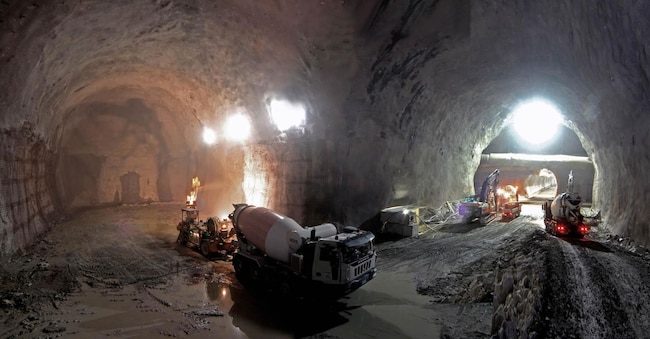
Brenner Tunnel, down the diaphragm: this is what the new rail link between Italy and Austria will look like
Today the ceremony with Prime Minister Meloni and Chancellor Stocker. EU: 'A milestone for cross-border transport'

3' min read
Key points
3' min read
The last diaphragm of the exploratory tunnel for the Brenner Tunnel is torn down. This is the first underground connection between Italy and Austria. The ceremony was attended by Prime Minister Giorgia Meloni, her counterpart Christian Stoker, Rome's transport minister Matteo Salvini, and his counterpart from Vienna. Once completed, it will be the longest railway tunnel in the world at 65 kilometres. The breaking down of the diaphragm with the joining of the Italian and Austrian sides 'marks a milestone in the advancement of cross-border transport within the EU,' the European Commission emphasised. In addition to President Meloni, the ceremony will be attended by Austrian Chancellor Christian Stocker, Deputy Prime Minister and Minister of Infrastructure Matteo Salvini and his Austrian counterpart Peter Hanke. For Brussels, European Transport Commissioner Apostolos Tzitzikostas will be present. It is the day of great occasions with all the territories involved: therefore, in addition to the heads of the European company Bbt-Se, Gilberto Cardola and Martin Gradnitzer, the governors Arno Kompatscher (South Tyrol), Maurizio Fugatti (Trentino) and Anton Mattle (Tyrol) are also expected to attend. Representatives of the Italian railway network (Ff Group) and the Austrian railway Öbb will also be present.
The Project of the Century
.The Brenner Tunnel is one of the most ambitious projects of the Ten-t network, the Scandinavia-Mediterranean corridor that will connect Helsinki to Valletta. With its 55 kilometres, extended up to 64 considering the Innsbruck bypass, the tunnel will directly connect Fortezza to Innsbruck, cutting time and costs of rail transport along the Munich-Verona axis. This is a strategic work for both passengers and freight: work started in 2007 and is expected to be completed in 2032. Passenger trains will be able to travel at more than 200 km/h, while freight trains, thanks to the elimination of the steep gradients of the historic line, will be longer and heavier, with reduced energy consumption and increased frequency. And it is the technical data that draw the identikit of this work. The tunnel, excavated at an altitude of 794 metres below the lowest Alpine crossing (1,370 m), represents a radical change in the way the Alps are crossed. It is designed as an entirely railway infrastructure, with two main single-track tubes connected by transverse tunnels every 333 metres. The exploratory tunnel, located 12 metres below the main tunnels, performs a logistical function during construction and, when fully operational, will be used for water drainage. Its construction has already reduced risks and costs by providing a precise geological framework along the route. The cost of the Base Tunnel is in the region of EUR 9 billion.
The access works from the South
.The tunnel cannot be considered in isolation: to be fully operational, it needs the access lines. On the Italian side, the project concerns the Verona-Fortezza line, with a series of progressive interventions including the Bolzano, Trento and Rovereto bypasses, the expansion of the Fortezza-Ponte Gardena section and the entrance to the Verona node. The first functional lot is the Fortezza-Ponte Gardena quadruplet: 22.5 km almost entirely underground, with two natural tunnels (Scaleres 15.4 km and Gardena 6.3 km), two viaducts over the Isarco river and various construction windows. The total investment amounts to EUR 1.49 billion, partly financed by European funds from the CEC (Connecting Europe Facility) programme.
Impacts on traffic and expected benefits
According to the Fse Group and Bbt-Se, the project will allow an unprecedented increase in railway capacity. The separation of freight and passenger flows will allow greater punctuality, regularity of services and reduced journey times. The declared objective is to shift increasing shares of freight traffic from road to rail, reducing congestion and pollution along the Brenner axis, one of the busiest in Europe. For passengers, the Munich-Verona corridor will become competitive with air travel for medium-haul connections.
Project costs
.The total cost of the Brenner Base Tunnel is estimated at more than EUR 10 billion, supported by joint contributions from Italy, Austria and the European Union. For Lot 1 Fortezza-Ponte Gardena alone, the investment exceeds 1.49 billion. Brussels has already approved funding through the Cef programme for more than EUR 140 million. According to experts, the project requires an extraordinary financial commitment but is bound to yield economic, environmental and social benefits far exceeding the costs. The increased logistical efficiency will reduce transport costs for businesses, while citizens will have faster and more sustainable connections.


