Salumi

Bresaola della Valtellina Igp in precarious balance: production down and turnover up

President Moro: companies suffer from rising production costs and the increasing weight of customs barriers on non-EU meat imports

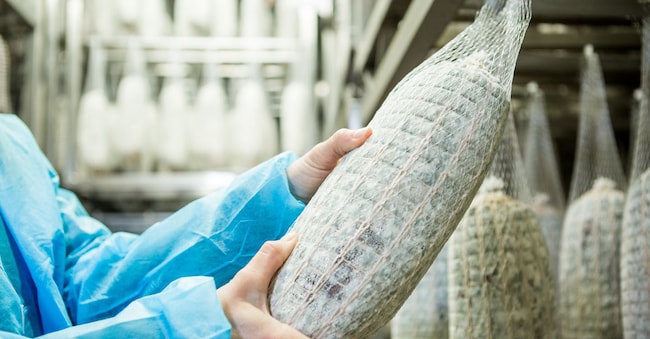
by E.Sg.

I costi elevati della carne penalizzano produzione e prezzi della Bresaola della Valtellina Igp

3' min read

Translated by AI
Versione italiana

3' min read

Translated by AI
Versione italiana

Bresaola della Valtellina PGI is going through a complex period, searching for a balance between rising costs and consequently prices and the difficult economic situation that is squeezing the spending power of families. A situation that in the 2025 budget released by the Protection Consortium translates into a production that stops at 11,947 tonnes (-5.47% compared to 2024) and a growth in consumer value of 4.6% to 502 million euro.

Resilience and export growth

The Bresaola della Valtellina Igp sector - represented by the 13 companies certified by the control body Csqua (Certificazione Sicurezza Qualità Agroalimentare) - confirms 'its resilience in a complex socio-economic context. Despite the increase in production costs, which has made it necessary to adjust prices, affecting consumption behaviour and purchasing frequency, the sector confirms its solidity both on the domestic market and above all on foreign markets,' comments a note.

Loading...

On the export front, in fact, growth in 2025 was more than 32% to 836 tonnes, 64% in EU countries (+17% over 2024) and 36% in non-EU countries (+70% over 2024), 'where several Middle Eastern countries stand out, especially Islamic countries'.

Concerns remain high: the reduction of the raw material available on the European market is pushing producers to increase imports from non-EU countries, which are becoming increasingly expensive due to changing international trade policies and customs barriers.

Trilling meat import costs

"The Gatt licences (General Agreement on Tariffs and Trade), which allow the import of meat at a preferential tariffs of 20%," explain the Consortium, "are in fact still bound to rigid quotas that cannot be expanded. In the current context, characterised by a persistent shortage of raw material, these licences are no longer used only for the importation of noble cuts (such as rump used for the production of bresaola) but also for numerous other food industry processes, including those destined for the production of hamburgers and preparations. As a result, recourse to non-Gatt imports has become structural and almost inevitable for producers of Bresaola della Valtellina'.

"The sector closes a 2025 that reflects the complex socio-economic dynamics of recent years," says Mario Francesco Moro, President of the Consortium for the Protection of Bresaola della Valtellina, "The consumer value has also been sustained by the decrease in production and the consequent price adjustment. Further impacting the sector today are also the supply difficulties andthe increase in costs linked to non-EU imports, aggravated by the current international tariff dynamics. It is true that the new document drawn up by the European Commissioner for Agriculture clearly expresses the intention to re-launch beef farming in the territories of the Union. However, to observe concrete effects it will be necessary to wait at least a year, the time required by the natural cattle cycle. On the one hand, it is essential to support European producers, encouraging them to increase production volumes to strengthen the continent's self-sufficiency. On the other hand, it is undeniable that, in the meantime, meat processors are suffering severely, facing a shortage of raw material that could jeopardise their stability'.

"The sector continues to show solidity and resilience, but without concrete interventions it will be difficult to sustain this situation for long. The increase in production costs, which has been weighing on companies for years, can no longer be borne solely by producers. As a consortium we are committed to containing this imbalance, but a shared effort along the entire supply chain is necessary, involving not only producers, but also distribution, institutions and political decision-makers. Only through common action will it be possible to effectively face the challenges of the current context,' Moro concludes.

New rules in the product specification

In March, the application for an ordinary amendment to the production specification of Bresaola della Valtellina Igp was published in the Official Gazette of the Italian Republic and officially came into force today.

Among the main new features of the specification is the strengthening of product traceability and retraceability systems. In particular, all stages of the production process will have to be documented through a precise registration of the incoming flows of raw materials and outgoing flows of finished products.

This is flanked by the obligation of registration in special lists - managed by the delegated body - for all operators involved in the various stages, including processors, portioners, slicers and packers, as well as the timely communication of the quantities processed. Together, these measures ensure full traceability and retraceability of the product along the entire production chain, from upstream to downstream.

Copyright reserved ©
Loading...

Brand connect

Loading...

Newsletter

Notizie e approfondimenti sugli avvenimenti politici, economici e finanziari.

Iscriviti