
Brescia and its surrounding area: a water hub thanks to new investment
A2A Ciclo Idrico and local authorities have opened new water treatment plants in Calvisano and Visano, whilst the city of Leonessa has seen its water wastage fall to 20 per cent, compared with a national average of over 40 per cent

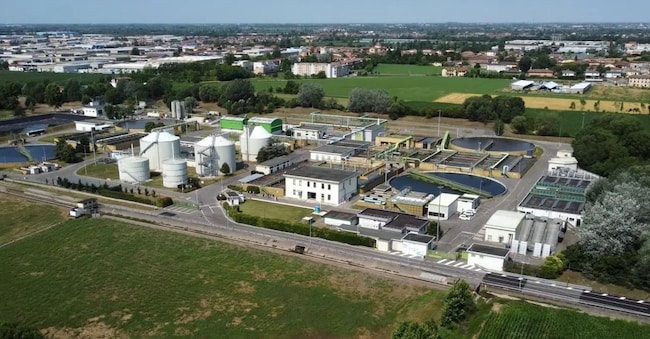
A2A continues to invest significantly in the Brescia water cycle to modernise the networks, further reduce water losses and improve the quality of service. In recent weeks, two significant milestones have been reached with a view to developing strategic infrastructure for the region. These were the inauguration of the new inter-municipal wastewater treatment plant in Visano, a modern and highly innovative facility built by A2A Ciclo Idrico to serve the Brescia municipalities of Visano, Acquafredda, Isorella and Remedello, representing a total investment of over 50 million. And the ribbon-cutting ceremony for another treatment plant, already operational and also in the province of Brescia, in Calvisano, where the water supply system will come into operation by the end of the year and, subsequently, the entire sewerage network will be completed. For the municipality, which until now has lacked this infrastructure, this marks a historic change, the result of a water management plan launched by A2A and the local council, worth over 81 million.
Overall, in recent years A2A has invested over 200 million in Brescia’s water cycle to remedy breaches of EU regulations, whilst the Business Plan to 2035 provides for a further half a billion to be allocated to the development of the province’s water infrastructure, of which around 80 million is earmarked for wastewater treatment projects yet to be completed.
Calvisano Wastewater Treatment Plant: local and national significance
The Calvisano plant is of crucial importance both locally and nationally. The shortcomings in the design of the sewerage networks and wastewater treatment systems that characterise our country have, in fact, led to Italia facing four infringement proceedings over the last 20 years for failure to comply with European Union law. The Calvisano treatment plant lays the foundations for resolving the proceedings initiated in 2014 and ensuring compliance with EU regulations on wastewater treatment, thereby avoiding EU sanctions. This new infrastructure required an investment of 6.5 million, of which 6 million was funded by the PNRR. The Plan for the municipality in the province of Brescia also allocates 21.5 million for the construction of the water supply network and a further 53.6 million for the sewerage network. To date, 57.5 million has already been spent. “Italia still invests too little in the water cycle. In 2023, average expenditure stood at 65 euros per inhabitant, well below the European average of 82 euros,” explained A2A’s Chief Executive Officer Renato Mazzoncini . In the same year, A2A invested 130 euros per inhabitant, demonstrating just how much of a priority water management and infrastructure efficiency are for us. We are working to reduce water losses, which at national level stand at an average loss rate of 42 per cent, and we are focusing on advanced wastewater treatment plants. Today, treatment plants are not just treatment systems, but tools of the circular economy: they transform wastewater into reusable water – for example, for agriculture – and sludge into energy and heat. In recent years, we have invested 120 million to resolve European infringements and, in our Business Plan up to 2035, we are planning to invest 500 million in the water cycle for the Brescia area, of which 80 million will be used to resolve the remaining issues. Calvisano is a concrete example of what we can achieve in partnership with local authorities.”
The Visano wastewater treatment plant
Another exemplary project is the Visano wastewater treatment plant, which has also just been inaugurated. The project, carried out under the supervision of the Brescia Water District Office, represents one of the most eagerly awaited developments in recent years within the province’s water cycle: an infrastructure facility designed to serve 20,000 population equivalents, intended to meet the environmental needs of the area and help resolve the European infringement proceedings affecting the municipalities concerned. The total investment amounts to over 50 million, including the construction of over 22 kilometres of new sewerage network. The new plant replaces systems that no longer meet European standards and will eliminate numerous untreated discharges, significantly improving the environmental quality of the local water network. In particular, the project relates to European infringement case 2059/2014 concerning Remedello and infringement case 2181/2017 concerning Visano and Isorella. Work on the new treatment plant began on 19 March 2024 and was completed on 24 March 2026. The total investment amounts to approximately 18.1 million euros, of which 11.6 million was funded through the PNRR. The treatment plant was designed in accordance with criteria of maximum environmental sustainability and energy efficiency. The processes generating the strongest odours have been confined within an enclosed building fitted with an air deodorisation system using a biofilter. The treated wastewater undergoes UV disinfection, enabling its reuse in agriculture via discharge into a consortium-managed water body intended for irrigation. Particular attention has also been paid to energy efficiency: the plant is equipped with a photovoltaic system sized to fully meet the facility’s energy requirements, in line with the latest European sustainability directives.
Brescia, the ‘capital’ of water
At the same time, Brescia is continuing its efforts to protect water, an increasingly precious resource threatened by climate change. By 2025, water losses from the city’s network had fallen to 20 per cent. This figure places the city amongst the best performers nationally and confirms the effectiveness of the strategy adopted by A2A Ciclo Idrico and Brescia City Council, in collaboration with the Area Authority. Whilst the average water loss rate in Italy still exceeds 42 per cent, Brescia has reduced its rate by over 4.5 percentage points in just one year, falling to 20.25 per cent thanks to a combination of innovation, planning and continuous monitoring. This result is the outcome of a process that has rethought the way in which the network is monitored and managed. Since 2017, when water loss stood at 31.9 per cent, A2A Ciclo Idrico has made steady progress, leading to a reduction of twelve percentage points and halving the absolute volume of water lost through a two-pronged strategy: districts and sensors. Compared with the water loss in 2017, Brescia has saved 5.4 million cubic metres of water by 2025 – enough to cover the entire annual water requirements of a town with 70,000 inhabitants. This result takes on even greater significance in light of the scenarios outlined in the Utilitatis Blue Book, which highlight how climate change and periods of drought are forcing all regions to use water resources in an increasingly careful and rational manner.


