
Brescia celebrates the triumph of Art Nouveau
Until 14 June Palazzo Martinengo narrates the art of modern Italia
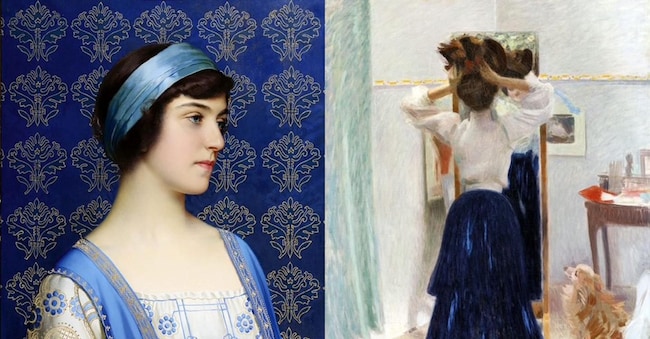
At the end of the 19th and beginning of the 20th century, a new current established itself in Italia: Art Nouveau. The exhibition at Palazzo Martinengo - with more than one hundred works and no fewer than eight thematic sections - recounts the rise of this artistic and cultural movement that developed at the same time as the Belle Époque. While Art Nouveau flourished in France, Art Nouveau was characterised by sinuous forms and refined serpentine lines inspired by the natural world, so much so that it was renamed 'Stile floral' in Italia, thus influencing cinema, painting, architecture and fashion indelibly.
Lyda Borelli in "Ma l'amor mio non muore!" (1913)
The exhibition develops around this thread: at the centre, the eternal female figure, archetypal muse and allegory of modernity itself - a woman taking her first steps towards emancipation, represented through the many noble arts. An exquisite example of this is the cinema, which with its early language recounts the phenomenon of stardom thanks to the famous icon Lyda Borelli in 'Ma l'amor mio non muore!' (1913).
Flowers, plants, gardens and landscapes
In a context marked by industrialisation and the growth of cities, the call to the natural world takes on a value that is both aesthetic and symbolic: flowers, plants, gardens and landscapes become the expression of a search for harmony as an alternative to the fragmentation of the present. The Art Nouveau in the exhibition, straddling nature and urban life, takes into account the artists' participation in the great exhibitions held in Italia between the end of the 19th century and the first two decades of the 20th century, such as the International Exhibition of Modern Decorative Art in Turin in 1902, in which the well-known manifesto, with allegorical figures dancing in a flowery landscape, recounts the aesthetics of the 'new style'. Notable in the exhibition is the work by Felice Casorati, 'Persone' (1910), in which the cheerful figures are the curtain of a convivial human theatre, foreshadowing the development of a more modernist sensibility. At the beginning of the 20th century, the home was considered a woman's 'natural' place, a perfect microcosm in which to bring up children: a domestic intimism that was well conveyed by the painting of the time. The wind of change, however, blew irrevocably, and artists became fascinated by women reading and finding space for themselves. The rituals of body care, reading and toileting take on a new meaning: not just moments of well-being, but preparation for a life of urban seduction that is not confined to four walls. A clear example of this is the subtly sensual intimacy of Camillo Innocenti's gesture of tying up her hair in 'Bianco e azzurro' (1906) or the unclothed shoulder of the noblewoman who reflects herself in admiration by Umberto Coromaldi in 'La donna e lo specchio' (1903), or in the Klimtian echoes on a gold background that resonate in the work 'Ritratto di donna' (Portrait of a Woman) by Gino Parin from Trieste, in which the protagonist sports an ironic and mocking expression. The first Venice Biennale (1895) marked a decisive moment for Italian art, which was captured by the English current. Traces of the English school can be seen, for example, in Ettore Tito's 'Portrait of Countess Nerina Volpi di Misurata' (1909), which catches the eye due to the woman's direct gaze and the sinuous line traced by her body. The exhibition presents two admirable masterpieces by Vittorio Matteo Corcos: 'Portrait of Countess Lia Goldmann Clerici' and 'Portrait of Marquise Edith Oliver Dusmet' (1911). The former is fascinating because of its background composed of a rich floral parade with 15th-century taste, showing a woman of cultured and self-conscious femininity; the latter is inspired by the theatre posters of Alphonse Mucha, in which the protagonist is depicted as a sort of opulent Byzantine queen, endowed with a broad decorative halo composed of stylised floral motifs. An image emerges of an Italia in transformation and turmoil, poised between ancient memory and tension towards modernity.

