Energy

Brescia over the Gigawatt: top in solar power

First among all Italian provinces in terms of installed photovoltaic power: there are more than 60,000 systems in the area Decisive is the weight of industrial installations, which also push the area to the top in terms of new large-scale facilities starting in 2023

by Luca Orlando

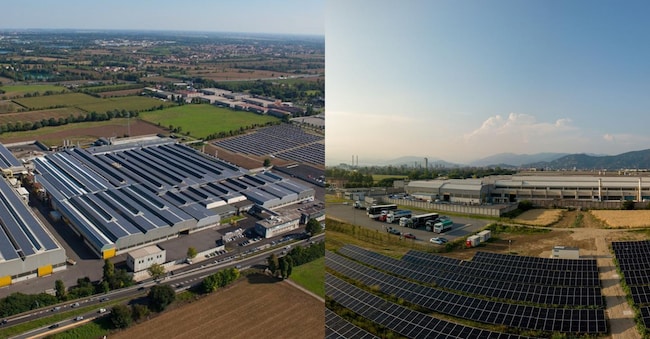
Eredi Gnutti Metalli (barre di ottone) dopo aver realizzato un maxi-impianto nel 2011 ha deciso di andare ad un quasi-raddoppio, arrivando ora a disporre di quasi 10 Mwatt di potenza installata

3' min read

3' min read

"We were delighted with the investment made. And in fact we relaunched'. A four million euro relaunch, that of Nicola Cantele, general manager of Eredi Gnutti Metalli. A brass bigwig (Europe's third largest producer) that recently doubled its photovoltaic equipment, bringing the total to close to 10 MW of installed power.

This is not an isolated path in the region, which in fact, thanks to the industry's drive, has risen to the top nationally in the field of solar energy production.

Loading...

With more than 60,000 photovoltaic plants in its territory, Brescia is the Italian province with the largest installed capacity, the only one to exceed one million kilowatts.

An analysis of the data processed by Italia Solare, which updates the Gse report on 2023, highlights for the Lombardy province an almost numerical supremacy. Only Rome, with 66 thousand photovoltaic systems installed, is in fact superior in absolute value. Other smaller provinces have a higher ratio of systems to population, but even in this 'density' ranking Brescia is still well placed, coming tenth in Italy.

Merit for a solar run-up that continues, bearing in mind that Gse data show that in 2023 Brescia was the best province in terms of new power added with 224 MW, 4.3% of the total. Other areas further south are certainly favoured in terms of irradiation, but even when looking at the energy produced Brescia is at the top, with 737 GWh in 2023 it is in fifth place among the provinces, on a par with Brindisi.

Brescia thus comes to account for 3% of the national 33.6 Gwatts in terms of power, 3.4% when looking at numbers. Compared to the first quarter of 2023, in particular, the connection of non-residential plants with a power output greater than one megawatt (i.e. plants linked to the industrial and commercial sector) grew by 373%, with the 123 MW of the January-March period of last year jumping almost to 600 in the first quarter of 2024. This supremacy was again achieved by Brescia, with ten plants totalling 18.3 MW of installed power.

Looking at what happened in the first six months of the year, it is once again Lombardy at the top of the regional ranking, both in terms of the number of systems installed (almost 26,000, 37% more than the second-placed Veneto), and with respect to installed power, 554 MW (16% of the total), again outstripping the other regions by a wide margin.

Additional installations in 2024 push up the total installed power to 4600 MW. Lombardy thus consolidates its supremacy, reaching 290 thousand plants for 4.6 Gw installed, 13.7% of the total.

In the case of Eredi Gnutti Metalli, one of the largest plants in the area, production, almost entirely self-consumed, covers 20 per cent of the company's needs (about 50 GWh per year), but the goal is to go further. "Eventually I think we will reach 30%," explains Cantele, "perhaps by focusing on motorised systems and also exploiting the possibilities of storage. At today's prices, the investment will pay for itself in 7-8 years.

Direct construction of plants to which trading activities are added. As in the case of the Feralpi group, one of Europe's steel bigwigs, which closed an agreement with Enfinity Global to purchase 23GWh per year of clean energy produced by a power plant in the province of Ferrara, an agreement that will eliminate almost 9,000 tonnes of CO2 emissions per year.

"What is happening in Brescia," explains the president of Italia Solare, Paolo Rocco Viscontini, "demonstrates the responsiveness of companies, which have decisively embarked on this path. The 2024 connections are actually the effect of previous choices, and what we see now is a slightly less dynamic market, as a result of the Transition 5.0 rules. Waiting for the implementing decrees has curbed demand to some extent, and we will now see whether and to what extent the newly launched incentives will translate into new projects.

A local push towards sustainability that in Brescia is also complemented by upstream parts of the supply chain, primarily in the production of photovoltaic panels. The main reality is Peimar, with 110 employees and a production capacity of 500 MW per year, which is counting on the new 5.0 investments to return to the peaks of 2022 linked to the superbonus, with revenues close to 100 million and a continuous cycle production on three shifts.

Another local producer is Eclipse, with 25 employees and 400 Mw of annual production capacity, active since 2008 and also, like Peimar, in possession of the requirements to be able to intercept the demand coming from Transition 5.0.

Copyright reserved ©
Loading...

Brand connect

Loading...

Newsletter

Notizie e approfondimenti sugli avvenimenti politici, economici e finanziari.

Iscriviti