Art system/1

The British Museum gets a makeover with archistars and help from in-house staff

There are museums that still retain an aura of intangibility and permanence, as if time had never passed and their image had become a brand and an icon.

by Fulvio Irace
4' min read

4' min read

There are museums that still retain an aura of intangibility and permanence, as if time had never passed and their image had become a brand and an icon.

The Vatican Museums and the Uffizi, in Italy; the Louvre, in Paris; the Met in New York; the Altes Museum in Berlin, the Rjiksmuseum in Amsterdam, etc.: the list is long and mostly coincides with those museums that came into being between the 18th and 19th centuries as repositories of great national treasures.

Loading...

But this perception is almost always the result of a suggestion or a lack of in-depth knowledge, belied by the reality of a history that instead tells us that even these 'perennial' institutions are living organisms that, in order to adapt to the changing cultural environment, are forced to transform themselves in a more or less obvious way: the expansion of collections pushes them to plan rearrangements of existing spaces or outright additions; the change in museum audiences and the need to reach growing segments of visitors by accommodating their requests for self-recognition in the documents of the past, impose drastic choices on how to display works that might offend the ethical codes of inclusiveness (for example in ethnographic museums of colonial origin, but also in classical ones where Roman sculptures and African masks are called upon to confront each other); the need to reach out to communities who see in museum spaces the answer to the lack of public spaces, are the stimulus to create environments that are somewhere between a traditional cultural space and a social centre.

Never before has the world of museums been in turmoil, between bewilderment and enthusiasm: renewal cannot be postponed, but the ways forward are all to be defined: the same new technologies (internet, digital, touchscreen, smartphones) that have rewritten our mechanisms for thinking and communicating, are full of both promise and threat.

This was discussed at Mudec in Milan during the Forum of Culture, where the theme of intervention on consolidated historical buildings was also addressed, just as the news arrives that one of the most illustrious British institutions, the British Museum in London, is gearing up to face the most demanding challenge in its century-long history. In fact, the result of the first phase of selection of the six design teams (including that of the Dutch OMA with the consultancy of our own Salvatore Settis) that will compete for the contract to redevelop the museum in the nineteenth century by Sir Robert Smirke in the grandiose neoclassical style that has imposed itself in our minds as the best logo for the place where the famous Parthenon marbles are kept.

Founded in 1753 on the basis of Sir Hans Sloane's rich collection in Montague House, for two centuries the museum did nothing but grow on the basis of Britain's colonial fortunes, now counting more than eight million works that include Greek Roman antiquities, Egyptian (the Rosetta Stone is kept here), African, Indian and Oceanian art, Chinese jade, botanical collections, housed in more than 60 galleries. Then, throughout the 20th century, there was a continuous succession of more or less creeping transformations: the creation of mezzanine floors, the demolition and replacement of walls, the filling of gaps used as storage rooms, the moving of works from one room to another according to the phases of restoration and modernisation.

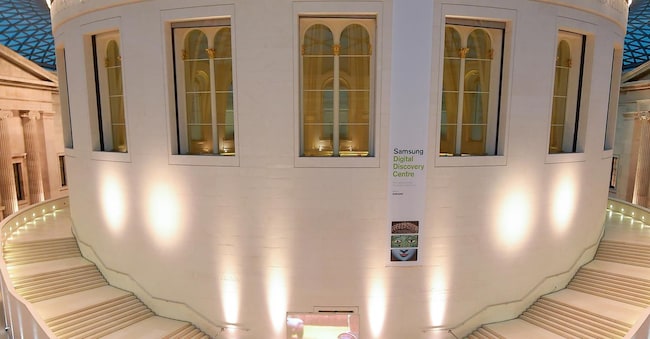
Already in the post-war period it became necessary to update some rooms to meet the taste of the new public; then, at the end of the second millennium, the great leap signed by Norman Foster with the creation of the Great Court. By freeing itself from internal superfetations and highlighting the drum of the British Library (which in the meantime had been moved to another location), the museum moved forward in cultural geopolitics, becoming an example of how conservation of antiquity and new languages could be reconciled. The glass roof of the courtyard turned the entrance space into a square open to all, in the same way as the almost contemporary Louvre Pyramid with which I.M.Pei had revolutionised access to the collections. The museum-hub was then said to be the museum-airport, where the lounge distributed and channelled the flow of visitors, unable to see everything in one day.

Hence began the race of museums towards society, the (often) frantic drive towards an inclusive vision that would open its arms to the global public, trying to meet their expectations and alleviate their possible frustrations and inadequacies.

If it is in fact somewhat easier for a newly built museum to conceive structures that reflect current events, for historical museums the road is often uphill. How to ensure that the overall image of architectures that are the embodiment of national history is not distorted? How to ensure that the understanding of a work through digital technologies does not overwhelm the direct contemplation of the artefact? How to introduce the classical time sequences that made the halls a kind of compendium of art history textbooks? How to juxtapose works that are expressions of cultures differing in tradition, meaning, location in such a way as to avoid the original sin of Eurocentrism?

Questions overlap along with possible answers: but it is clear that the case-by-case rule still applies here.

The British's response is noteworthy; instead of settling for a project to redesign the galleries of the so-called Western Range, it has opted for a cautious, shared process of interaction between internal staff and the future winner. Russel Torrance put it very well: 'we want to share the team's vision and collaborate on the basis of a long-term programme that carefully reconciles our historical heritage with the collections housed, with visitors and users of all kinds, inside and outside the museum'.

The second phase will involve a series of meetings and workshops in which each selected group will be able to expound their method and long-term vision, producing diagrams and drawings that highlight possible ways of non-traumatic and efficient transformation. The British Museum's transformation, said Director Nicholas Cullinan, will be a cultural transformation before being an architectural one.

Copyright reserved ©
Loading...

Brand connect

Loading...

Newsletter

Notizie e approfondimenti sugli avvenimenti politici, economici e finanziari.

Iscriviti