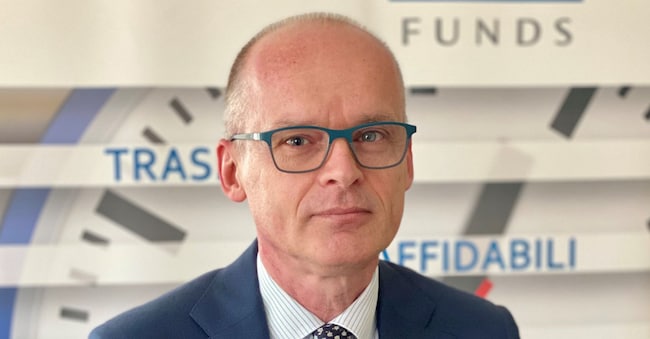
A word from the manager: Pharus Asset Management

'Brown-Forman is a defensive, quality company'

"The other companies I watch carefully are Terna, Novo Nordisk and Alphabet."

Davide Pasquali è vicepresidente e direttore di Pharus Asset Management Sa e Pharus Management Lux Sa e presidente di Pharus Sicav e Multi Stars Sicav

3' min read

Translated by AI
Versione italiana

3' min read

Translated by AI
Versione italiana

Here are the evaluations of Davide Pasquali, vice-president and director of Pharus Asset Management Sa and Pharus Management Lux Sa and president of Pharus Sicav and Multi Stars Sicav, on the uncertainties that are currently shaping financial market trends globally.

How will pressures on energy prices reshuffle the variables that shape markets, first and foremost interest rates and inflation?

Tensions on energy prices are bringing a supply shock back to the fore, complicating the work of central banks. Inflation, which seemed to be on its way to target, is rising again and, above all, risks being transferred to the more persistent core component. This radically changes the scenario: the expected rate cuts turn into a prolonged pause or, in case of further escalation, into new rises. The problem is that all this takes place in a context of already weak growth, with a real risk of a stagflationary dynamic, i.e. high inflation and slowing GDP.

Loading...

Are there any geographical areas that can be considered more sheltered from the escalation of geopolitical tensions in the Middle East?

Some areas are relatively more resilient for structural reasons. North America benefits from substantial energy autonomy, which mitigates the impact of the shock. In parallel, several emerging economies, particularly in Latin America, benefit from rising commodity prices, offsetting energy costs. Some South-East Asian economies are also benefiting from the global production diversification process. Europe remains among the most exposed areas in terms of energy dependence and industrial vulnerability.

How are you coping in terms of investment strategy with such a complex phase as the current one?

At this stage we favour quality and resilience. We focus on companies with high pricing power, able to pass on costs without squeezing margins. On the bond front, we are keeping duration low to limit the impact of high rates. We also reinforce our geographical diversification, with a dollar component serving as a hedge in times of stress. We complement the portfolio with a portion of real assets, such as gold, commodities and infrastructure, which historically protect against inflationary erosion.

Which drivers do you follow most closely?

There are mainly three. The first is core inflation, the true indicator of inflation persistence. The second is monetary policy, with a focus on central bank signals and trends in bond yields, which directly influence valuations. The third is energy prices, today the main transmission channel for geopolitical risk. For Italia, the trend of the BTP-Bund spread also remains central.

What sectors might be interesting to be exposed to today?

Sectoral rotation is now necessary. We see opportunities in defence and aerospace, bolstered by a structural increase in public spending; in cybersecurity, which has become a strategic priority; in utilities and energy infrastructure, which offer visibility into flows and benefits from the transition; and finally in artificial intelligence-related technology, selecting companies with a real ability to generate efficiency and maintain high margins.

What would you advise someone with a portfolio exposed to the US and Italia stock markets that are performing well? Stay invested or lighten up?

In the presence of positive performance, the most rational choice is not to exit, but to rebalance. In the United States, the main theme remains that of valuations, which are now within the valuation average and sensitive to rate trends. In Italia, on the other hand, dividend support is strong, but the risk linked to the spread should not be underestimated. In both cases, we suggest reducing exposures in excess of original weight and consolidating some of the gains, while still maintaining strategic exposure.

Which titles do you find most interesting?

Brown-Forman is a classic defensive quality company, with global brands such as Jack Daniel's providing strong pricing power. In an inflationary environment, it manages to pass on costs without compromising demand, maintaining high margins and stable cash generation, also supported by a long history of increasing dividends. Terna, on the other hand, represents a profile of stability and visibility. It operates under a regulated regime and with predictable revenues, but the real driver is growth related to investments in the electricity grid and energy transition. This translates into an expanding regulatory base and rising profits, accompanied by solid dividends. Novo Nordisk is one of the leading structural growth stories globally. The market for obesity and diabetes drugs is booming and, after the recent correction, valuations are more attractive than in the past. The pipeline remains very solid and is a further catalyst in the medium term. Alphabet finally combines growth and strength. In addition to leadership in digital advertising, it is strengthening its position in artificial intelligence and the cloud. The integration of AI into core services and the growth of Google Cloud offer new levers for development, with valuations still relatively sustainable compared to other technology stocks.

Copyright reserved ©
Loading...

Brand connect

Loading...

Newsletter

Notizie e approfondimenti sugli avvenimenti politici, economici e finanziari.

Iscriviti