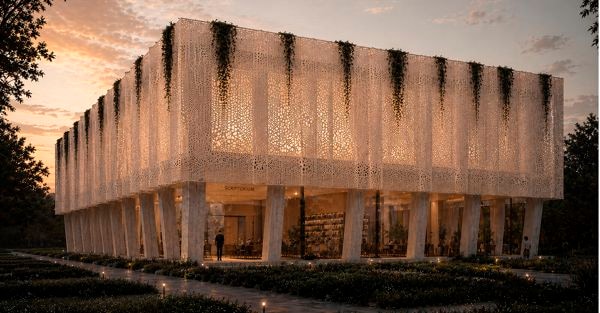
Brunello Cucinelli is backing the regeneration of the former Enel power station in Pietrafitta
From dereliction to data centres: a project that aims to breathe new life into a symbol of Umbria’s industrial history and its region, with a focus on innovation and sustainability

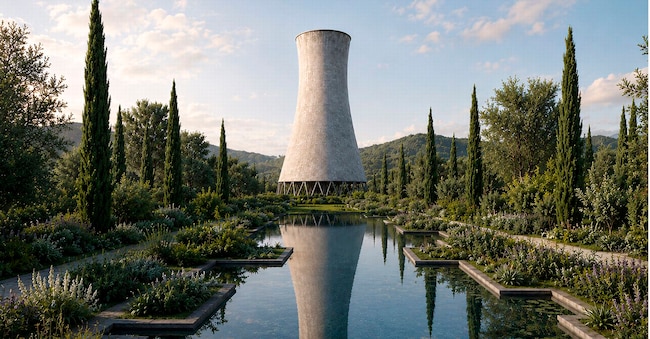
Closed for almost 30 years, the former Enel power station at Pietrafitta, 30 km from Perugia, was a blight on a region rich in medieval villages and oak forests, for which it had been a source of wealth and development for over a century. For years, a new purpose had been sought for this symbol of Umbria’s industrial history, with its 130,000 cubic metres of buildings, and it now seems to have finally been found: the site will be home to a Contemporary Innovation Park, featuring data centres, research hubs, start-up incubators, and innovation centres dedicated to renewable energy and public healthcare. Graffiti, broken glass, crumpled shutters, and nature – which, as in an apocalyptic film, has reclaimed the spaces abandoned by humankind – will give way to environments where design will express both a willingness to embrace and a confidence in the future.
The project was supported by Foro delle Arti, which provided the concept and design, the holding company of the Brunello Cucinelli family – whose headquarters are in nearby Solomeo – together with Umbria Data Garden, a newco led by Riccardo Stefanelli and Brunello Cucinelli, to oversee its development and implementation by engaging industrial, technological and financial partners. “We expect it to be ready within the next three years, a timeframe shortened in part by the fact that Umbria falls within the ZES (Special Economic Zone, ed.), a factor that will speed up the bureaucratic procedures.”
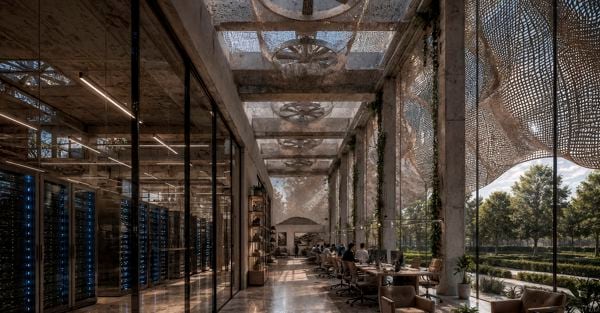
“It will be a humanistic data centre, founded on the principles of Vitruvius, according to which buildings must be sound, useful and beautiful,” added Brunello Cucinelli, who reiterated his confidence in the development of artificial intelligence, describing it as “a servant at the service of humankind: we must not be afraid of it”.
Words that stand in contrast to the fears raised by developments in AI, particularly in recent weeks, and which go hand in hand with protests by communities around the world who do not want huge data centres in their areas, with their well-documented excessive consumption of resources, primarily water: the Pietrafitta model, on the other hand, repurposes a disused industrial site whilst retaining its spirit of innovation and offering a contemporary reinterpretation of the role – including the social role – of energy.
Lignite, which is found in abundance underground, has fuelled the power station for decades, making it a driving force behind the recovery of the Italian economy, particularly in the post-war period, but it has also damaged and polluted the local area. The Contemporary Innovation Park, thanks in part to the involvement in the project of the Region, the municipalities of Piegaro and Panicale (to which the area belongs), the university, the Province and the Superintendency, will rebuild the relationship with the local area, offering a potential and powerful draw for people and businesses in a zone which, for about a year now, has indeed been part of the Single Special Economic Zone (ZES Unica).