Copenhagen

Bruun Collection Coin Auction Exceeds Expectations

The 287 lots of Scandinavian cones, a Danish national treasure, dispersed to an international audience for €14.8 million, exceeding estimates by 25 per cent

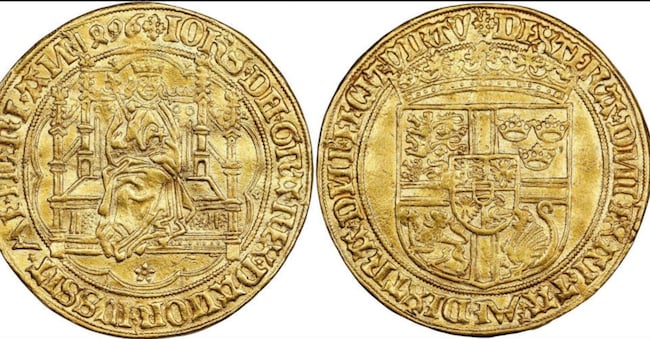
Moneta d’oro del XV secolo, nota come “Hans Noble” aggiudicata per 1,2 milioni di euro, ben oltre la stima prevista di 300.000-600.000 euro.

4' min read

4' min read

The first 287 lots of one of the most valuable collections of Scandinavian coins belonging to Danish industrialist Lars Emil Bruun (1852-1923) did not disappoint expectations. The auction, which took place on 14 September at Stack's Bowers Gallerie, an American auction house specialising in coins, generated a counter value of EUR 14.8 million and represented the first part of the approximately 20,000 coins that had remained in the Bruun collection for a century. Earlier this year, seven coins had been sold to the National Museum of Denmark for about EUR 1 million.

The in-person auction that took place in Copenhagen lasted eight hours and at the end, Michael Fornitz, director of the Danish branch of Stack's Bowers, stated that the final sum exceeded estimates by about 25%. The collection includes rare coins and medals from Denmark, Norway, Sweden and England dating back to the Viking Age and is considered the most valuable collection of non-US coins ever sold.

Loading...

I top lot

.

Thus began the dispersal of the butter magnate's collection, which, preserved for 100 years as a Danish national treasure by the collector's will, arrived on the international market with all proceeds benefiting Bruun's heirs. In 1922, Bruun, an experienced coin collector, bought the collection from the aristocratic Bille-Brahe family. After the First World War, fearing another conflict or a bombing of Copenhagen, he decided that his historical collection should be kept in reserve for the Royal Coin and Medal Collection in Copenhagen for a century.

Rarity is the term that most connotes the lots in the collection and among them the top lot is number 1001: a 15th century gold coin known as the 'Hans Noble' sold for €1.2 million, well above the expected estimate of €300,000-600,000. Considered the jewel in the crown of any Scandinavian numismatics collection, being one of the oldest, it is the earliest dated Scandinavian coin (not counting the mysterious Danish penny from 1234) and one of the most beautiful Gothic coins produced in Scandinavia. Of all the Danish Nobles minted between 1496 and 1532 for Kings Hans, Christian II and Frederik I only 20 remain, most of which are in the National Museum of Denmark.

It far exceeded estimates (€200,000-300,000) for a 17th century 10 ducat coin, or Portugaloser, described by the auction house as 'one of only four coins believed to have survived' of the 237 originally minted and 'unique in private hands', and fetched just over half a million euros.
A lively demand from the public led two lots to fetch prices well above the estimates (70,000-100,000 euros). These were lot 1066 a Portuguese 1/2 (5 ducats), 1655, from the Copenhagen Mint, Frederik III, one of two privately owned specimens, which fetched €240,000. The other lot, number 1079, a 5 ducat coin of 1664 probably owned by King Frederik VII, is the only known specimen available privately, fetched €228,000.

Lot 1021 was sold for € 384,000 from a range of € 200,000 to € 300,000: it is a Renaissance coinage of the sovereign Christian IV which, according to experts, is the best of the three known specimens in private collections. Other publicly owned coins can be found in Copenhagen, Oslo, Stockholm, Lund and St. Petersburg. The birth of this coin was prompted by Christian IV's visit to England in 1606, where he was probably inspired by the new monetary reform of his brother-in-law James I to promote the minting of 'Danish Sovereigns', which had the same weight and fineness as the new British Unions.

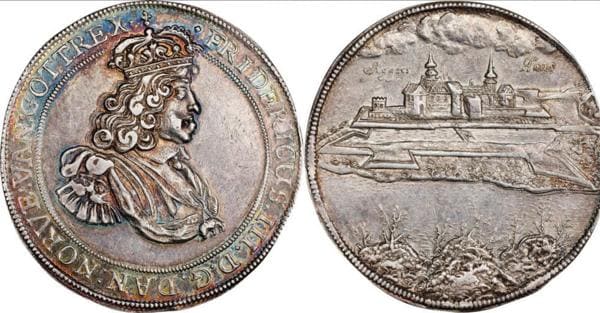
Akershus 1661 in argento venduto per €432.000 (stima €500,000-€750,000)

Lots under 10 thousand euro

.

Many other lots fetched six-figure sums, but most objects sold for values of a few tens of thousands of euros. Among the most affordable were a Duchy, 1692 of the Copenhagen Mint that sold for €6,000 from an estimate of between €3,500 and €4,500; the 2 Rigsdaler, 1872 with a portrait of King Christian IX by sculptor Harald Conradsen, whose initials are visible on the trunk (sold for €8,400 from an estimate of between €4,000 and €6,000).

With estimates below 15,000 euro there are several coins and among them lot 1007 the Danish Silver Gulden (Taler), 1547 of the Flensburg Mint which was in use only for about 30 years, from 1540 to 1571, when it was transformed into a bell foundry (sold at 7,800 euro from an estimate 7-9.000 euro); lot 1009 fetched a price above estimate (12,000 - 15,000 euro), sold for 22,800 euro, this is the Klippe Duchy, 1564, of the Copenhagen mint, the first proper Duchy to be minted in Denmark, although Duchies continued to be minted regularly until 1802, this is the only one bearing a denomination (DOGKATE). Another noteworthy lot was 1064, which fetched €14,400 from an estimate of between €5,000 and €7,000: this is the Duchy, 1653 of the Copenhagen Mint, a rare ducat coined with the same obverse as the 5 and 2 ducats but with a different reverse mould with GOTHOR instead of GOTTOR in the king's title.

Some disappointment compared to estimates

.

Remaining below the minimum estimate, lot 1217, one of the auction's top lots, fetched €432,000 (estimate: €500-750,000) due to the rarity of the coin minted to celebrate Frederik as ruler of Norway and the only specimen in private hands of the three known. The other two are in the National Museum of Denmark and the Gotha Coin Cabinet in Friedenstein.

Lot 1196 the massive 4 Speciedaler, the only known specimen in private hands, also failed to meet expectations and came in at €264,000 (estimate €300,000 - €400,000), despite being described as a truly monumental, highly detailed numismatic treasure with abundant lustre. Of the six known Speciedaler quads of Frederik III remaining, four (1656, 1657, 1658, 1661) are in the National Museum of Denmark and one (1657) in the Hermitage in St. Petersburg.

Same fate for lot 1224 4 Speciedaler, 1680 sold for €192,000 from an estimate of €250-350,000. One of only 10 traced examples of Quadruple Speciedaler of Christian V, minted in 1674, 1678, 1679 and 1680. Of these, only four are privately owned, while the other six are in public collections in Oslo, Copenhagen and St. Petersburg. Now, for those who have been left high and dry, all they have to do is wait for the forthcoming auctions of the Bruun collection.

Copyright reserved ©
Loading...

Brand connect

Loading...

Newsletter

Notizie e approfondimenti sugli avvenimenti politici, economici e finanziari.

Iscriviti