
Budapest reportedly signed a 12-point plan to 'get closer' to Moscow
This was revealed by the news site Politico, in possession of papers drawn up by the Kremlin. Elections in Hungary are expected on Sunday

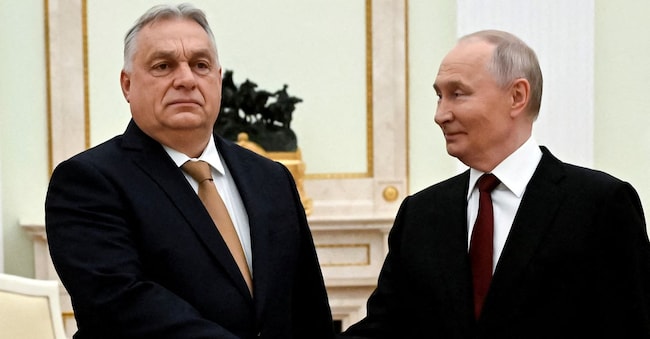
The Hungarian government has reportedly signed an agreement with the Russian government, so far not made public, to 'expand economic, trade, energy and cultural ties between the two countries'. This was revealed by the news site Politico, explaining that it had obtained documents drafted by the Russian government that 'clearly underline how Budapest and Moscow hope to get closer'.
From the papers we learn that on 9 December, during a meeting in the Russian capital, Hungarian Foreign Minister Peter Szijjarto and Russian Health Minister Mikhail Murashko signed a 12-point plan setting out the extent to which the two governments would align in areas ranging from nuclear fuel to education and sport.
The occasion of the signing was the 16th meeting of the Russian-Hungarian Intergovernmental Commission on Economic Cooperation, established in 2005 and meeting annually, with a break between the 14th meeting in November 2021 and the 15th in September 2024, according to the pan-European newspaper. According to the documents, Russia and Hungary "addressed current issues of bilateral trade and economic cooperation, joint activities in the energy sector, industry, healthcare, agriculture, construction, and other areas of mutual interest, as well as in the cultural and humanitarian spheres," while also emphasising the importance of "developing long-term and mutually beneficial ties between the two countries in areas of common interest."
Politico - which admits that it had no way of independently verifying the documents, although it had consulted experts in the field - also explains that it had asked Szijjarto himself for a comment. "Bilateral cooperation in Budapest is driven by national interest, not by pressure to conform to the extremely biased liberal mainstream media. Carry on with your partisan work!" was the Hungarian minister's reply.
Among the points of the agreement are a commitment to 'reverse the negative trend in bilateral trade', which has decreased due to EU sanctions against Russia, and an opening for Russian companies to start new electricity and hydrogen projects in Hungary, as well as closer cooperation on oil, gas and nuclear fuel.


