
Building houses made of books, words and people important to us
Designing is a poetic gesture: Lebanese architect Aline Asmar d'Amman works with stone, concrete and affect to create furniture and rooms that tell life stories.
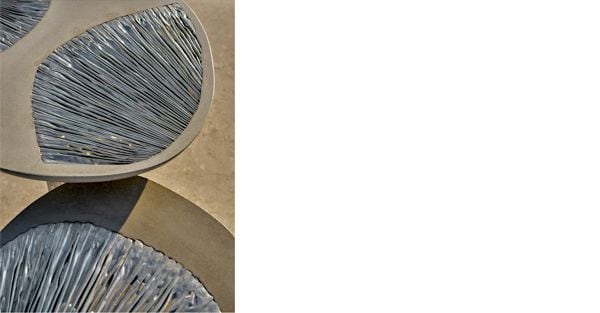
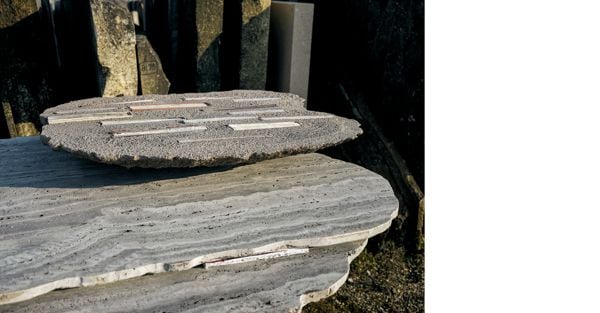
Her Béton Littéraire are furniture-sculptures that blend books and concrete, a sort of celebration of literary culture. Aline Asmar d'Amman, Lebanese by origin but French by adoption, founder of the Paris studio Culture in Architecture is certainly one of the most original and transversal voices on the international architecture and design scene. That of Béton is an almost ascetic, meditative work: "I cut the books, I choose the sentences, I compose them as foundations so that they can have a profound meaning", she tells me when I meet her in Milan in the garden of Rossana Orlandi's gallery that exhibits them. The veins of the stone and the printed pages delicately intertwine, giving life to an expressive material, skilfully sculpted in the Morseletto workshops in Vicenza. The end result: a poetic manifesto on the importance of knowledge and memory. "I have always perceived culture as a path to salvation, an act of resistance against adversity," she says. "When, as a child, there was war in my country, reading was the only form of escapism, along with the cult of beauty: I remember that when the sound of the bombs fell silent, my mother would make us dress up and set the table with great care. It was our Lebanese way of surviving hardship, celebrating life'. Aline studied architecture at the Beirut Academy of Fine Arts, her thesis project was awarded as the best of the year by the Minister of Culture. "I was proud of it, but I soon realised that my country was too narrow for me. Those born in Lebanon, too often torn by conflict, experience the culture of exile. But as Amin Maalouf, a Lebanese writer who, like me, chose Paris as his second homeland, says, our origins - not so much the roots because they would be too difficult to uproot - we take them everywhere, they travel with us and build what we really are'. The choice of France as a landing place was natural: Aline had studied since primary school in a French school. "Although part of my family was in the United States, I liked the idea of staying in a Mediterranean country: our cultures, the Greco-Roman and the Phoenician, are close, sometimes similar".

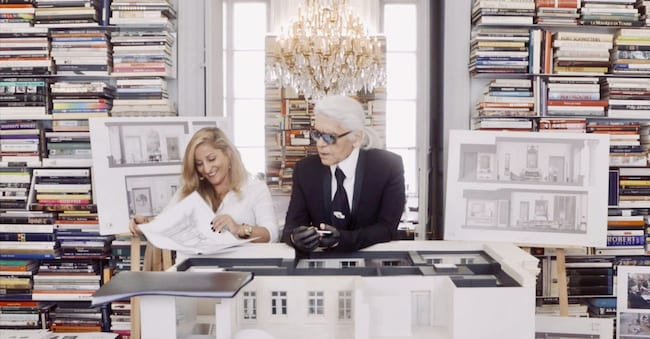
Arriving in Paris after graduating, she began her first major project, immediately a turning point in her career, the renovation of the Hôtel de Crillon, which became a symbol of her multidisciplinary and intercultural approach. Above all, it was the occasion for one of the most important encounters of his life, the one with Karl Lagerfeld. "I was a young professional and, when I was asked to work on this 18th century building, I thought of him, of his passion for 18th century French decorative arts from his historical collection of period furniture". He did not know him personally. And she had no channel to him. However, she wrote him a letter by hand and took it personally to her Parisian bookshop, the Librairie 7L, located at 7 rue de Lille in the VIIth arrondissement, dedicated mainly to art and photography books. They advised her to leave it on a desk, at which Karl often sat. 'The next day he called me, giving me an appointment three hours later,' she says almost with tears in her eyes. Easy to imagine the emotion. "I didn't even have time to prepare a portfolio of my work, I just went. I told him about my love for books, about Lebanon.... Maybe he, a German from Hamburg, knew what it was like to live in a country at war'. A deep, human and creative partnership was born. Which goes beyond the hotel. Together they designed the Architectures furniture collection, a tribute to Greek proportion revisited in a contemporary key. "I believe it was one of Lagerfeld's last personal projects, and I cherish its memory as a sort of spiritual legacy. Even today, in the studio, my collaborators know that, when faced with each project, I always ask myself: "What would Karl say?"".
Loading...
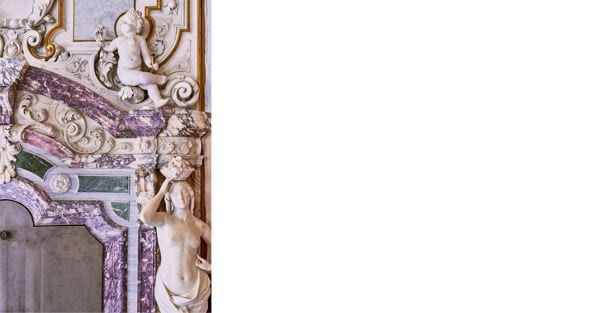
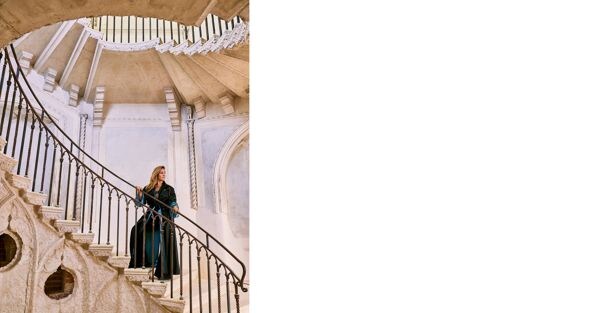
The question is now being asked about another beautiful period building, Palazzo Donà Giovannelli, this time in Venice, which Aline is working on from 2019 with Paolo Barletta of the Arsenale Group. Built in the mid-15th century by Filippo Calendario, the master architect of the Doge's Palace, it was the residence of the Duke of Urbino and over the centuries has had only one major renovation in the 19th century, by the renowned architect Gian Battista Meduna, the designer of the Ca' d'Oro and La Fenice. Today it is about to become the site of the second Orient Express hotel. "Every stone here speaks and you have to know how to listen to it," says the architect, undoubtedly gifted with a special sensitivity for interpreting culture, including that of places, not just books. Her job here, she says, is to preserve the memory, restoring the emotion, indeed that rare sense of happiness one feels when one has the opportunity to experience a context so rich in history and art. This is the real luxury for her. Even if she has to transform everything so that it is efficient and contemporary, the challenge is to find harmony, a symphony between epochs, needs and style.
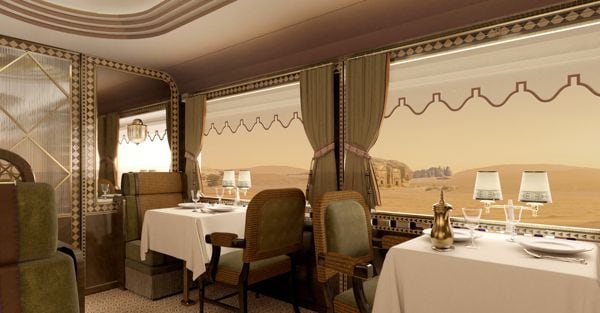
With Arsenale, Aline is working on another major project in partnership with Saudi Arabia: Dream of the Desert, a train with 14 carriages and 34 luxury suites, which will depart in late 2026 from Riyadh to arrive in Al-Jouf, via Al-Ula. The Italian group has the antique carriages and the engineering skills to put them back on the tracks, Italy has the craftsmanship, manufacturing skills and design. The architect has the task of transferring, filtering and interpreting all this through the Saudi cultural heritage, their proportions, geometries, patterns. "It is the beauty of crossing knowledge, a fascinating journey in which I never stop learning," she says. "The last thing that delighted me, for example, about the Arab world is the existence on its lands of a very special desert flower that has a violet-pink hue, unique in the world. So much so that King Salman bin Abdulaziz Al Saud protected it by registering it. That colour will certainly be among the leading nuances on the train carriages'.
After Venice and Saudi Arabia, we now land on Lake Como, with the renovation project of another historic residence, Villa Belinzaghi in Cernobbio, which will become the property of the neighbouring Villa d'Este in April 2022. Built in 1860 by Count Giulio Belinzaghi, a Milanese banker and mayor first of Cernobbio and then of Milan, the mansion with its 2,500 square metres and a park of 8,000 complete with a greenhouse, a dock and a pier for mooring boats, had already been a luxury hotel at the end of the 19th century and is now returning to luxury accommodations with an F&B outlet. "There is a special light on this lake with the hills and mountains reaching down to the water," says the architect. "There is an old world air, cultured and intense, beloved all over the world, and the challenge here too will be to maintain it and make it contemporary."


Loading...
