
Bulgari and Castellani, stories and encounters of goldsmiths with a passion for antiquity
At the National Museum of Villa Giulia in Rome, the golds of Castellani, a family of 19th-century goldsmiths, dialogue with Bulgari heritage creations in an ideal bridge between past and future

4' min read
4' min read
Hot under hats bearing 'Roma' in neon letters and tucked into T-shirts depicting the Colosseum, looking for an opening to catch at least a glimpse of the Trevi Fountain, contemporary tourists do not suspect that it was on that very square a century and a half ago that their fellow ancestors would gather, eager to enter the Palazzo Castellani, which still stands above the oldest pharmacy in the city, perhaps in Europe. It had been built by the family of the same name of antique dealers and goldsmiths who had invented the luxury archaeological souvenir, jewellery identical to Etruscan and Roman antiquities, but not only, that conquered the ladies from northern Europe who had come down to Rome in search of imperial relics even to wear. In 1880, the city was the infant capital of the Kingdom of Italy and both from its streets, disrupted by excavations to erect emblems of the new modernity, and from the countryside, gushed finds, including jewellery, which were also sold through quite anarchic channels, for example in the famous Piazza Montanara, under the Rupe Tarpea of the Capitoline Hill, which no longer exists.
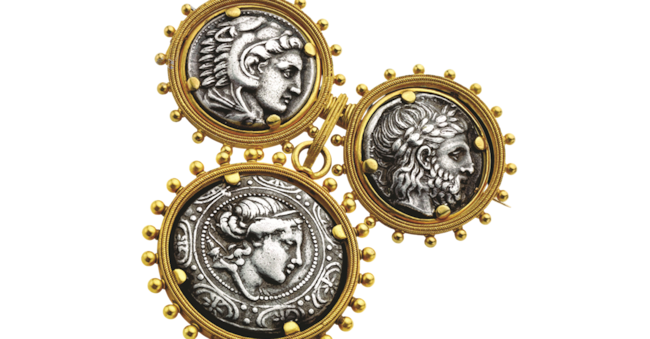
Around 1830, Fortunato Pio Castellani, founder of the dynasty and passionate collector, had taken up the invitation of his friend and duke Michelangelo Caetani to reproduce antique jewellery. Together they conducted passionate research that allowed them to recover age-old techniques, even in remote villages in the Marche region where they had mysteriously been rescued from oblivion, and succeeded in reproducing the famous 'giallone' of Etruscan gold. They also invented a punch-monogram with two crossed Cs, quite identical to the one Coco Chanel would adopt in the 1920s. Success was immediate, fuelled also by the commercial talent of the second Castellani generation, especially the revolutionary son Alessandro: sent into exile by the Pope to Paris for taking part in the Roman Republic, he opened a branch on the Champs-Élysées and sold jewellery even to Napoleon III.
In the same years, the equally enterprising Sotirio Bulgari, a skilled silversmith and merchant born in Epirus who by selling sophisticated bibelots to rich tourists had already made his fortune in Naples, arrived in Rome from the East. He had to leave it, however, because his shop was burgled and so he came to Rome, where he managed to open his first shop in Via Sistina, the heart of the new haunt of the international and tourist elite. Bulgari also loved antique jewellery, as evidenced by his sumptuous silver necklace with coins bearing the symbols of the seven Ionian islands of Greece, and he certainly came into contact with the Castellani family, sharing their passion for antique coins in jewellery. That necklace has now left the Bulgari archives to shine again in the exhibition Una storia infinita. Arte Orafa at the Etruscan Museum of Villa Giulia, the institution that in 1919 received as an inheritance from the last of the Castellanis, Alfredo, the family's entire collection of ancient and modern gold, which finally ended its business in 1927.
In an exchange of amiable correspondence, a century and a half later Bulgari and Castellani are reunited, as the maison, which has in the meantime become a globally successful brand, through its young and very active Foundation has decided to finance several projects at the Museum (follow carefully the work of the volcanic director, Luana Toniolo) including the new lighting of the room where the Castellani Ori are kept, together with the ancient and modern ones, according to the precise conditions of the bequest. This is an urgently needed intervention, as the current lighting does not do them justice, rather it afflicts them, and which also promises to ignite new interest in this family that is so peculiar but known mostly to specialists and enthusiasts.
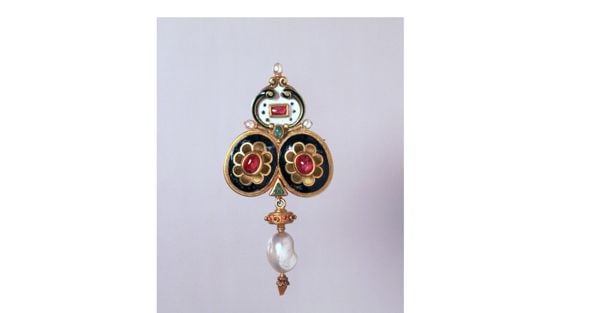
Not that the Castellan Ori have spent their long existence in oblivion. Far from it: on Easter night 2013 they were stolen from the museum in a daring action that involved a smoky Roman antique dealer, a wealthy Russian lady, a gang of inexperienced criminals from Aprilia, and a suburban bar on the Via Portuense, and that fortunately ended with the recovery of the entire booty, but only years later. Only in 2019, in fact, on the point of death, did one of the thieves hand over to his wife, with instructions to return it, the last missing piece, but one of the most precious, a necklace with engraved emeralds, rubies and pearls. It was one of the famous Castellani souvenirs, who also invented a souvenir brooch in medieval taste, with the typical and fabulous Roman micromosaic forming the palindrome 'Amoroma'. Made by good 21st-century craftsmen, it would be a resounding success among tourists even today, as well as having the much-sought-after power to undermine fridge magnets with carbonara.


