
4' min read
4' min read
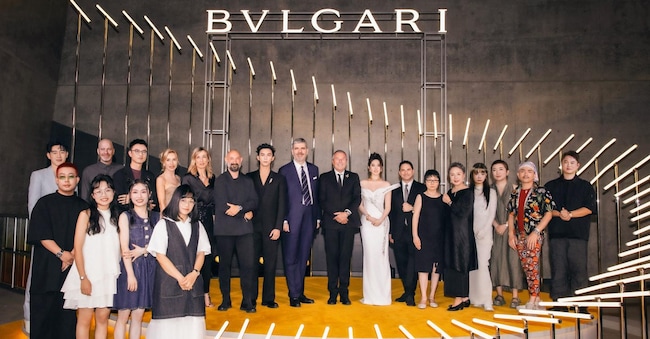
At all hours of the day, often in the evening, Beijingers love to dive into the waters of the Liangma River, which flows through the central Chaoyang district. Clean, full of fish and aquatic plants, they reveal the evolution of the Chinese capital and the country, where, swimmers claim, '15 years correspond to 150'. Also overlooking the river is the garden of the Bulgari hotel, opened in 2017 and considered by the most affluent Chinese, surveyed by Hurun Report, to be the best in the nation. A few steps away from its entrance, in the futuristic Genesis Art Gallery designed by Tadao Ando, the exhibition "Serpenti Infinite Tales" is on display until 18 August, closing and culminating (with 16 artists) the Serpenti Art Factory tour of events dedicated to the 75th anniversary of one of Bulgari's iconic collections, which started in November 2023 from Shanghai. "We could not but return to China, one of the first markets for luxury, to conclude this first circle," explains Jean-Christophe Babin, CEO of the Lvmh group brand.
The exhibition, from Shanghai to Beijing
.The Serpenti Factory format involved creative collaborations between Bulgari and international contemporary artists, who developed works inspired by the aesthetics and meanings of the snake exclusively for the maison. In the capital, in addition to some of the creatives who took part in the tour's eight other world stops, four students from the Central Academy of Fine Arts in Beijing also took up the challenge. "For China, Beijing is the city that sets the pace in terms of art and architecture, as demonstrated by the Genesis Gallery itself," he continues. The exhibition is certainly also a channel for recounting the success of this collection, its versatility, its evolutions: in 1948, snakes only gave shape to precious secret watches, to then inspire Tubogas creations, and even later those of Viper, a collection launched in 2020 and offering pieces priced between three thousand and hundreds of thousands of euros, to then appear on our bags. Transformation is inherent in the snake, a theme that the exhibition also investigates by recounting the belonging of this animal to different cultures and eras".
Chinese societal evolution impacts luxury
.Chinese society has also evolved, as shown by what is happening along the river. While 20 years ago Bulgari opened its first 8 square metre shop in Beijing at the Peninsula Hotel, it now has six boutiques and official retailers in the capital. The Hurun Report also attests that Bulgari is the favourite jewellery brand of the wealthy Chinese ("and in watches we are fourth", notes Babin). However, as confirmed by the figures in the recent half-yearly reports of the big luxury groups, China is no longer the sector's borderless Eldorado. On the same day that Serpenti Infinite Tales was inaugurated, the Third Plenum of the Chinese Communist Party, grappling with the economic slowdown and the cooling of domestic consumption, closed in the capital. Phenomena that have repercussions on luxury purchases, afflicted in these complex times also by a sort of modesty for their ostentation. While the middle class suffers, in the name of the 'common prosperity' professed by Mao in May, China's powerful Cyberspace Administration blocked the social profiles of a number of influencers famous for their lavish lifestyles, decreed guilty of 'displaying a luxurious life based on money to attract followers and traffic'. For Lvmh, the Asian market (with China) fell by 14% in the first six months of 2024 (see Il Sole 24 Ore of 24 July). However, the most significant brands in terms of history and quality endure: 'I believe that our success in China is due to several elements,' Babin reflects. 'Like Rome, our city of origin, China has an imperial history and loves its symbols.
The family dimension, of business and living, is a trait that also belongs to them. Moreover, the snake is a fundamental element in Chinese art, and the shape of the leaf of the Gingko, one of the sacred trees, evokes the motif of our Diva collection, which in fact has its first market in China. We were also pioneers on social, the first to open a platform on WeChat, to be on TikTok. A very selective strategy on Jd.com and Tmall fuelled our sense of exclusivity. We chose local ambassadors such as Liu Yifei, a 40-year-old, highly respected actress who attracts not only Gen Z, but also those more mature customers who drive our sales. Today we have about 40 shops in 25 cities, and although it is true that the domestic market has declined, the Chinese nationality for us remains number one in terms of turnover. Their purchases are now very strong in Japan, thanks to a favourable exchange rate'. The way of buying has also evolved: 'Whereas in the past, sales used to be about quick delivery, today service is more important than ever,' continues Babin, for whom, in the end, the fact that the luxury industry is no longer focusing its growth ambitions on China alone is a good thing: 'It is not healthy to focus only on one country. All it takes is a political crisis, an unfavourable exchange rate to jeopardise everything. Today we are more balanced than in the pre-Covid era'.
In the same way, focusing on art is a way to enrich and differentiate one's brand, in an increasingly crowded and competitive context such as that of jewellery. Has the time come, even for Bulgari, to create its own, permanent project in this sense? As with snakes, or the water of the Liangma River, evolution means the future.


