
Business management software: the hidden cost of a patchwork of solutions in SMEs

The digital transformation of European businesses continues to gather pace, though at very different rates depending on company size. Whilst large organisations have now integrated management platforms, cloud-based applications and advanced tools (including artificial intelligence) for customer relationship management into their processes, the path to modernisation remains more fragmented and often incomplete in small and medium-sized enterprises.
According to the latest Eurostat data, by the end of 2025, 46.4% of European businesses were using ERP (Enterprise Resource Planning) systems, capable of integrating and coordinating key business processes. However, this average figure comprises two very different percentages: only 41% of SMEs use this type of software, whilst the figure for large companies is almost 90%. More generally, again according to data compiled by Eurostat, only 53% of European businesses operate using at least one advanced solution, whether ERP, CRM or business intelligence tools.
These well-known indicators reflect the reality of the SME sector, where software purchased at different times coexists alongside specialist applications dedicated to individual functions or specific needs, and processes are still managed using basic spreadsheets or manual tasks. This technological stratification often generates significant operational complexity, compounded by the presence of systems implemented years ago (and subsequently adapted to new requirements through manual integrations) and a multitude of ‘stand-alone’ applications that do not communicate with one another.
The IT infrastructure of a typical SME often reflects a fragmented technological ecosystem in which accounting, sales, customer management, stock, human resources and operational activities are managed using different tools, which appear to still be functioning but whose real cost (largely hidden) goes far beyond licence or maintenance fees. Added to this is a further factor, which is becoming increasingly significant in a data-driven economic landscape characterised by tighter margins and constantly evolving regulatory requirements. The lack of integration between data and processes leads to daily inefficiencies that affect productivity and the overall view of the business, slowing down the decision-making process and limiting the speed at which the company can react to market changes.
Technological stagnation comes at a price
For many SMEs, the main obstacle to change is not technological but organisational in nature, stemming from a fear of disrupting established processes and the perception that implementing platforms will require significant investment, factors that often lead to the postponement of decisions that are, in fact, becoming increasingly urgent.
The true cost of existing management software, however, is often underestimated because the direct costs appear modest and already amortised. Maintaining legacy systems and outdated management applications actually generates a series of indirect costs that are rarely measured systematically: in the final calculation of the ‘total cost of ownership’ of a management system, in fact, the following must be included (in addition to subscription fees and licences): maintenance activities, the technical support required to keep obsolete applications operational, and the resources used to compensate for the inefficiencies caused by a lack of integration.
The range of factors that ultimately affect overall productivity and the company’s growth dynamics is very varied (data entry errors, duplication of tasks, cumbersome updates, limited visibility into business data and longer decision-making times) and requires SMEs to change tack in order to overcome organisational inertia, which is made even more detrimental by regulatory requirements.
Electronic invoicing, tax compliance, traceability requirements, data security and various compliance obligations all require continuous updates; for a small organisation, managing these aspects through disparate and fragmented systems can become a burdensome and complex task, with the risk of errors and delays that affect both costs and the ability to operate efficiently. Furthermore, the growing prevalence of artificial intelligence amplifies even more clearly the need for structured and integrated data: without a coherent information base, it becomes difficult to capitalise on the new opportunities offered by advanced automation technologies and predictive analytics systems. In other words, the cost of not changing risks becoming higher than that of innovation itself. The challenge facing small and medium-sized enterprises is not limited to the mere adoption of new technologies, but concerns, above all, the ability to build a management platform capable of supporting their development and ensuring their long-term continuity.
An integrated platform to simplify growth
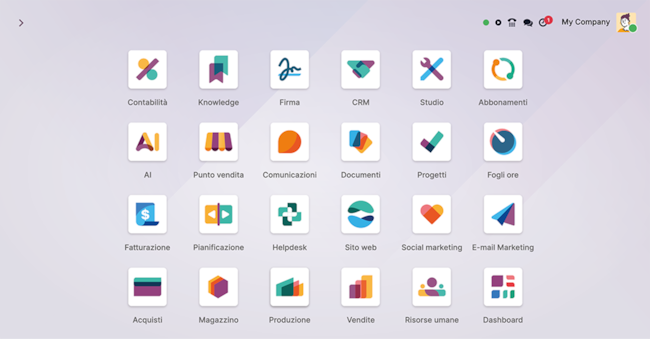
It is against this backdrop that the proposal from Odoo, a software company that has built its business model on a integrated and modular management platform that enables the management of operations in a shared environment various business processes, from accounting to sales, from CRM to production, and from logistics to human resources. The Belgian company’s aim is to move beyond the model of isolated software and non-communicating vertical applications, offering a single ecosystem in which all the organisation’s key operational areas share data and processes. The platform allows companies to initially adopt only the application modules they actually need, whilst retaining the option to expand the solution’s functional scope at a later date without having to undertake complex integration projects. This is particularly important for smaller companies, which often lack dedicated in-house IT expertise and require advanced tools that are simple to implement and use.
One of the distinctive features of Odoo’s offering is its ability to adapt to businesses operating in a wide range of sectors. In the food distribution sector, for example, the integration of sales, logistics and stock management allows for real-time monitoring of stock availability, orders, procurement and deliveries, whilst the automatic sharing of information improves product traceability and enables the optimisation of operational planning. Similar benefits can also be achieved by companies operating in the services and retail sectors, thanks to the coordinated management of commercial activities, service contracts, support tickets and invoicing, which eliminates many of the inefficiencies associated with using separate tools.
Equally important is the cost-effectiveness of the investment: replacing a constellation of separate applications with a single integrated platform means reducing the costs of managing and governing the digital infrastructure, as well as excessive dependencies on different suppliers. Finally, a key aspect of the Odoo platform concerns regulatory compliance. For SMEs, tax and documentation obligations represent a significant burden, and having tools designed to support local requirements helps to reduce operational risk and transform compliance from a source of complexity into an integral part of business processes. Overcoming the obstacles associated with legacy systems thus becomes not merely a technological ‘upgrade’, but a strategic choice to underpin competitiveness, efficiency and innovation in the long term.

