Chemical industry

Buzzella (Federchimica): Energy costs too high, an EU plan for industry is needed

There must be a strong commitment to environmental sustainability, but with different timing and modalities: transitions are not made in a short time, they take decades

6' min read

6' min read

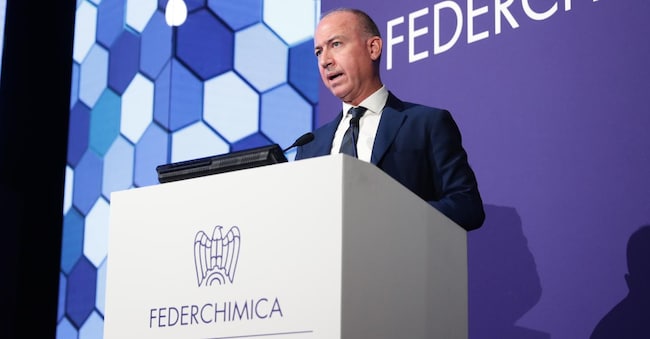
"Mattei's great vision was to have intuited, more than 70 years ago, that energy is the basis of everything: it makes companies competitive and determines the purchasing power of families. Transitions are not made in a short time, they take decades'. Francesco Buzzella has been the president of Federchimica since last autumn. He is an industrialist and 'a convinced pro-European,' he says of himself.

Why?

Loading...

Europe has given us rules and the protective shield of the euro, but we need to recover the founding spirit of Europe in order to rise to the challenges, avoiding demolishing everything that has been built so far.

By the way, the new European Commission, again headed by Ursula von der Leyen, has just taken office. What are your expectations?

We should try to answer some questions clearly: do we believe in the future of industry in Europe? Do we want to continue to be a globally important area for manufacturing? The premises do not seem exciting: as a first indication, it is said that by 2040 net emissions must be cut by 90 per cent. But that is an unachievable target. Obviously there has to be a strong commitment to environmental sustainability, but different timescales and methods are needed.

What do you think of the known political line?

It is crucial that Europe's plans do not remain on paper and are turned into concrete actions. The New Chemicals Industry Package could be a step towards achieving these goals as it aims to create a more streamlined and sustainable regulatory framework for the chemical industry while promoting safety and environmental sustainability. But the package's measures must be the result of dialogue with industry and accompanied by incentives for those who invest in innovation and green technologies.

Should the setting be changed?

Let us not forget what happened to packaging, which in some ways undermined years of good intentions and the development of the circular economy. Those who had invested in recycling found themselves displaced. In the absence of certain scientific data, there is no point in continuing to legislate: let us consider, for example, that there is no single software for measuring the carbon footprint and the results are therefore different depending on the tool used. Maybe one day we will discover that there is no packaging that is as efficient and low in CO2 emissions as plastic.

What do you think of the Ets system?

Conceptually it may be considered correct if we think that oil and coal are responsible for 75% of climate-changing gas emissions. In reality, however, it is very penalising for Europe and even more so for Italy, where the cost of energy is very high: gas, which is also a raw material for chemicals, is very expensive. At the moment there is a mix of alternative solutions, but we cannot do without fossil fuels. In time, I am sure, there will be new discoveries and an advancement of technologies that will make them available on an industrial scale: I am thinking of green hydrogen and next-generation nuclear power, which will speed up the resolution of problems. But we have to get there. Today there seem to be solutions at hand: this is not the case.

In comparing energy costs with other countries, Italy loses?

Not enough is being done. Studies show us that, looking at data from the beginning of the year, in June the cost of electricity in our country reached more than twice the European average. Our companies are particularly affected by these high costs, which diminish our ability to compete.

President Buzzella how is Italian chemistry?

Italy is the second largest manufacturing economy in Europe and chemistry is the country's fifth largest industry. In Europe it is the third industrial sector. If we look at the last few years, we come from a 2022 in which production contracted by 4.1% and a 2023 in which the contraction was 6.7%. This year, at least in the first five months, there have been the first signs of stabilisation, but we remain in negative territory, with a drop of 1.1%. It is quite a worrying picture in Italy, as well as in Europe where we are witnessing many announced closures, mainly in Europe.

What is the proportion? .

75% of the chemical plants that close are in Europe. This means that if 100 plants close in the world, 75, three quarters therefore, are in Europe. European chemical production accounts for 10% globally, but we are witnessing the advance of Asian countries: China until a few years ago accounted for 5%, today it is 45%.

Has the momentum towards investment been lost?

Very high energy costs, uncertainty and the mass of new regulations related to the green deal severely penalise development plans. Investment and innovation, however, are everything. It is not tariffs that defend companies, but investments in new plants. No new cracker has been built in Europe for 25 years. Companies need to invest, but with the brakes they have in Europe, I think they are losing momentum. I see mostly small-scale investments, aimed at maintaining production levels.

What is the distinction between investing or not investing in a chemical plant?

Chemical plants are capital intensive and require investments amounting to hundreds of millions or sometimes billions of Euros. They are usually very large, often interconnected, and must be of a certain scale, with an adequate output. When these plants, which are pillars for entire supply chains, are lost, the risk is that in just a few years, an automatic knock-on effect of entire sectors to other geographies is generated.

President, is there a real risk of deindustrialisation in Europe?

It seems to me that the deindustrialisation of Europe has already been going on for a few years and is continuing in a worrying way, especially in energy-intensive sectors such as chemicals. Meanwhile, however, imports from China are increasing. In two years, they have doubled and in the post-Covid era, chemistry has become a net importer for the first time. The picture is undoubtedly worrying in Europe, especially for basic production.

And in Italy?

Less so, because our country is stronger on speciality chemistry than on basic chemistry. This, however, does not detract from the fact that if there is no more basic chemistry in Europe, we will be dependent on other countries, with truly critical consequences for the whole of manufacturing, which is inextricably linked to chemistry: in fact, if there is no chemistry, there is no manufacturing. The concern is that institutions are underestimating the importance of chemistry: we are not talking about stand-alone products, but products that are used in all production chains and in our daily lives. Special attention is needed.

Can you give an example?

Ammonia. It is the basis for fertilisers and many other products. Even, for example, for the automotive industry, if one chemical is missing, entire production chains come to a halt, in a global context in which we have gone from a substantial sharing of rules and standards to a clash of blocs, where we are witnessing trade wars between China, the United States and Russia. In this context, not being autonomous on the raw materials front means not being masters of one's own future. In the last five years, European policy has been inspired more by a rigidly orthodox green ideology than by a more than shareable environmental sensitivity. I would also like to point out that Europe emits only 7% of global emissions while China, the United States and India are responsible for 50%. Measures that are too restrictive risk triggering unfair competition for European companies.

What role does the Antwerp Declaration play?

The Antwerp Declaration is an urgent call to revitalise Europe's industrial landscape, strengthen core sectors, and ensure their competitiveness, sustainability and resilience. In essence, it calls for an industrial deal to accompany the Green deal. In Italy it was promoted by Federchimica and, to date, has been signed by over 1,200 signatories and 25 sectors, many of them energy-intensive. Among the 10 concrete actions it envisages is the integration of the EU industrial deal into the broader European strategic agenda, the streamlining of legislation and the simplification of the state aid framework.

Copyright reserved ©
Loading...

Brand connect

Loading...

Newsletter

Notizie e approfondimenti sugli avvenimenti politici, economici e finanziari.

Iscriviti