
From Gucci to Tod's, it convinces those who focus on poetic subtraction
Matteo Tamburini's rarefied sensuality for Tod's, Sabato De Sarno is happy to dare with bold colour and little else. Versace confirms its proud maximalism

3' min read
3' min read
Does a Milanese style still exist in fashion? The question insists, in these days of mostly nostalgic fashion shows, generally lacking in driving or original ideas. Everywhere one sees clumsy copies of Miuccia Prada, the putative mother of an entire generation of Italian stylists, all of them ensnared by the perversion of upper-class chic that the lady succeeds and the others do not, translating into a mannered Milaneseness. If the root of Italian style lies instead in a certain realism-pragmatism, born of the alliance between design and industry, it is in an inspired minimalism that the raison d'être, and the aesthetic singularity, of our fashion in the global chessboard today should be identified. The best collections seen these days are united by a poetic subtraction.
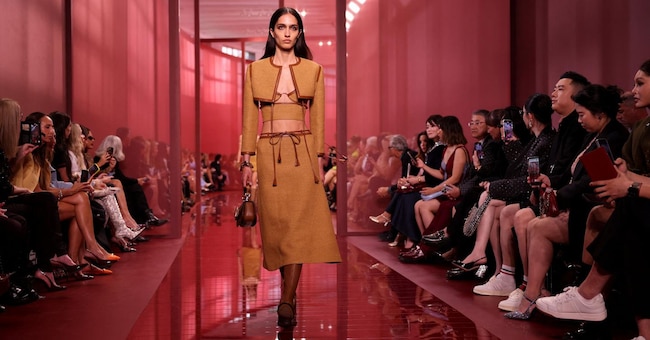
Matteo Tamburini, at Tod's, turns out to be a star. Following in the footsteps of Jil Sander, Issey Miyake, the early Giorgio Armani, but adding a rarefied sensuality that is his personal signature, Tamburini gives Tod's what the brand needs: modernity within classicism, an ineffable demeanour and, what doesn't hurt, desirable bags. The idea of a trip to the Mediterranean, from the beaches immortalised by Pier Luigi Ghirri to Greece, is just a pretext to string together a sequence of dresses and trench coats as fluid as sails, sculpted blazers and suits, impalpable anoraks, with the final pathos of tragic chorus tunics, dramatic but light. Combining simplicity and decisive design, Tamburini emerges as an author.
At Gucci, Sabato De Sarno explores an idea of casual grandeur. He too is somewhat of a creator prone to subtraction, happy to dare with bold colour and little else, measured even when decorating. Exactly one year after his debut as creative director, the contours of his vision for the historic brand are clear. "I'm interested in real fashion that people can wear," he says before the fashion show. The intentions are laudable, but the result is not entirely coherent: the different parts of the collection do not always speak to each other, which may be justified by the aesthetic chaos of real life, but it seems above all a problem of focusing on the reference woman, who is still nebulous. De Sarno is convincing when he works on workwear shapes, or when he fluidises, and these are the most successful parts, worthy of further study even at the cost of not pleasing everyone.
Filippo Grazioli's reductionism for Missoni is of a different nature. Of all the possible stories that lurk between the brand's stitches and patterns, the creative director isolates perhaps the most obvious, the zig zag. While this is an obvious limitation, it becomes an opportunity to unleash the imagination by reducing the means to a minimum: the colours are the primaries with the addition of black and white, the shapes are elementary, while the zigzags expand into the third dimension or become mille-feuille. It is a fun but monotonous game, with an obvious debt to, again, Issey Miyake.
Geometry is inexorable but light at Sportmax, in a collection that has no theme other than the seductive translation, through the wisdom of tailoring, of flat, elementary shapes - squares, rectangles - into clothes that move around the body, flake off, touch it.

