
'First ship power supply test in Genoa by June'
The announcement was made by the Port Authority and Gnv during the LNG refuelling of the ferry Aurora, the company's second gas-powered ship
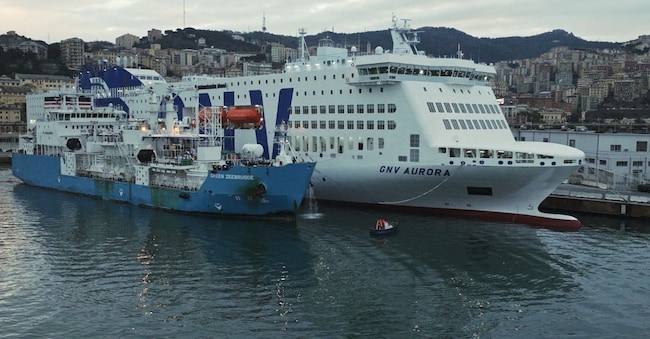
By June, if schedules are respected, the first cold ironing test, i.e. power supply from land, will be carried out on a Gnv (Msc group) ferry in the port of Genoa. This was the announcement made by the President of the Western Ligurian Sea Port Authority, Matteo Paroli, and the shipping company's CEO, Matteo Catani, during the LNG refuelling of the Gnv Aurora ferry, the second ship in the company's fleet powered by liquefied natural gas (the first was Gnv Virgo) and the fourth unit in the series of new-generation ferries built at the Gsi shipyard in Guangzhou.
Cold ironing is a technological solution designed to reduce emissions in port areas: by connecting the ship to the shore power grid, it is possible to switch off the on-board generators, zeroing out both CO₂ emissions and, almost completely, other pollutants, such as nitrogen oxides and sulphur, with direct benefits for the air quality in the port and surrounding areas.
As was the case last December with Virgo, the gas supply was completed thanks to the collaboration between Adsp, Gnv, the Genoa Port Authority and energy partner Axpo. "Today's operation," said Catani, "represents a fundamental moment for Gnv and the port of Genoa. It is not just about bunkering: it is the concrete confirmation of the path of innovation undertaken by the company, with new LNG-powered ships, which significantly reduce emissions, pave the way for cold ironing, and strengthen the commitment to environmental sustainability".
This transition, added Catani, "is structural, not episodic, and concretely enhances the daily work of the people working on ships and in ports. This appointment is the continuation of the path started with Virgo and confirms how the collaboration between port, ship owner and energy partner is the key to making the maritime system more and more modern and sustainable".
The energy transition, moreover, is part of a complex geopolitical context, characterised today by widespread volatility in the energy markets and generalised increases in fuel prices, which affect all types of fuel. "Investing in LNG," says Catani, "is a strategic choice for Gnv and Msc, fundamental for reducing emissions and innovating maritime transport. The volatility of energy prices today affects the entire fuel market, not just LNG. In this scenario, our belonging to the Msc group and our solid collaborations with partners in the supply chain allow us to deal with these dynamics with solidity, managing their effects along the entire value chain and guaranteeing operational continuity. Moreover, ferry transport remains one of the most efficient and sustainable solutions for the mobility of people and goods in the Mediterranean".


